QUESTION IMAGE
Question
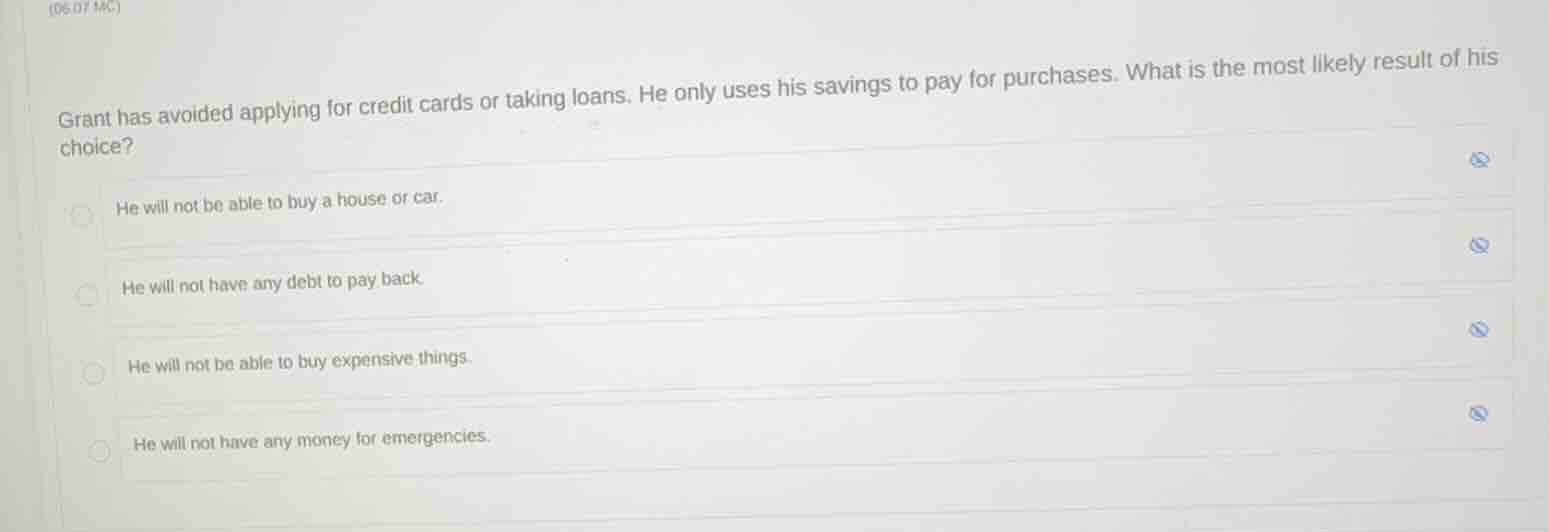
(06.07 mc)
grant has avoided applying for credit cards or taking loans. he only uses his savings to pay for purchases. what is the most likely result of his choice?
he will not be able to buy a house or car.
he will not have any debt to pay back.
he will not be able to buy expensive things.
he will not have any money for emergencies.
<pre_analysis>
{
"quality": "clear",
"question_count": 1,
"skills_matched": [
"direct_cot",
"multiple_choice_formatter",
"explain_then_answer",
"quick"
],
"needs_drawing": false,
"concepts_used": [],
"new_concepts": [
"Personal Credit",
"Debt Management"
],
"current_concepts": [
"Personal Credit",
"Debt Management"
]
}
</pre_analysis>
<reasoning>
Analyze the scenario
Grant avoids credit cards and loans, relying solely on his savings for purchases.
Evaluate the consequences
By not borrowing money or using credit, he does not accumulate debt. Therefore, he has no obligation to pay back borrowed funds.
Assess the options
- "He will not be able to buy a house or car": Incorrect, as he can save up to buy them in cash, though it may take longer.
- "He will not have any debt to pay back": Correct, as avoiding credit and loans directly prevents debt accumulation.
- "He will not be able to buy expensive things": Incorrect, savings can be used for expensive purchases.
- "He will not have any money for emergencies": Incorrect, using savings does not automatically mean he has no emergency fund.
</reasoning>
<answer>
<mcq-option>He will not be able to buy a house or car.</mcq-option>
<mcq-correct>He will not have any debt to pay back.</mcq-correct>
<mcq-option>He will not be able to buy expensive things.</mcq-option>
<mcq-option>He will not have any money for emergencies.</mcq-option>
</answer>
<post_analysis>
{
"subject": "Business",
"question_type": "Multiple Choice",
"knowledge_point": [
"Business",
"Finance",
"Personal Credit"
]
}
</post_analysis>
Snap & solve any problem in the app
Get step-by-step solutions on Sovi AI
Photo-based solutions with guided steps
Explore more problems and detailed explanations
<pre_analysis>
{
"quality": "clear",
"question_count": 1,
"skills_matched": [
"direct_cot",
"multiple_choice_formatter",
"explain_then_answer",
"quick"
],
"needs_drawing": false,
"concepts_used": [],
"new_concepts": [
"Personal Credit",
"Debt Management"
],
"current_concepts": [
"Personal Credit",
"Debt Management"
]
}
</pre_analysis>
<reasoning>
Analyze the scenario
Grant avoids credit cards and loans, relying solely on his savings for purchases.
Evaluate the consequences
By not borrowing money or using credit, he does not accumulate debt. Therefore, he has no obligation to pay back borrowed funds.
Assess the options
- "He will not be able to buy a house or car": Incorrect, as he can save up to buy them in cash, though it may take longer.
- "He will not have any debt to pay back": Correct, as avoiding credit and loans directly prevents debt accumulation.
- "He will not be able to buy expensive things": Incorrect, savings can be used for expensive purchases.
- "He will not have any money for emergencies": Incorrect, using savings does not automatically mean he has no emergency fund.
</reasoning>
<answer>
<mcq-option>He will not be able to buy a house or car.</mcq-option>
<mcq-correct>He will not have any debt to pay back.</mcq-correct>
<mcq-option>He will not be able to buy expensive things.</mcq-option>
<mcq-option>He will not have any money for emergencies.</mcq-option>
</answer>
<post_analysis>
{
"subject": "Business",
"question_type": "Multiple Choice",
"knowledge_point": [
"Business",
"Finance",
"Personal Credit"
]
}
</post_analysis>