QUESTION IMAGE
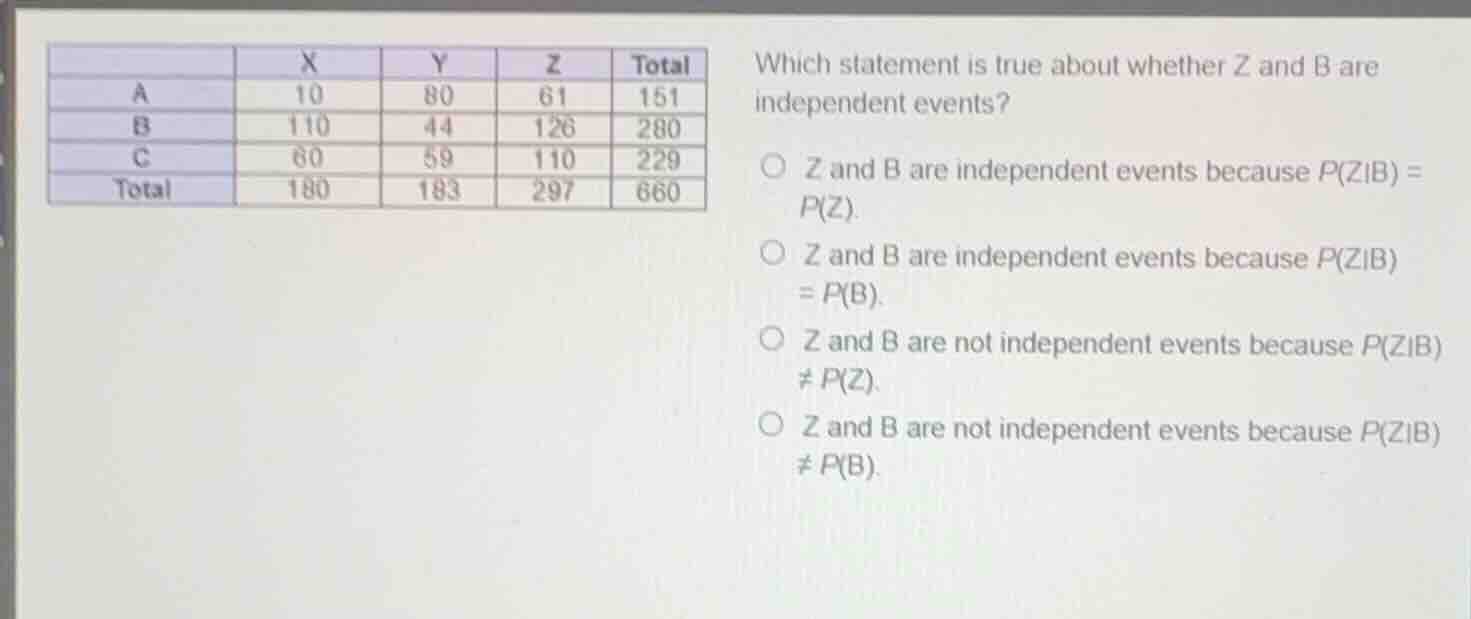
Question
which statement is true about whether z and b are independent events?
\\(z\\) and \\(b\\) are independent events because \\(p(z|b) = p(z)\\).
\\(z\\) and \\(b\\) are independent events because \\(p(z|b) = p(b)\\).
\\(z\\) and \\(b\\) are not independent events because \\(p(z|b) \
eq p(z)\\).
\\(z\\) and \\(b\\) are not independent events because \\(p(z|b) \
eq p(b)\\).
Calculate the marginal probability of Z
Using the Two-Way Frequency Tables knowledge point
$$
P(Z) = \frac{\text{Total for } Z}{\text{Grand Total}} = \frac{297}{660} = 0.45
$$
Calculate the conditional probability of Z given B
Using the Conditional Probability Calculation knowledge point
$$
P(Z|B) = \frac{\text{Frequency of } Z \text{ and } B}{\text{Total for } B} = \frac{126}{280} = 0.45
$$
Determine independence
Using the Independent Events knowledge point
$$
LATEXBLOCK0
$$

Snap & solve any problem in the app
Get step-by-step solutions on Sovi AI
Photo-based solutions with guided steps
Explore more problems and detailed explanations
- (A) Z and B are independent events because P(Z|B) = P(Z). (Correct answer)
- (B) Z and B are independent events because P(Z|B) = P(B).
- (C) Z and B are not independent events because P(Z|B) ≠ P(Z).
- (D) Z and B are not independent events because P(Z|B) ≠ P(B).