Sovi.AI - AI Math Tutor

Scan to solve math questions

QUESTION IMAGE

which of the following statements about skin and mucous membranes is tr…

Question

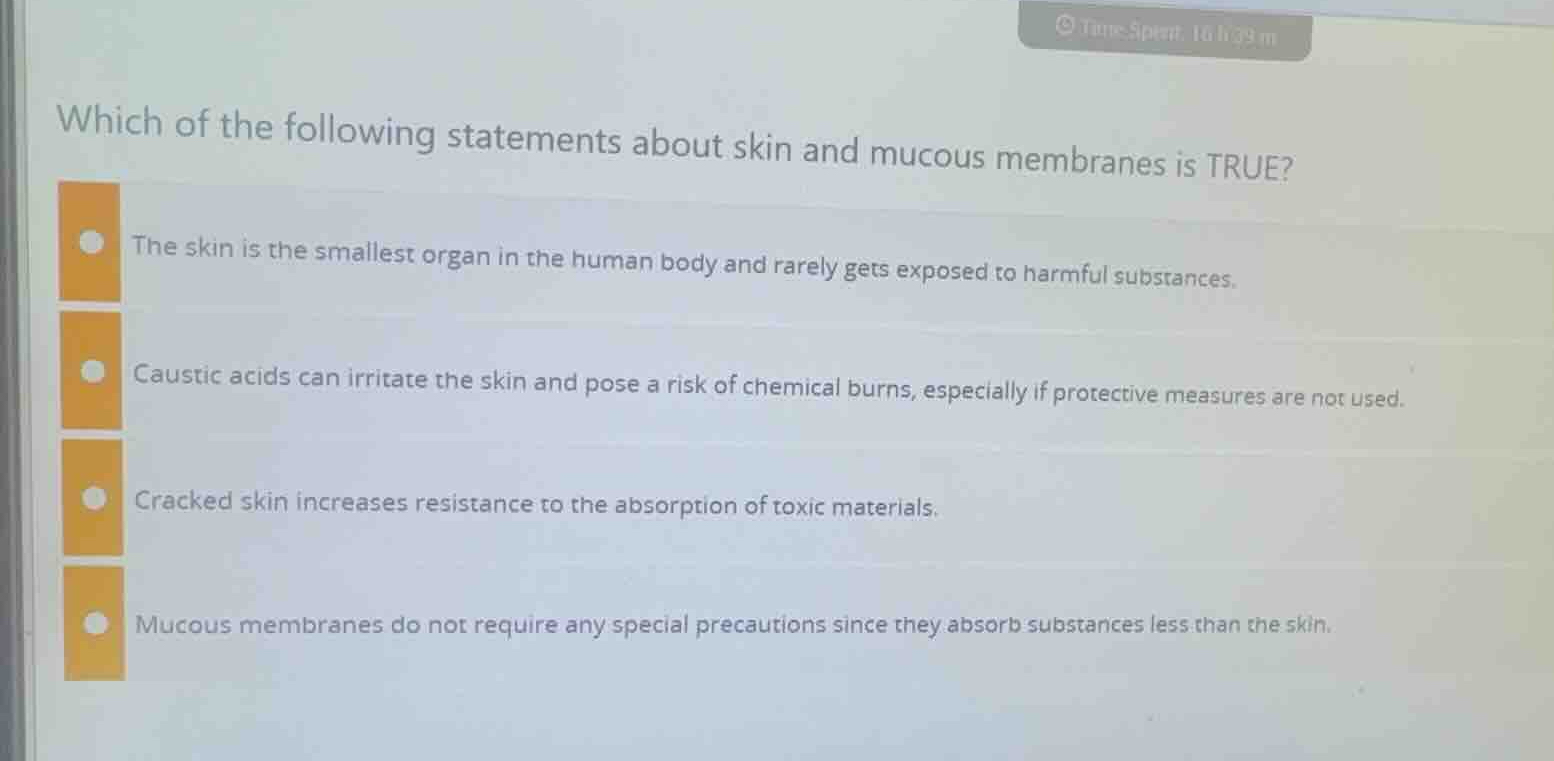
which of the following statements about skin and mucous membranes is true?

the skin is the smallest organ in the human body and rarely gets exposed to harmful substances.

caustic acids can irritate the skin and pose a risk of chemical burns, especially if protective measures are not used.

cracked skin increases resistance to the absorption of toxic materials.

mucous membranes do not require any special precautions since they absorb substances less than the skin.

Explanation:

Response

<pre_analysis>
{
"quality": "clear",
"question_count": 1,
"skills_matched": [
"direct_cot",
"multiple_choice_formatter",
"explain_then_answer",
"quick"
],
"needs_drawing": false,
"concepts_used": [],
"new_concepts": [
"Integumentary System",
"Chemical Safety"
],
"current_concepts": [
"Integumentary System",
"Chemical Safety",
"Toxicology"
]
}
</pre_analysis>

<reasoning>

Evaluate statements about skin and mucous membranes

  • Statement 1: "The skin is the smallest organ..." is false. The skin is the largest organ of the human body and is frequently exposed to the environment.
  • Statement 2: "Caustic acids can irritate the skin and pose a risk of chemical burns..." is true. Caustic substances cause direct chemical damage to tissues upon contact.
  • Statement 3: "Cracked skin increases resistance..." is false. Damaged or cracked skin compromises the barrier function, increasing absorption of toxins.
  • Statement 4: "Mucous membranes do not require any special precautions..." is false. Mucous membranes are highly permeable and absorb substances more rapidly than intact skin, requiring strict protection.

</reasoning>

<answer>
<mcq-option>(A) The skin is the smallest organ in the human body and rarely gets exposed to harmful substances.</mcq-option>
<mcq-correct>(B) Caustic acids can irritate the skin and pose a risk of chemical burns, especially if protective measures are not used.</mcq-correct>
<mcq-option>(C) Cracked skin increases resistance to the absorption of toxic materials.</mcq-option>
<mcq-option>(D) Mucous membranes do not require any special precautions since they absorb substances less than the skin.</mcq-option>
</answer>

<post_analysis>
{
"subject": "Natural Science",
"question_type": "Multiple Choice",
"knowledge_point": [
"Natural Science",
"Biology",
"Integumentary System"
]
}
</post_analysis>

Answer:

<pre_analysis>
{
"quality": "clear",
"question_count": 1,
"skills_matched": [
"direct_cot",
"multiple_choice_formatter",
"explain_then_answer",
"quick"
],
"needs_drawing": false,
"concepts_used": [],
"new_concepts": [
"Integumentary System",
"Chemical Safety"
],
"current_concepts": [
"Integumentary System",
"Chemical Safety",
"Toxicology"
]
}
</pre_analysis>

<reasoning>

Evaluate statements about skin and mucous membranes

  • Statement 1: "The skin is the smallest organ..." is false. The skin is the largest organ of the human body and is frequently exposed to the environment.
  • Statement 2: "Caustic acids can irritate the skin and pose a risk of chemical burns..." is true. Caustic substances cause direct chemical damage to tissues upon contact.
  • Statement 3: "Cracked skin increases resistance..." is false. Damaged or cracked skin compromises the barrier function, increasing absorption of toxins.
  • Statement 4: "Mucous membranes do not require any special precautions..." is false. Mucous membranes are highly permeable and absorb substances more rapidly than intact skin, requiring strict protection.

</reasoning>

<answer>
<mcq-option>(A) The skin is the smallest organ in the human body and rarely gets exposed to harmful substances.</mcq-option>
<mcq-correct>(B) Caustic acids can irritate the skin and pose a risk of chemical burns, especially if protective measures are not used.</mcq-correct>
<mcq-option>(C) Cracked skin increases resistance to the absorption of toxic materials.</mcq-option>
<mcq-option>(D) Mucous membranes do not require any special precautions since they absorb substances less than the skin.</mcq-option>
</answer>

<post_analysis>
{
"subject": "Natural Science",
"question_type": "Multiple Choice",
"knowledge_point": [
"Natural Science",
"Biology",
"Integumentary System"
]
}
</post_analysis>