QUESTION IMAGE
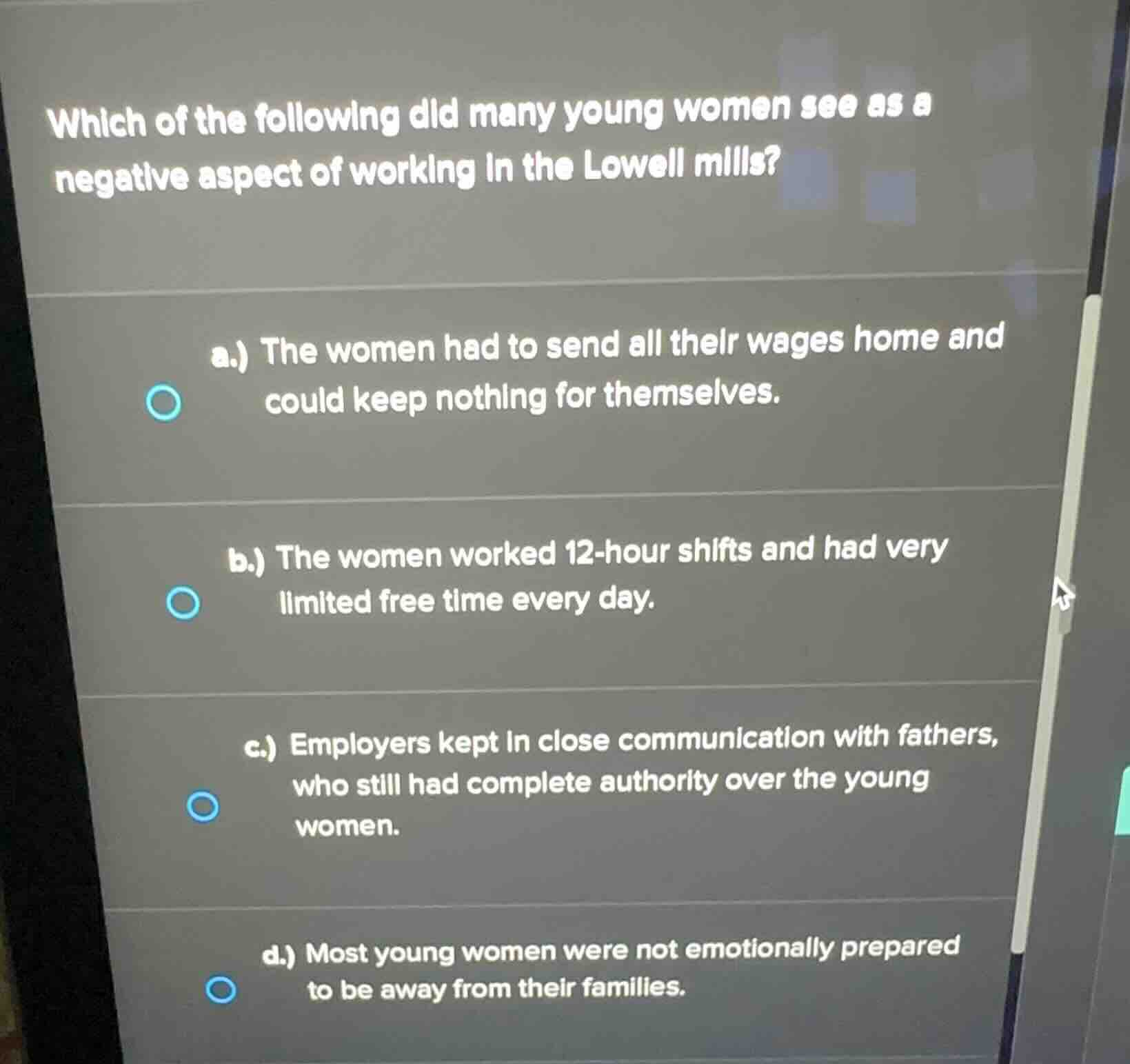
Question
which of the following did many young women see as a negative aspect of working in the lowell mills?
a.) the women had to send all their wages home and could keep nothing for themselves.
b.) the women worked 12-hour shifts and had very limited free time every day.
c.) employers kept in close communication with fathers, who still had complete authority over the young women.
d.) most young women were not emotionally prepared to be away from their families.
Analyze the historical context of the Lowell mills
The Lowell system in Massachusetts during the early 19th century recruited young, unmarried New England farm women to work in textile mills. While it offered them unprecedented economic independence and social opportunities, the actual working conditions were highly demanding.
Evaluate the daily schedule and working hours
The mill operatives typically worked extremely long hours, often averaging 12 to 14 hours a day, six days a week. This grueling schedule left them with very little personal time or leisure outside of work and sleep.
Assess the incorrect options
- Option a: While many women sent a portion of their wages home to help support their families or pay for a brother's education, they were not forced to send all of it. They kept a significant portion for their own savings, clothes, and personal use, which was a major draw of the job.
- Option c: The mill owners acted in loco parentis (enforcing strict curfews and moral codes in boardinghouses), but they did not maintain constant direct communication with fathers to enforce paternal authority.
- Option d: While some experienced homesickness, many young women eagerly sought the opportunity to leave rural farms for the social and educational environment of Lowell, making emotional unpreparedness a less defining systemic negative aspect than the physical demands of the labor.
Identify the correct historical negative aspect
The long, exhausting 12-hour shifts and the highly restricted, disciplined schedule were universally recognized and documented grievances among the Lowell mill girls, eventually leading to early labor protests and petitions for a 10-hour workday.

Snap & solve any problem in the app
Get step-by-step solutions on Sovi AI
Photo-based solutions with guided steps
Explore more problems and detailed explanations
- a.) The women had to send all their wages home and could keep nothing for themselves.
- b.) The women worked 12-hour shifts and had very limited free time every day. (Correct answer)
- c.) Employers kept in close communication with fathers, who still had complete authority over the young women.
- d.) Most young women were not emotionally prepared to be away from their families.