Sovi.AI - AI Math Tutor

Scan to solve math questions

QUESTION IMAGE

which of the following is not an assumption of stage theories? a. stage…

Question

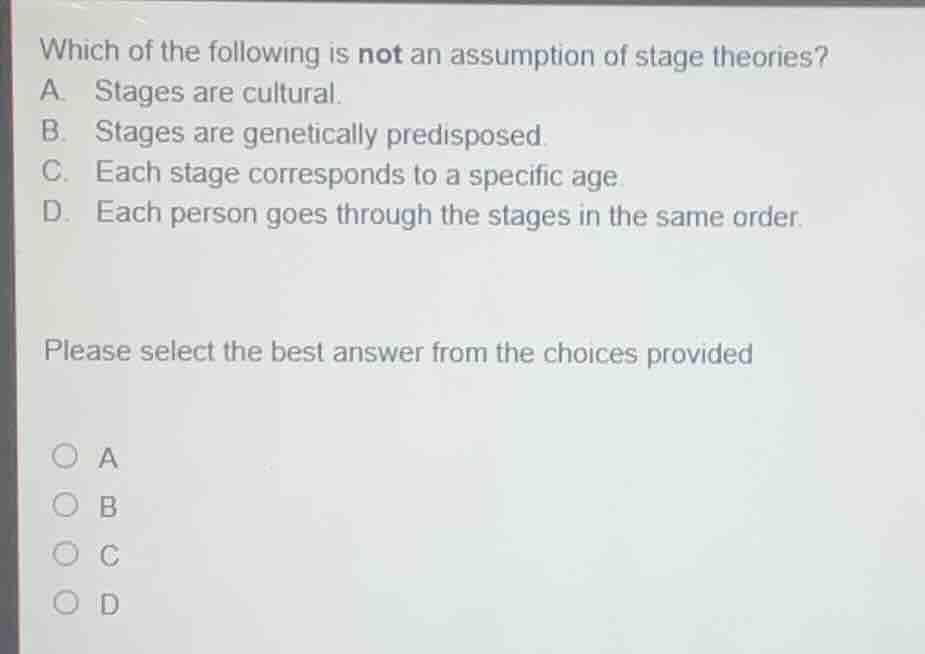
which of the following is not an assumption of stage theories?
a. stages are cultural.
b. stages are genetically predisposed.
c. each stage corresponds to a specific age.
d. each person goes through the stages in the same order.

please select the best answer from the choices provided

a
b
c
d

Explanation:

Response

<pre_analysis>
{
"quality": "clear",
"question_count": 1,
"skills_matched": [
"direct_cot",
"multiple_choice_formatter",
"explain_then_answer",
"quick"
],
"needs_drawing": false,
"concepts_used": [
"Stage Theories"
],
"new_concepts": [],
"current_concepts": [
"Stage Theories",
"Developmental Psychology"
]
}
</pre_analysis>

<reasoning>

Analyze assumptions of stage theories

Stage theories in developmental psychology assume that development is a series of qualitative, distinct steps. Key assumptions include:

  • Development is genetically predisposed or biologically driven.
  • Each stage corresponds roughly to a specific age range.
  • Individuals progress through the stages in a fixed, universal order (invariant sequence).

Identify the non-assumption

Stage theories generally assume that these developmental milestones are universal across humans, rather than being culturally specific or determined primarily by culture. Therefore, the statement "Stages are cultural" is not a standard assumption of stage theories.
</reasoning>

<answer>
<mcq-correct>(A) Stages are cultural.</mcq-correct>
<mcq-option>(B) Stages are genetically predisposed.</mcq-option>
<mcq-option>(C) Each stage corresponds to a specific age.</mcq-option>
<mcq-option>(D) Each person goes through the stages in the same order.</mcq-option>
</answer>

<post_analysis>
{
"subject": "Social Science",
"question_type": "Multiple Choice",
"knowledge_point": [
"Social Science",
"Psychology",
"Developmental Psychology"
]
}
</post_analysis>

Answer:

<pre_analysis>
{
"quality": "clear",
"question_count": 1,
"skills_matched": [
"direct_cot",
"multiple_choice_formatter",
"explain_then_answer",
"quick"
],
"needs_drawing": false,
"concepts_used": [
"Stage Theories"
],
"new_concepts": [],
"current_concepts": [
"Stage Theories",
"Developmental Psychology"
]
}
</pre_analysis>

<reasoning>

Analyze assumptions of stage theories

Stage theories in developmental psychology assume that development is a series of qualitative, distinct steps. Key assumptions include:

  • Development is genetically predisposed or biologically driven.
  • Each stage corresponds roughly to a specific age range.
  • Individuals progress through the stages in a fixed, universal order (invariant sequence).

Identify the non-assumption

Stage theories generally assume that these developmental milestones are universal across humans, rather than being culturally specific or determined primarily by culture. Therefore, the statement "Stages are cultural" is not a standard assumption of stage theories.
</reasoning>

<answer>
<mcq-correct>(A) Stages are cultural.</mcq-correct>
<mcq-option>(B) Stages are genetically predisposed.</mcq-option>
<mcq-option>(C) Each stage corresponds to a specific age.</mcq-option>
<mcq-option>(D) Each person goes through the stages in the same order.</mcq-option>
</answer>

<post_analysis>
{
"subject": "Social Science",
"question_type": "Multiple Choice",
"knowledge_point": [
"Social Science",
"Psychology",
"Developmental Psychology"
]
}
</post_analysis>