QUESTION IMAGE
Question
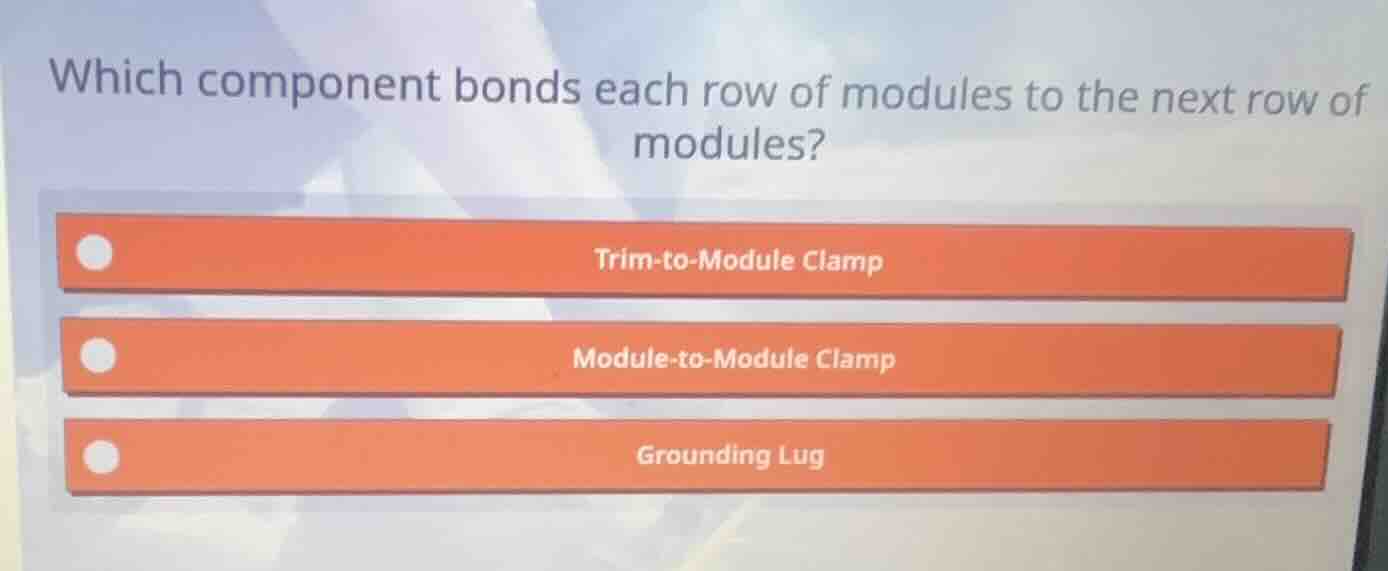
which component bonds each row of modules to the next row of modules?
trim-to-module clamp
module-to-module clamp
grounding lug
🆕 New Concept Discovered: Solar PV Grounding and Bonding
Connecting conductive parts to establish electrical continuity
Step 1: Understand the terminology
In solar photovoltaic (PV) installations, "bonding" refers to the practice of electrically connecting all metal parts that do not carry current (such as module frames and racking) to ensure they are at the same electrical potential. This prevents electrical shock hazards.
Step 2: Analyze the options
- Trim-to-Module Clamp: Typically used to secure the outer edges or trim pieces of an array to the adjacent solar modules, rather than establishing electrical bonding between entire rows of modules.
- Module-to-Module Clamp: These clamps physically secure and electrically bond adjacent solar modules within a row or between rows, establishing a continuous ground path across the array.
- Grounding Lug: A terminal component used to connect the entire bonded system (the racking or module frames) to a heavy-gauge copper grounding electrode conductor that runs to the earth. It does not connect individual rows to each other directly.
Step 3: Identify the correct component
The component designed specifically to bridge and electrically bond one module (or row of modules) to the next adjacent module/row is the Module-to-Module Clamp.

Snap & solve any problem in the app
Get step-by-step solutions on Sovi AI
Photo-based solutions with guided steps
Explore more problems and detailed explanations
Module-to-Module Clamp