QUESTION IMAGE
Question
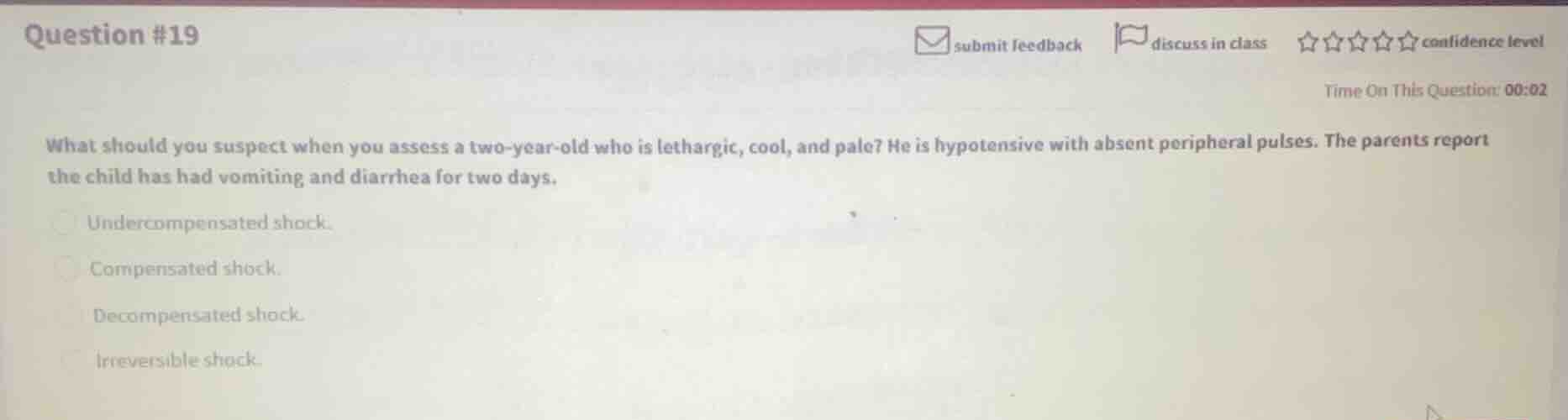
what should you suspect when you assess a two-year-old who is lethargic, cool, and pale? he is hypotensive with absent peripheral pulses. the parents report the child has had vomiting and diarrhea for two days.
undercompensated shock.
compensated shock.
decompensated shock.
irreversible shock.
<pre_analysis>
{
"quality": "clear",
"question_count": 1,
"skills_matched": [
"direct_cot",
"multiple_choice_formatter",
"explain_then_answer",
"tutor",
"mastery_adaptive_brevity"
],
"needs_drawing": false,
"concepts_used": [
"Pediatric Shock Pathophysiology",
"Decompensated Shock",
"Shock Stages"
],
"new_concepts": [],
"current_concepts": [
"Pediatric Shock Pathophysiology",
"Decompensated Shock",
"Shock Stages"
]
}
</pre_analysis>
<reasoning>
Analyze clinical presentation and age
Using the Pediatric Shock Pathophysiology knowledge point, we evaluate a 2-year-old patient presenting with lethargy, cool and pale skin, hypotension, absent peripheral pulses, and a history of fluid loss (vomiting and diarrhea for two days). In pediatric patients, fluid loss rapidly leads to hypovolemic shock.
Determine the stage of shock
Using the Shock Stages and Decompensated Shock knowledge points:
- Compensated shock in pediatrics is characterized by signs of poor peripheral perfusion (cool, pale skin, delayed capillary refill) and tachycardia, but the body is still able to maintain a normal blood pressure.
- Decompensated shock occurs when compensatory mechanisms fail, leading to key indicators such as hypotension, altered mental status (lethargy), and profoundly weak or absent peripheral pulses.
Because this child is hypotensive and lethargic with absent peripheral pulses, they have progressed past compensation into decompensated shock.
Evaluate the given options
- Undercompensated shock: Not a standard clinical classification for stages of shock.
- Compensated shock: Incorrect, because the patient is hypotensive and lethargic, indicating compensatory mechanisms have failed.
- Decompensated shock: Correct, as hypotension in a pediatric patient with signs of hypovolemia is a defining hallmark of decompensation.
- Irreversible shock: Incorrect, as this stage is characterized by cell and organ death where resuscitation is impossible; we must assume and treat this as a reversible, life-threatening emergency (decompensated shock).
</reasoning>
<answer>
<mcq-option>Undercompensated shock.</mcq-option>
<mcq-option>Compensated shock.</mcq-option>
<mcq-correct>Decompensated shock.</mcq-correct>
<mcq-option>Irreversible shock.</mcq-option>
</answer>
<post_analysis>
{
"subject": "Natural Science",
"question_type": "Multiple Choice",
"knowledge_point": [
"Natural Science",
"Medicine",
"Emergency Medical Services"
]
}
</post_analysis>
Snap & solve any problem in the app
Get step-by-step solutions on Sovi AI
Photo-based solutions with guided steps
Explore more problems and detailed explanations
<pre_analysis>
{
"quality": "clear",
"question_count": 1,
"skills_matched": [
"direct_cot",
"multiple_choice_formatter",
"explain_then_answer",
"tutor",
"mastery_adaptive_brevity"
],
"needs_drawing": false,
"concepts_used": [
"Pediatric Shock Pathophysiology",
"Decompensated Shock",
"Shock Stages"
],
"new_concepts": [],
"current_concepts": [
"Pediatric Shock Pathophysiology",
"Decompensated Shock",
"Shock Stages"
]
}
</pre_analysis>
<reasoning>
Analyze clinical presentation and age
Using the Pediatric Shock Pathophysiology knowledge point, we evaluate a 2-year-old patient presenting with lethargy, cool and pale skin, hypotension, absent peripheral pulses, and a history of fluid loss (vomiting and diarrhea for two days). In pediatric patients, fluid loss rapidly leads to hypovolemic shock.
Determine the stage of shock
Using the Shock Stages and Decompensated Shock knowledge points:
- Compensated shock in pediatrics is characterized by signs of poor peripheral perfusion (cool, pale skin, delayed capillary refill) and tachycardia, but the body is still able to maintain a normal blood pressure.
- Decompensated shock occurs when compensatory mechanisms fail, leading to key indicators such as hypotension, altered mental status (lethargy), and profoundly weak or absent peripheral pulses.
Because this child is hypotensive and lethargic with absent peripheral pulses, they have progressed past compensation into decompensated shock.
Evaluate the given options
- Undercompensated shock: Not a standard clinical classification for stages of shock.
- Compensated shock: Incorrect, because the patient is hypotensive and lethargic, indicating compensatory mechanisms have failed.
- Decompensated shock: Correct, as hypotension in a pediatric patient with signs of hypovolemia is a defining hallmark of decompensation.
- Irreversible shock: Incorrect, as this stage is characterized by cell and organ death where resuscitation is impossible; we must assume and treat this as a reversible, life-threatening emergency (decompensated shock).
</reasoning>
<answer>
<mcq-option>Undercompensated shock.</mcq-option>
<mcq-option>Compensated shock.</mcq-option>
<mcq-correct>Decompensated shock.</mcq-correct>
<mcq-option>Irreversible shock.</mcq-option>
</answer>
<post_analysis>
{
"subject": "Natural Science",
"question_type": "Multiple Choice",
"knowledge_point": [
"Natural Science",
"Medicine",
"Emergency Medical Services"
]
}
</post_analysis>