QUESTION IMAGE
Question
what is the evidence for this unit? *
all matter is made of atoms, atoms make up molecules, molecules make up macromolecules and are used by living organisms, matter is transferred between organisms in an ecosystem..
you can physically see the cells dividing
the cell cycle describes the process of how cells divide including check points
the cell cycle describes how bacteria cells divide
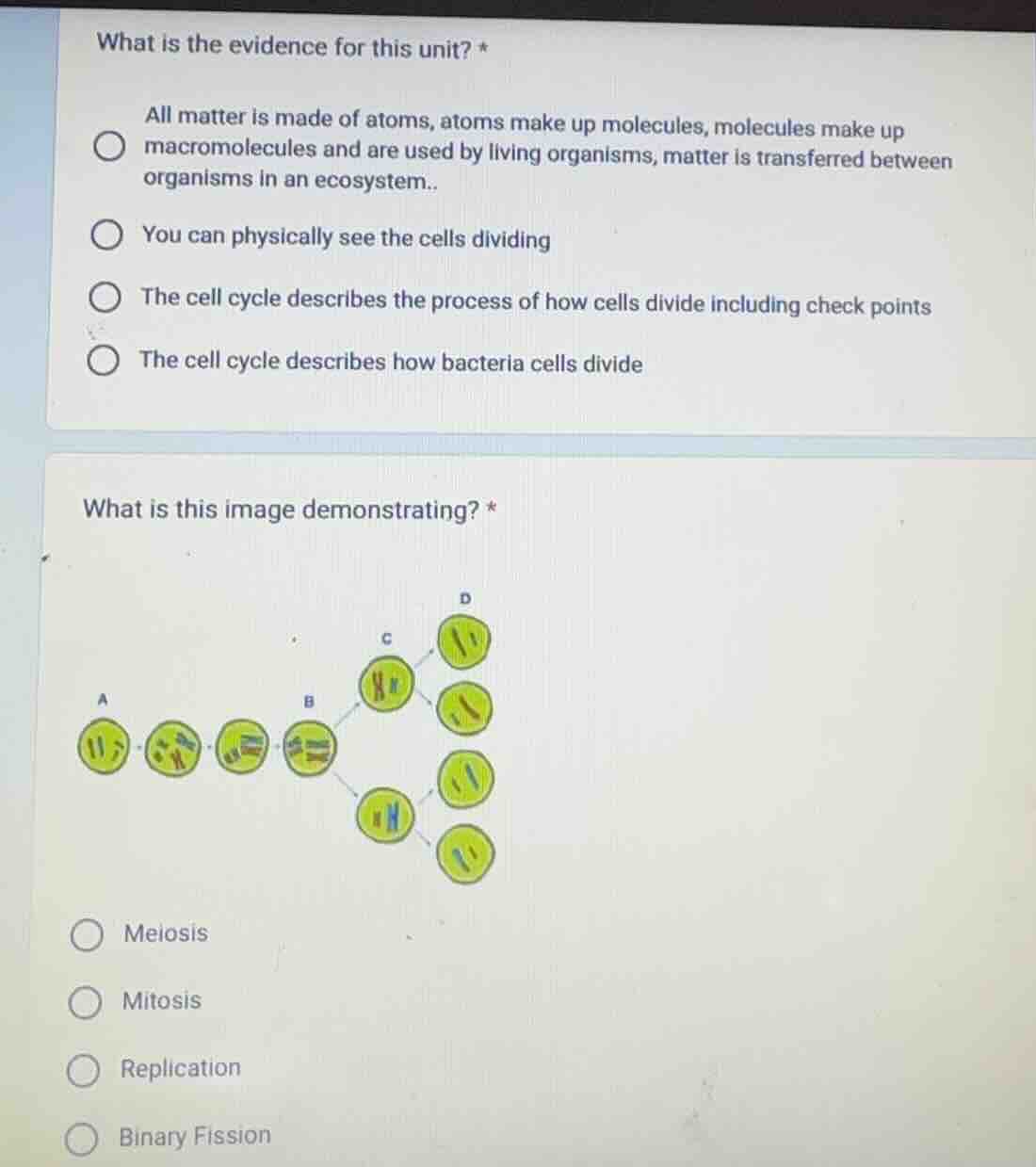
what is this image demonstrating? *
meiosis
mitosis
replication
binary fission
<pre_analysis>
{
"quality": "clear",
"question_count": 2,
"skills_matched": [
"direct_cot",
"multiple_choice_formatter",
"explain_then_answer",
"tutor"
],
"needs_drawing": false,
"concepts_used": [
"Meiosis",
"Cell Division"
],
"new_concepts": [],
"current_concepts": [
"Meiosis",
"Cell Division",
"Cell Cycle Regulation"
]
}
</pre_analysis>
<reasoning>
Analyze the first question
The first question asks: "What is the evidence for this unit?"
The options discuss matter, observing cell division, the cell cycle with checkpoints, and bacterial cell division.
To provide evidence for a unit on cell division and the cell cycle, the direct observation of cells undergoing division serves as physical, empirical evidence.
Therefore, "You can physically see the cells dividing" is the most direct empirical evidence supporting the study of cell division.
Analyze the second question
The second question asks: "What is this image demonstrating?"
Let's trace the diagram:
- It starts with a diploid cell \(A\) containing homologous chromosomes.
- The chromosomes replicate and align.
- At stage \(B\), homologous chromosomes pair up and then separate during the first division into two haploid cells at stage \(C\).
- At stage \(D\), sister chromatids separate, resulting in four haploid daughter cells, each containing a single set of chromosomes.
This process of producing four genetically diverse haploid cells from one diploid cell is Meiosis.
We can connect this to the student's mastered concepts of Meiosis and Cell Division.
</reasoning>
<answer>
Question 1
<mcq-option>(A) All matter is made of atoms, atoms make up molecules, molecules make up macromolecules and are used by living organisms, matter is transferred between organisms in an ecosystem..</mcq-option>
<mcq-correct>(B) You can physically see the cells dividing</mcq-correct>
<mcq-option>(C) The cell cycle describes the process of how cells divide including check points</mcq-option>
<mcq-option>(D) The cell cycle describes how bacteria cells divide</mcq-option>
Question 2
<mcq-correct>(A) Meiosis</mcq-correct>
<mcq-option>(B) Mitosis</mcq-option>
<mcq-option>(C) Replication</mcq-option>
<mcq-option>(D) Binary Fission</mcq-option>
</answer>
<post_analysis>
{
"subject": "Natural Science",
"question_type": "Multiple Choice",
"knowledge_point": [
"Natural Science",
"Biology",
"Meiosis"
]
}
</post_analysis>
Snap & solve any problem in the app
Get step-by-step solutions on Sovi AI
Photo-based solutions with guided steps
Explore more problems and detailed explanations
<pre_analysis>
{
"quality": "clear",
"question_count": 2,
"skills_matched": [
"direct_cot",
"multiple_choice_formatter",
"explain_then_answer",
"tutor"
],
"needs_drawing": false,
"concepts_used": [
"Meiosis",
"Cell Division"
],
"new_concepts": [],
"current_concepts": [
"Meiosis",
"Cell Division",
"Cell Cycle Regulation"
]
}
</pre_analysis>
<reasoning>
Analyze the first question
The first question asks: "What is the evidence for this unit?"
The options discuss matter, observing cell division, the cell cycle with checkpoints, and bacterial cell division.
To provide evidence for a unit on cell division and the cell cycle, the direct observation of cells undergoing division serves as physical, empirical evidence.
Therefore, "You can physically see the cells dividing" is the most direct empirical evidence supporting the study of cell division.
Analyze the second question
The second question asks: "What is this image demonstrating?"
Let's trace the diagram:
- It starts with a diploid cell \(A\) containing homologous chromosomes.
- The chromosomes replicate and align.
- At stage \(B\), homologous chromosomes pair up and then separate during the first division into two haploid cells at stage \(C\).
- At stage \(D\), sister chromatids separate, resulting in four haploid daughter cells, each containing a single set of chromosomes.
This process of producing four genetically diverse haploid cells from one diploid cell is Meiosis.
We can connect this to the student's mastered concepts of Meiosis and Cell Division.
</reasoning>
<answer>
Question 1
<mcq-option>(A) All matter is made of atoms, atoms make up molecules, molecules make up macromolecules and are used by living organisms, matter is transferred between organisms in an ecosystem..</mcq-option>
<mcq-correct>(B) You can physically see the cells dividing</mcq-correct>
<mcq-option>(C) The cell cycle describes the process of how cells divide including check points</mcq-option>
<mcq-option>(D) The cell cycle describes how bacteria cells divide</mcq-option>
Question 2
<mcq-correct>(A) Meiosis</mcq-correct>
<mcq-option>(B) Mitosis</mcq-option>
<mcq-option>(C) Replication</mcq-option>
<mcq-option>(D) Binary Fission</mcq-option>
</answer>
<post_analysis>
{
"subject": "Natural Science",
"question_type": "Multiple Choice",
"knowledge_point": [
"Natural Science",
"Biology",
"Meiosis"
]
}
</post_analysis>