QUESTION IMAGE
Question
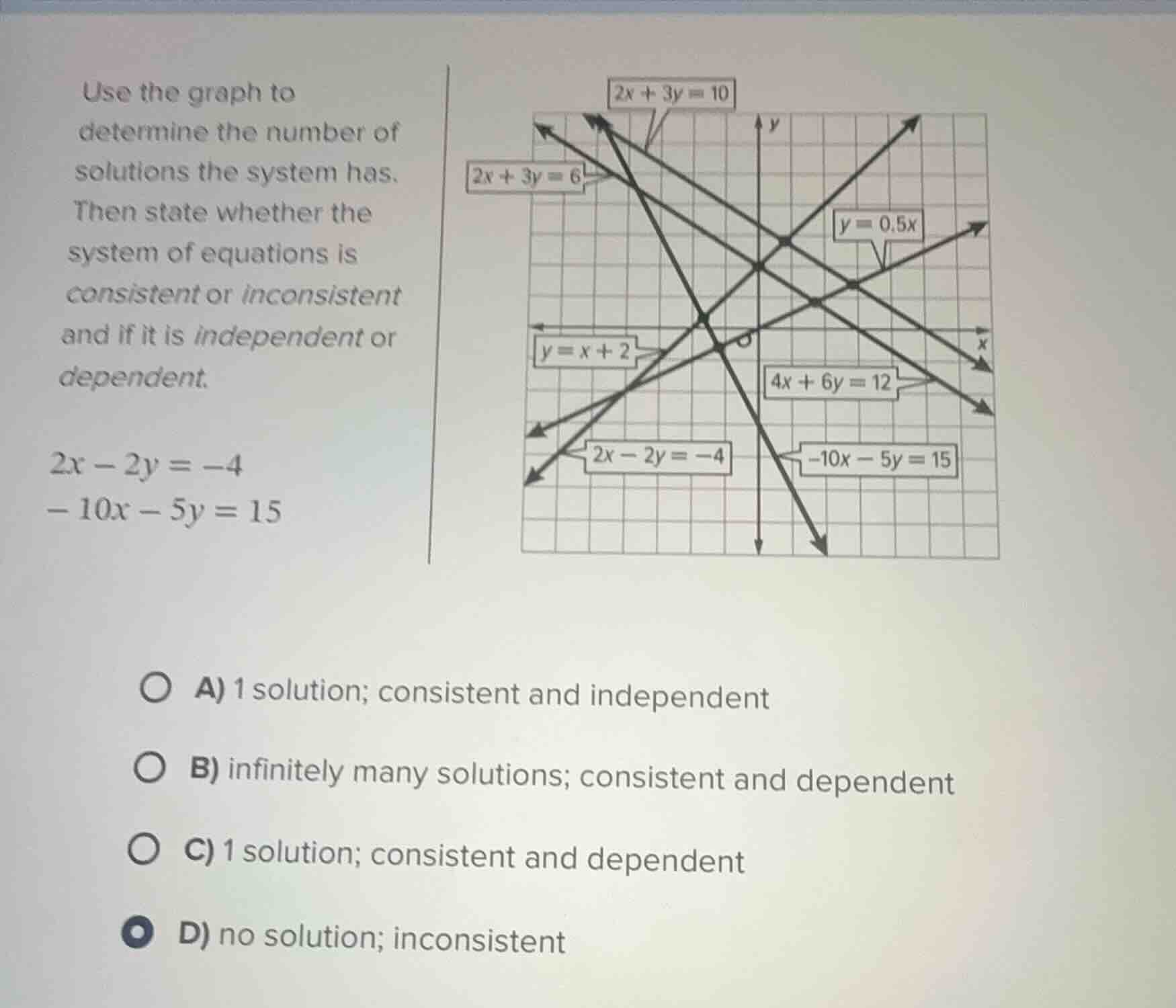
use the graph to determine the number of solutions the system has. then state whether the system of equations is consistent or inconsistent and if it is independent or dependent. 2x - 2y = -4 -10x - 5y = 15 a) 1 solution; consistent and independent b) infinitely many solutions; consistent and dependent c) 1 solution; consistent and dependent d) no solution; inconsistent
To determine the number of solutions and the consistency of the system \(
\), we analyze the lines represented by the equations.
- Rewrite the equations in slope - intercept form (\(y=mx + b\)):
- For the first equation \(2x-2y=-4\):
- Subtract \(2x\) from both sides: \(-2y=-2x - 4\).
- Divide by \(-2\): \(y=x + 2\). The slope \(m_1 = 1\) and the \(y\) - intercept \(b_1=2\).
- For the second equation \(-10x - 5y=15\):
- Add \(10x\) to both sides: \(-5y = 10x+15\).
- Divide by \(-5\): \(y=-2x - 3\). The slope \(m_2=-2\) and the \(y\) - intercept \(b_2=-3\).
- Analyze the intersection of the lines:
- Parallel lines have the same slope. Since \(m_1
eq m_2\) ( \(1
eq - 2\)), the two lines are not parallel. But from the graph (or by solving the system), we can also check the nature of the system. A system of linear equations \(a_1x + b_1y=c_1\) and \(a_2x + b_2y=c_2\) has:
- One solution if \(\frac{a_1}{a_2}
eq\frac{b_1}{b_2}\) (the lines intersect at one point).
- No solution if \(\frac{a_1}{a_2}=\frac{b_1}{b_2}
eq\frac{c_1}{c_2}\) (parallel lines).
- Infinitely many solutions if \(\frac{a_1}{a_2}=\frac{b_1}{b_2}=\frac{c_1}{c_2}\) (coincident lines).
- For the given system \(\frac{2}{-10}=\frac{-2}{-5}\)? \(\frac{2}{-10}=-\frac{1}{5}\), \(\frac{-2}{-5}=\frac{2}{5}\), so \(\frac{2}{-10}
eq\frac{-2}{-5}\), but when we look at the graph (or by checking the slopes and intercepts), the two lines \(y = x + 2\) and \(y=-2x - 3\) intersect at exactly one point. Wait, there is a mistake in the initial analysis. Let's re - examine the system.
- Wait, the user's selected option is D, but let's re - do the slope - intercept form correctly.
- First equation: \(2x-2y=-4\), divide by 2: \(x - y=-2\), then \(y=x + 2\) (slope \(m_1 = 1\), \(y\) - intercept \(b_1 = 2\)).
- Second equation: \(-10x-5y=15\), divide by - 5: \(2x + y=-3\), then \(y=-2x-3\) (slope \(m_2=-2\), \(y\) - intercept \(b_2=-3\)).
- Since the slopes are different (\(m_1
eq m_2\)), the two lines intersect at exactly one point. But the selected option in the image is D, which is wrong. Wait, maybe there is a mis - reading of the equations. Wait, the system is \(
\). Let's check the slopes again. The first line \(y=x + 2\) (slope 1), the second line \(y=-2x-3\) (slope - 2). Since the slopes are different, the lines intersect at one point. A system with one solution is consistent and independent. So the correct option should be A.
- Wait, maybe the user made a mistake in the selected option. Let's re - solve the system by substitution. From \(y=x + 2\), substitute into \(-10x-5y=15\):
- \(-10x-5(x + 2)=15\).
- \(-10x-5x-10 = 15\).
- \(-15x=25\), \(x=-\frac{5}{3}\).
- Then \(y=-\frac{5}{3}+2=\frac{1}{3}\). So the system has one solution. A system with one solution is consistent (because it has at least one solution) and independent (because the equations are not equivalent, i.e., the lines are not coincident). So the correct option is A.

Snap & solve any problem in the app
Get step-by-step solutions on Sovi AI
Photo-based solutions with guided steps
Explore more problems and detailed explanations
A) 1 solution; consistent and independent