QUESTION IMAGE
Question
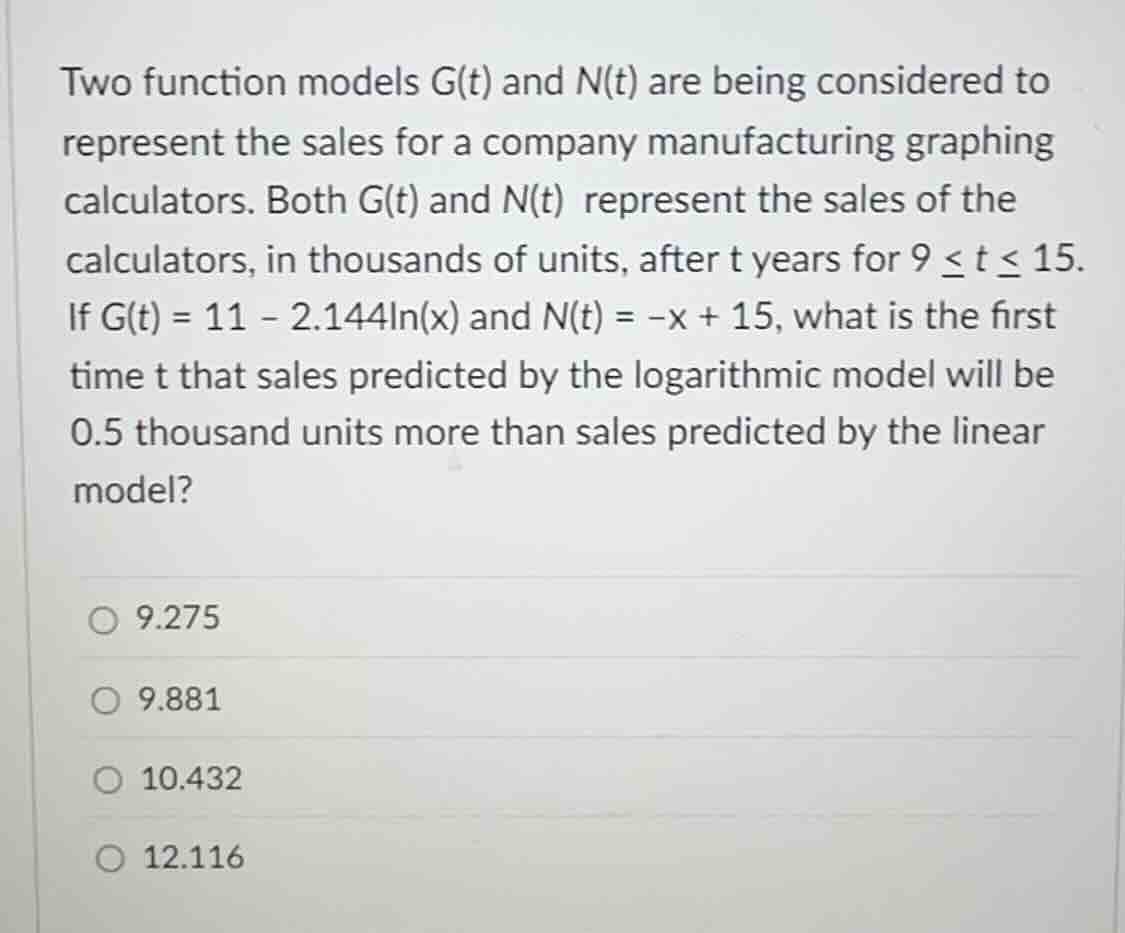
two function models \\(g(t)\\) and \\(n(t)\\) are being considered to represent the sales for a company manufacturing graphing calculators. both \\(g(t)\\) and \\(n(t)\\) represent the sales of the calculators, in thousands of units, after \\(t\\) years for \\(9 \le t \le 15\\). if \\(g(t) = 11 - 2.144\ln(x)\\) and \\(n(t) = -x + 15\\), what is the first time \\(t\\) that sales predicted by the logarithmic model will be 0.5 thousand units more than sales predicted by the linear model?
9.275
9.881
10.432
12.116
Set up the equation
We seek the first time \(t\) where logarithmic sales exceed linear sales by \(0.5\).
Using Exponential Equations concepts, we set up the relation:
Substituting the given functions (treating \(x\) in the text as the variable \(t\)):
Simplify the equation
Combine the constant terms on the right side:
Rearrange the terms to set the equation to zero:
Evaluate the options
We test the given multiple-choice options in the equation \(f(t) = t - 2.144\ln(t) - 4.5\):
For \(t = 9.275\):
For \(t = 9.881\):
For \(t = 10.432\):
For \(t = 12.116\):
Identify the correct time
The value \(t \approx 9.275\) yields approximately \(0\), satisfying the condition.

Snap & solve any problem in the app
Get step-by-step solutions on Sovi AI
Photo-based solutions with guided steps
Explore more problems and detailed explanations
- (A) 9.275 (Correct answer)
- (B) 9.881
- (C) 10.432
- (D) 12.116