Sovi.AI - AI Math Tutor

Scan to solve math questions

QUESTION IMAGE

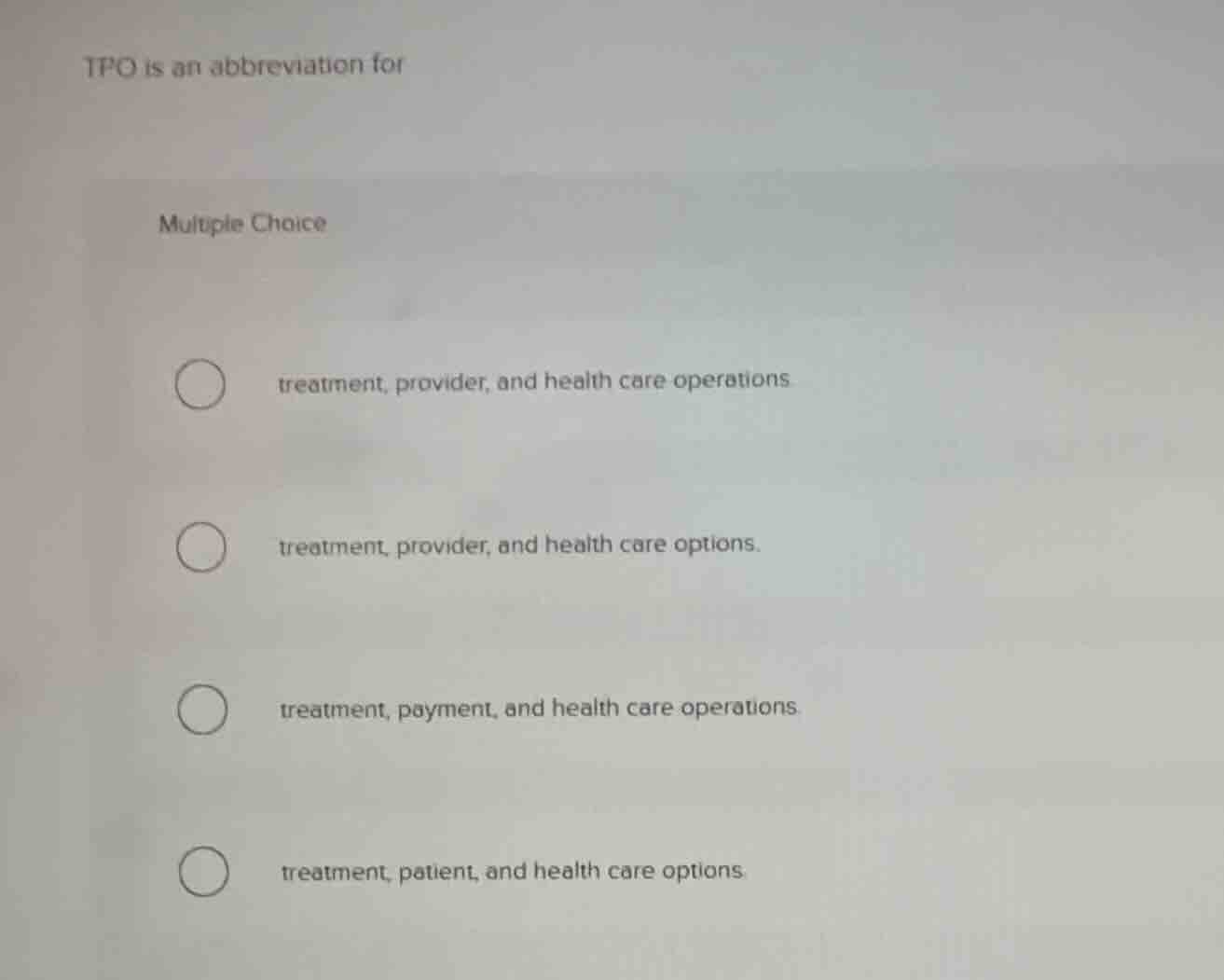
tpo is an abbreviation for multiple choice treatment, provider, and hea…

Question

tpo is an abbreviation for

multiple choice

treatment, provider, and health care operations

treatment, provider, and health care options.

treatment, payment, and health care operations

treatment, patient, and health care options

Explanation:

Response

<pre_analysis>
{
"quality": "clear",
"question_count": 1,
"skills_matched": [
"direct_cot",
"multiple_choice_formatter",
"explain_then_answer",
"tutor",
"mastery_adaptive_brevity"
],
"needs_drawing": false,
"concepts_used": [
"HIPAA Privacy Rule"
],
"new_concepts": [],
"current_concepts": [
"HIPAA Privacy Rule",
"Medical Abbreviations"
]
}
</pre_analysis>

<reasoning>

Define the abbreviation TPO

Using the HIPAA Privacy Rule knowledge point

  • Under the Health Insurance Portability and Accountability Act (HIPAA) Privacy Rule, the abbreviation TPO stands for Treatment, Payment, and Health Care Operations.
  • These represent the three primary areas where a covered entity is permitted to use and disclose protected health information (PHI) without obtaining a specific written authorization from the patient.

Evaluate the given options

  • Option 1: "treatment, provider, and health care operations" — Incorrect. The "P" stands for Payment, not provider.
  • Option 2: "treatment, provider, and health care options" — Incorrect. The "P" stands for Payment and the "O" stands for Operations.
  • Option 3: "treatment, payment, and health care operations" — Correct. This matches the official HIPAA definition.
  • Option 4: "treatment, patient, and health care options" — Incorrect. The "P" stands for Payment and the "O" stands for Operations.

</reasoning>

<answer>
<mcq-option>treatment, provider, and health care operations</mcq-option>
<mcq-option>treatment, provider, and health care options</mcq-option>
<mcq-correct>treatment, payment, and health care operations</mcq-correct>
<mcq-option>treatment, patient, and health care options</mcq-option>
</answer>

<post_analysis>
{
"subject": "Others",
"question_type": "Multiple Choice",
"knowledge_point": [
"Others",
"Healthcare Administration",
"HIPAA Privacy Rule"
]
}
</post_analysis>

Answer:

<pre_analysis>
{
"quality": "clear",
"question_count": 1,
"skills_matched": [
"direct_cot",
"multiple_choice_formatter",
"explain_then_answer",
"tutor",
"mastery_adaptive_brevity"
],
"needs_drawing": false,
"concepts_used": [
"HIPAA Privacy Rule"
],
"new_concepts": [],
"current_concepts": [
"HIPAA Privacy Rule",
"Medical Abbreviations"
]
}
</pre_analysis>

<reasoning>

Define the abbreviation TPO

Using the HIPAA Privacy Rule knowledge point

  • Under the Health Insurance Portability and Accountability Act (HIPAA) Privacy Rule, the abbreviation TPO stands for Treatment, Payment, and Health Care Operations.
  • These represent the three primary areas where a covered entity is permitted to use and disclose protected health information (PHI) without obtaining a specific written authorization from the patient.

Evaluate the given options

  • Option 1: "treatment, provider, and health care operations" — Incorrect. The "P" stands for Payment, not provider.
  • Option 2: "treatment, provider, and health care options" — Incorrect. The "P" stands for Payment and the "O" stands for Operations.
  • Option 3: "treatment, payment, and health care operations" — Correct. This matches the official HIPAA definition.
  • Option 4: "treatment, patient, and health care options" — Incorrect. The "P" stands for Payment and the "O" stands for Operations.

</reasoning>

<answer>
<mcq-option>treatment, provider, and health care operations</mcq-option>
<mcq-option>treatment, provider, and health care options</mcq-option>
<mcq-correct>treatment, payment, and health care operations</mcq-correct>
<mcq-option>treatment, patient, and health care options</mcq-option>
</answer>

<post_analysis>
{
"subject": "Others",
"question_type": "Multiple Choice",
"knowledge_point": [
"Others",
"Healthcare Administration",
"HIPAA Privacy Rule"
]
}
</post_analysis>