Sovi.AI - AI Math Tutor

Scan to solve math questions

QUESTION IMAGE

someone consistently cuts you off while youre speaking. clearly label a…

Question

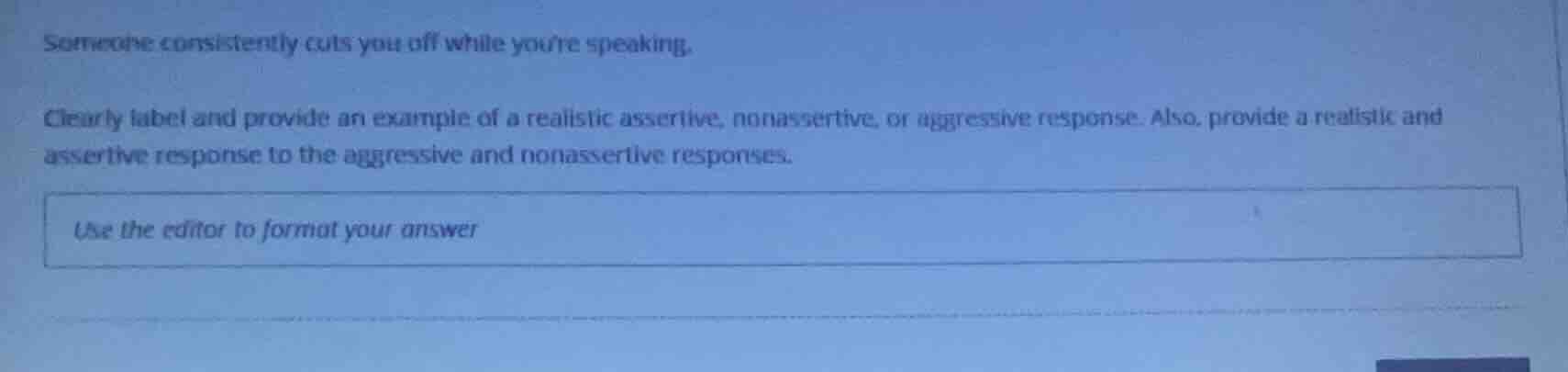
someone consistently cuts you off while youre speaking.

clearly label and provide an example of a realistic assertive, nonassertive, or aggressive response. also, provide a realistic and assertive response to the aggressive and nonassertive responses.

use the editor to format your answer

Explanation:

Response

<pre_analysis>
{
"quality": "clear",
"question_count": 1,
"skills_matched": [
"direct_cot",
"explain_then_answer",
"tutor",
"mastery_adaptive_brevity"
],
"needs_drawing": false,
"concepts_used": [
"Assertive Communication",
"Communication Styles"
],
"new_concepts": [],
"current_concepts": [
"Assertive Communication",
"Communication Styles"
]
}
</pre_analysis>

<reasoning>

Analyze the scenario and requirements

The scenario is: "Someone consistently cuts you off while you're speaking."
The prompt requires:

  1. Clearly label and provide an example of a realistic assertive, nonassertive, and aggressive response to this scenario.
  2. Provide a realistic and assertive response to the aggressive and nonassertive responses (i.e., how to handle or transition those responses into assertive ones, or how to respond assertively if someone else reacts in those ways).

Define communication styles

Using the Communication Styles knowledge point:

  • Assertive: Direct, respectful, and firm. Expresses needs clearly without violating others' rights.
  • Nonassertive (Passive): Submissive, avoiding conflict, letting others violate one's boundaries.
  • Aggressive: Hostile, violating others' boundaries, demanding, or attacking.

Formulate the examples

Using the Assertive Communication knowledge point:

  • Assertive Response: "I notice you've cut me off a few times. I'd really like to finish my thought before we discuss it."
  • Nonassertive Response: (Sighs, looks down, and stops talking entirely) "Oh, sorry, go ahead..."
  • Aggressive Response: "Shut up! Stop interrupting me, you are so rude and self-centered!"

Formulate assertive corrections

  • Assertive response to the nonassertive reaction: If you caught yourself being nonassertive, you can assertively reclaim your turn: "Actually, let me go back to what I was saying earlier so I can finish that point."
  • Assertive response to the aggressive reaction: If you reacted aggressively, you can de-escalate assertively: "I apologize for snapping earlier. I got frustrated because I wanted to finish my point. Let's take a step back so we can both speak and listen."

</reasoning>

<answer>

Part 1: Examples of the Three Communication Styles
  • Assertive Response
  • Example: "I notice that you've cut me off a few times while I was sharing my ideas. I would really appreciate it if you let me finish my thought before you respond."
  • Nonassertive (Passive) Response
  • Example: (Stops speaking immediately, looks down at the floor, and mutters) "Oh, sorry... go ahead, what you have to say is probably more important anyway."
  • Aggressive Response
  • Example: "Shut up and let me talk! You are incredibly rude and always make everything about yourself!"

---

Part 2: Assertive Responses to the Nonassertive and Aggressive Reactions
  • Assertive Response to the Nonassertive Reaction (Reclaiming your voice)
  • Example: "Actually, I realize I let myself get cut off earlier. I'd like to go back and finish the point I was making so we are on the same page."
  • Assertive Response to the Aggressive Reaction (De-escalating and resetting boundaries)
  • Example: "I apologize for raising my voice and snapping at you just now. I got frustrated because I felt unheard. Let's reset: I would like to finish my thought, and then I am completely ready to listen to your feedback."

</answer>

<post_analysis>
{
"subject": "Social Science",
"question_type": "Free Response",
"…

Answer:

<pre_analysis>
{
"quality": "clear",
"question_count": 1,
"skills_matched": [
"direct_cot",
"explain_then_answer",
"tutor",
"mastery_adaptive_brevity"
],
"needs_drawing": false,
"concepts_used": [
"Assertive Communication",
"Communication Styles"
],
"new_concepts": [],
"current_concepts": [
"Assertive Communication",
"Communication Styles"
]
}
</pre_analysis>

<reasoning>

Analyze the scenario and requirements

The scenario is: "Someone consistently cuts you off while you're speaking."
The prompt requires:

  1. Clearly label and provide an example of a realistic assertive, nonassertive, and aggressive response to this scenario.
  2. Provide a realistic and assertive response to the aggressive and nonassertive responses (i.e., how to handle or transition those responses into assertive ones, or how to respond assertively if someone else reacts in those ways).

Define communication styles

Using the Communication Styles knowledge point:

  • Assertive: Direct, respectful, and firm. Expresses needs clearly without violating others' rights.
  • Nonassertive (Passive): Submissive, avoiding conflict, letting others violate one's boundaries.
  • Aggressive: Hostile, violating others' boundaries, demanding, or attacking.

Formulate the examples

Using the Assertive Communication knowledge point:

  • Assertive Response: "I notice you've cut me off a few times. I'd really like to finish my thought before we discuss it."
  • Nonassertive Response: (Sighs, looks down, and stops talking entirely) "Oh, sorry, go ahead..."
  • Aggressive Response: "Shut up! Stop interrupting me, you are so rude and self-centered!"

Formulate assertive corrections

  • Assertive response to the nonassertive reaction: If you caught yourself being nonassertive, you can assertively reclaim your turn: "Actually, let me go back to what I was saying earlier so I can finish that point."
  • Assertive response to the aggressive reaction: If you reacted aggressively, you can de-escalate assertively: "I apologize for snapping earlier. I got frustrated because I wanted to finish my point. Let's take a step back so we can both speak and listen."

</reasoning>

<answer>

Part 1: Examples of the Three Communication Styles
  • Assertive Response
  • Example: "I notice that you've cut me off a few times while I was sharing my ideas. I would really appreciate it if you let me finish my thought before you respond."
  • Nonassertive (Passive) Response
  • Example: (Stops speaking immediately, looks down at the floor, and mutters) "Oh, sorry... go ahead, what you have to say is probably more important anyway."
  • Aggressive Response
  • Example: "Shut up and let me talk! You are incredibly rude and always make everything about yourself!"

---

Part 2: Assertive Responses to the Nonassertive and Aggressive Reactions
  • Assertive Response to the Nonassertive Reaction (Reclaiming your voice)
  • Example: "Actually, I realize I let myself get cut off earlier. I'd like to go back and finish the point I was making so we are on the same page."
  • Assertive Response to the Aggressive Reaction (De-escalating and resetting boundaries)
  • Example: "I apologize for raising my voice and snapping at you just now. I got frustrated because I felt unheard. Let's reset: I would like to finish my thought, and then I am completely ready to listen to your feedback."

</answer>

<post_analysis>
{
"subject": "Social Science",
"question_type": "Free Response",
"knowledge_point": [
"Social Science",
"Communication Studies",
"Assertive Communication"
]
}
</post_analysis>