Sovi.AI - AI Math Tutor

Scan to solve math questions

QUESTION IMAGE

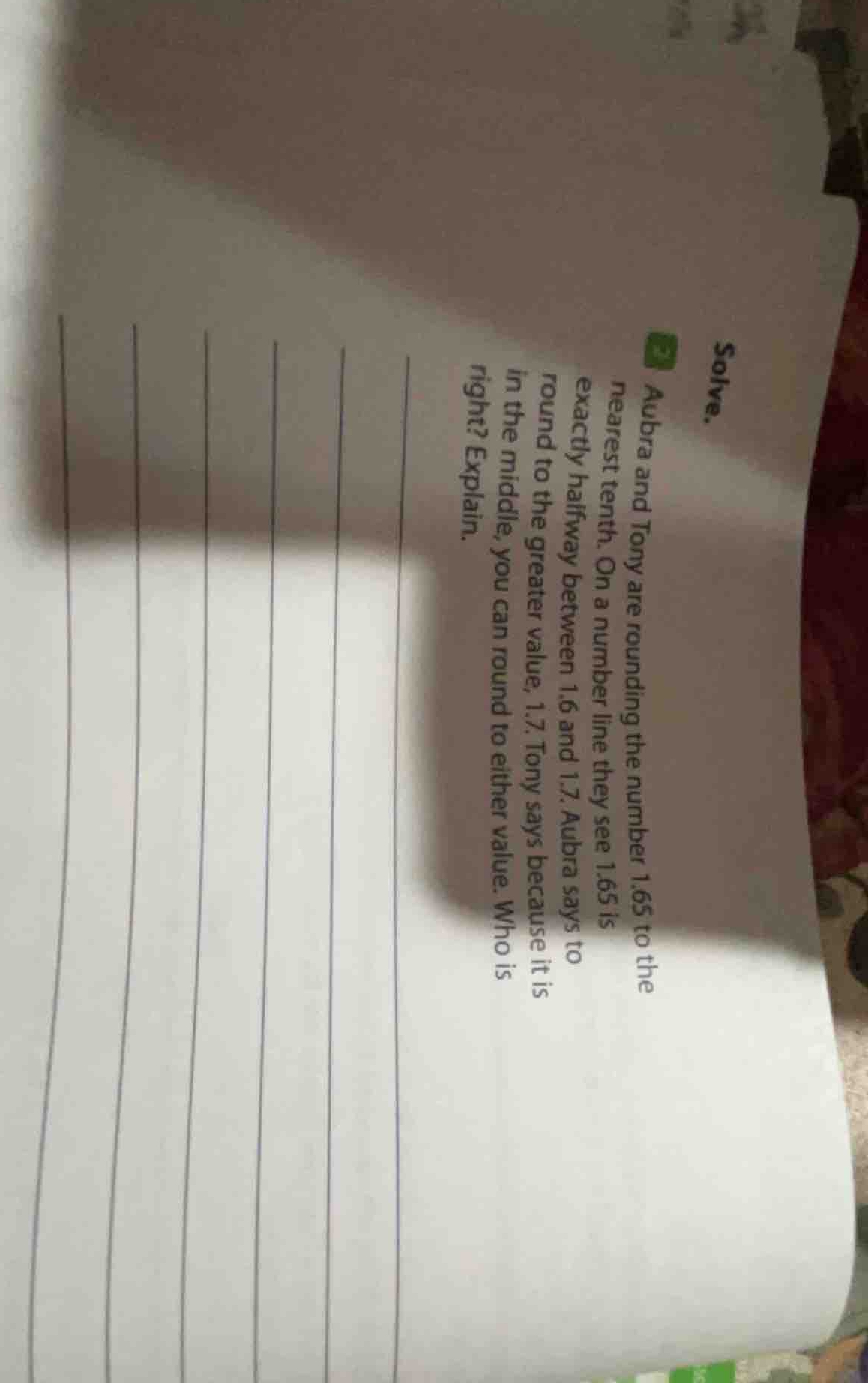
solve. 2 aubra and tony are rounding the number 1.65 to the nearest ten…

Question

solve.

2 aubra and tony are rounding the number 1.65 to the nearest tenth. on a number line they see 1.65 is exactly halfway between 1.6 and 1.7. aubra says to round to the greater value, 1.7. tony says because it is in the middle, you can round to either value. who is right? explain.

Explanation:

Response

<pre_analysis>
{
"quality": "clear",
"question_count": 1,
"skills_matched": [
"step_cot",
"explain_then_answer",
"tutor",
"mastery_adaptive_brevity"
],
"needs_drawing": true,
"concepts_used": [
"Rounding Decimals"
],
"new_concepts": [
"Rounding Rules and Conventions"
],
"current_concepts": [
"Rounding Decimals",
"Rounding Rules and Conventions"
]
}
</pre_analysis>

<reasoning>

Identify the rounding problem

The problem asks who is correct when rounding \(1.65\) to the nearest tenth.

  • Given value: \(1.65\)
  • Target place value: Tenths
  • Aubra's claim: Round up to \(1.7\) because \(1.65\) is exactly halfway.
  • Tony's claim: Round to either \(1.6\) or \(1.7\) because it is in the middle.

Apply rounding rules

Using the Rounding Decimals knowledge point
\[

$$\begin{aligned} &\text{Target digit (tenths): } 6\\ &\text{Deciding digit (hundredths): } 5\\ &5 \ge 5 \implies \text{Round up}\\ &1.65 \approx 1.7 \end{aligned}$$

\]

Evaluate the arguments

  • Aubra is correct because standard mathematical convention dictates that when a number is exactly halfway between two values, we round up to the greater value.
  • Tony is incorrect because rounding rules require a consistent, single outcome rather than choosing either value arbitrarily.

</reasoning>

<answer>
Aubra is right. When a number is exactly halfway between two values, standard mathematical convention dictates rounding up to the greater value, which is \(1.7\).
</answer>

<plot>
{
"elements": [
{
"type": "line",
"params": [[1.55, 0], [1.75, 0]],
"properties": {
"strokeColor": "#583C87",
"strokeWidth": 2
}
},
{
"type": "point",
"params": [[1.6, 0]],
"properties": {
"name": "1.6",
"size": 4,
"color": "#5583F2",
"withLabel": true,
"labelPosition": "bottom"
}
},
{
"type": "point",
"params": [[1.7, 0]],
"properties": {
"name": "1.7",
"size": 4,
"color": "#5583F2",
"withLabel": true,
"labelPosition": "bottom"
}
},
{
"type": "point",
"params": [[1.65, 0]],
"properties": {
"name": "1.65 (Halfway)",
"size": 5,
"color": "#F2557F",
"withLabel": true,
"labelPosition": "top"
}
},
{
"type": "arrow",
"params": [[1.65, 0.2], [1.69, 0.2]],
"properties": {
"strokeColor": "#8C55F2",
"strokeWidth": 2,
"labelText": "Round Up",
"withLabel": true
}
}
],
"timestamps": [0.5, 1.0]
}
</plot>

<post_analysis>
{
"subject": "Mathematics",
"question_type": "Word Problem",
"knowledge_point": [
"Mathematics",
"Arithmetic",
"Rounding Decimals"
]
}
</post_analysis>

Answer:

<pre_analysis>
{
"quality": "clear",
"question_count": 1,
"skills_matched": [
"step_cot",
"explain_then_answer",
"tutor",
"mastery_adaptive_brevity"
],
"needs_drawing": true,
"concepts_used": [
"Rounding Decimals"
],
"new_concepts": [
"Rounding Rules and Conventions"
],
"current_concepts": [
"Rounding Decimals",
"Rounding Rules and Conventions"
]
}
</pre_analysis>

<reasoning>

Identify the rounding problem

The problem asks who is correct when rounding \(1.65\) to the nearest tenth.

  • Given value: \(1.65\)
  • Target place value: Tenths
  • Aubra's claim: Round up to \(1.7\) because \(1.65\) is exactly halfway.
  • Tony's claim: Round to either \(1.6\) or \(1.7\) because it is in the middle.

Apply rounding rules

Using the Rounding Decimals knowledge point
\[

$$\begin{aligned} &\text{Target digit (tenths): } 6\\ &\text{Deciding digit (hundredths): } 5\\ &5 \ge 5 \implies \text{Round up}\\ &1.65 \approx 1.7 \end{aligned}$$

\]

Evaluate the arguments

  • Aubra is correct because standard mathematical convention dictates that when a number is exactly halfway between two values, we round up to the greater value.
  • Tony is incorrect because rounding rules require a consistent, single outcome rather than choosing either value arbitrarily.

</reasoning>

<answer>
Aubra is right. When a number is exactly halfway between two values, standard mathematical convention dictates rounding up to the greater value, which is \(1.7\).
</answer>

<plot>
{
"elements": [
{
"type": "line",
"params": [[1.55, 0], [1.75, 0]],
"properties": {
"strokeColor": "#583C87",
"strokeWidth": 2
}
},
{
"type": "point",
"params": [[1.6, 0]],
"properties": {
"name": "1.6",
"size": 4,
"color": "#5583F2",
"withLabel": true,
"labelPosition": "bottom"
}
},
{
"type": "point",
"params": [[1.7, 0]],
"properties": {
"name": "1.7",
"size": 4,
"color": "#5583F2",
"withLabel": true,
"labelPosition": "bottom"
}
},
{
"type": "point",
"params": [[1.65, 0]],
"properties": {
"name": "1.65 (Halfway)",
"size": 5,
"color": "#F2557F",
"withLabel": true,
"labelPosition": "top"
}
},
{
"type": "arrow",
"params": [[1.65, 0.2], [1.69, 0.2]],
"properties": {
"strokeColor": "#8C55F2",
"strokeWidth": 2,
"labelText": "Round Up",
"withLabel": true
}
}
],
"timestamps": [0.5, 1.0]
}
</plot>

<post_analysis>
{
"subject": "Mathematics",
"question_type": "Word Problem",
"knowledge_point": [
"Mathematics",
"Arithmetic",
"Rounding Decimals"
]
}
</post_analysis>