QUESTION IMAGE
Question
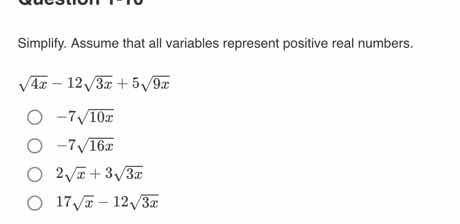
simplify. assume that all variables represent positive real numbers. \\(\sqrt{4x} - 12\sqrt{3x} + 5\sqrt{9x}\\) \\(\bigcirc\\) \\(-7\sqrt{10x}\\) \\(\bigcirc\\) \\(-7\sqrt{16x}\\) \\(\bigcirc\\) \\(2\sqrt{x} + 3\sqrt{3x}\\) \\(\bigcirc\\) \\(17\sqrt{x} - 12\sqrt{3x}\\)
Step1: Simplify each radical term
First, simplify \(\sqrt{4x}\) and \(5\sqrt{9x}\). We know that \(\sqrt{ab}=\sqrt{a}\cdot\sqrt{b}\) (for \(a,b\geq0\)). So, \(\sqrt{4x}=\sqrt{4}\cdot\sqrt{x} = 2\sqrt{x}\) and \(5\sqrt{9x}=5\cdot\sqrt{9}\cdot\sqrt{x}=5\cdot3\cdot\sqrt{x}=15\sqrt{x}\). The term \(- 12\sqrt{3x}\) remains as it is since it cannot be simplified further with the other terms (the radicand \(3x\) is different from \(x\) in the other simplified terms).
Step2: Combine like - radical terms
Now, combine the terms with \(\sqrt{x}\). We have \(2\sqrt{x}+15\sqrt{x}-12\sqrt{3x}\). Combining \(2\sqrt{x}\) and \(15\sqrt{x}\) (using the rule \(a\sqrt{c}+b\sqrt{c}=(a + b)\sqrt{c}\) for \(c\geq0\)), we get \((2 + 15)\sqrt{x}-12\sqrt{3x}=17\sqrt{x}-12\sqrt{3x}\).

Snap & solve any problem in the app
Get step-by-step solutions on Sovi AI
Photo-based solutions with guided steps
Explore more problems and detailed explanations
\(17\sqrt{x}-12\sqrt{3x}\) (which corresponds to the last option: \(17\sqrt{x}-12\sqrt{3x}\))