QUESTION IMAGE
Question
select the correct answer.
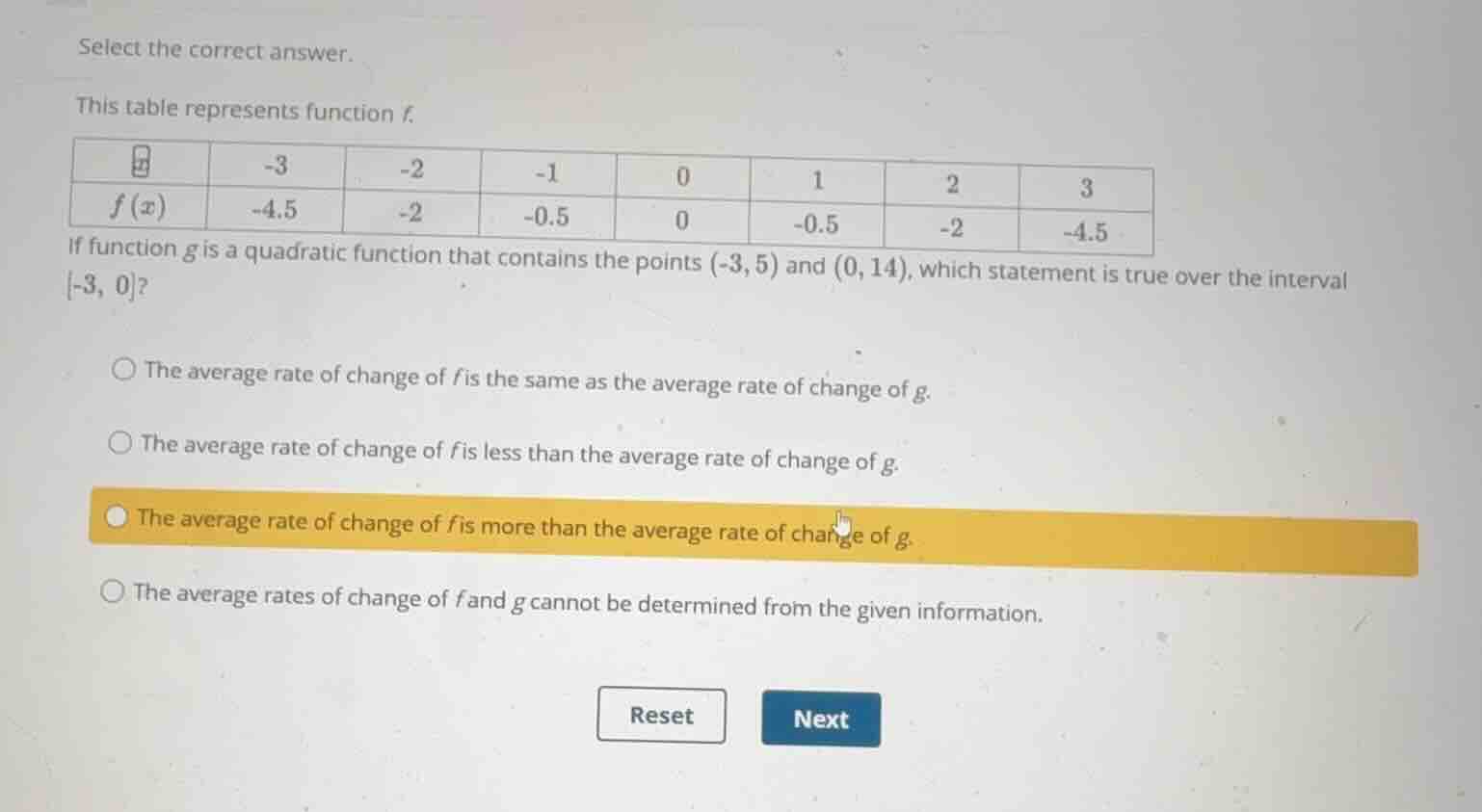
this table represents function (f).
\
$$\begin{array}{|c|c|c|c|c|c|c|c|}
\\hline
x & -3 & -2 & -1 & 0 & 1 & 2 & 3 \\\\
\\hline
f(x) & -4.5 & -2 & -0.5 & 0 & -0.5 & -2 & -4.5 \\\\
\\hline
\\end{array}$$
if function (g) is a quadratic function that contains the points ((-3, 5)) and ((0, 14)), which statement is true over the interval (-3, 0)?
- the average rate of change of (f) is the same as the average rate of change of (g).
- the average rate of change of (f) is less than the average rate of change of (g).
- the average rate of change of (f) is more than the average rate of change of (g).
- the average rates of change of (f) and (g) cannot be determined from the given information.
Calculate the average rate of change of \(f\) over \([-3, 0]\)
$$
LATEXBLOCK0
$$
Calculate the average rate of change of \(g\) over \([-3, 0]\)
$$
LATEXBLOCK1
$$
Compare the average rates of change
$$
LATEXBLOCK2
$$

Snap & solve any problem in the app
Get step-by-step solutions on Sovi AI
Photo-based solutions with guided steps
Explore more problems and detailed explanations
- The average rate of change of \(f\) is the same as the average rate of change of \(g\).
- The average rate of change of \(f\) is less than the average rate of change of \(g\). (Correct answer)
- The average rate of change of \(f\) is more than the average rate of change of \(g\).
- The average rates of change of \(f\) and \(g\) cannot be determined from the given information.