QUESTION IMAGE
Question
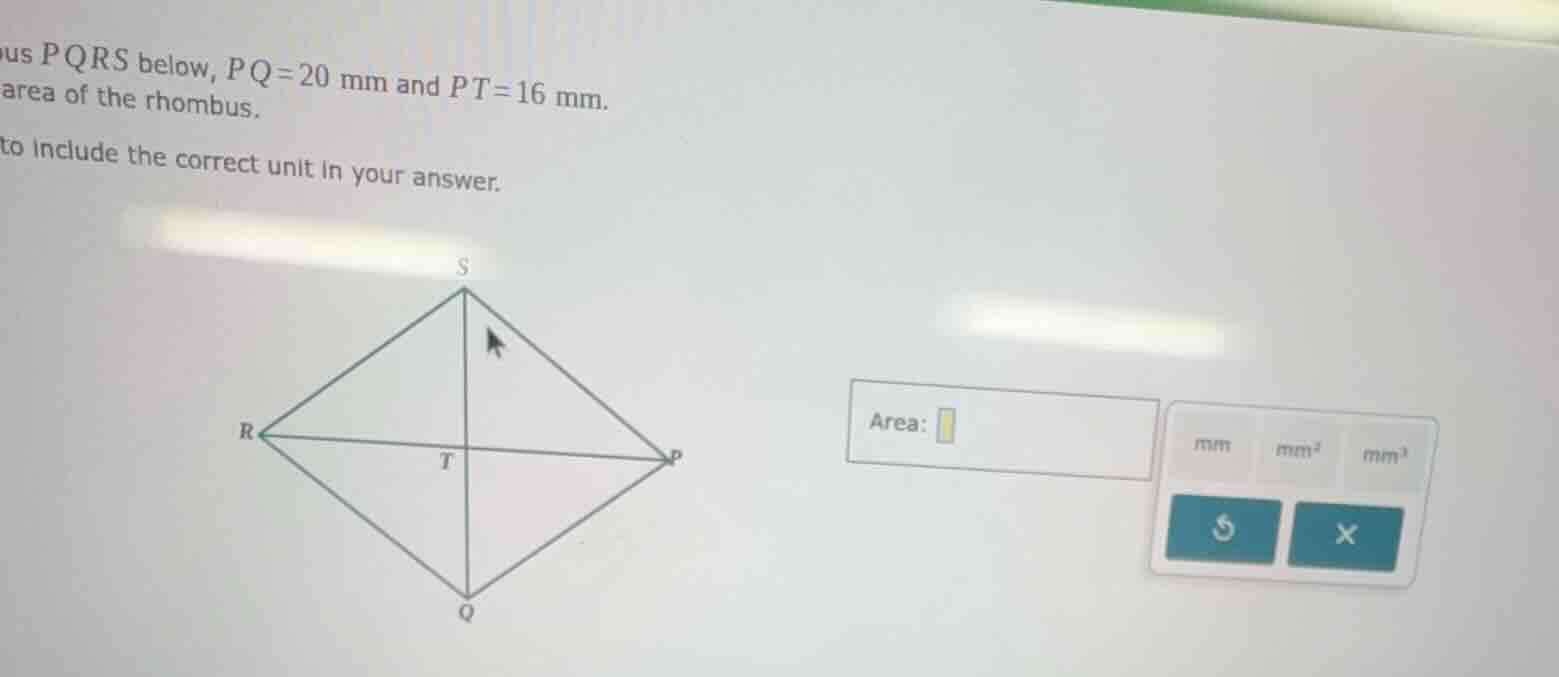
in the rhombus pqrs below, pq = 20 mm and pt = 16 mm.
find the area of the rhombus.
be sure to include the correct unit in your answer.
Identify given values and properties
We are given a rhombus \(PQRS\) with:
- Side length \(PQ = 20\text{ mm}\)
- Half-diagonal segment \(PT = 16\text{ mm}\)
- Diagonals \(PR\) and \(QS\) intersect perpendicularly at point \(T\).
Calculate the other half-diagonal segment
Since the diagonals of a rhombus are perpendicular, triangle \(\triangle PTQ\) is a right-angled triangle at \(T\).
Using the Pythagorean theorem:
$$
PT^2 + QT^2 = PQ^2
$$
$$
16^2 + QT^2 = 20^2
$$
$$
256 + QT^2 = 400
$$
$$
QT^2 = 144 \implies QT = 12\text{ mm}
$$
Determine the full lengths of the diagonals
The diagonals of a rhombus bisect each other:
- Diagonal \(d_1 = PR = 2 \times PT = 2 \times 16 = 32\text{ mm}\)
- Diagonal \(d_2 = QS = 2 \times QT = 2 \times 12 = 24\text{ mm}\)
Calculate the area of the rhombus
The formula for the area of a rhombus is:
$$
\text{Area} = \frac{1}{2} \times d_1 \times d_2
$$
$$
\text{Area} = \frac{1}{2} \times 32 \times 24 = 16 \times 24 = 384\text{ mm}^2
$$

Snap & solve any problem in the app
Get step-by-step solutions on Sovi AI
Photo-based solutions with guided steps
Explore more problems and detailed explanations
In the rhombus \(PQRS\) below, \(PQ = 20\text{ mm}\) and \(PT = 16\text{ mm}\).
Find the area of the rhombus.
Area: <blank>\(384\text{ mm}^2\)</blank>