QUESTION IMAGE
Question
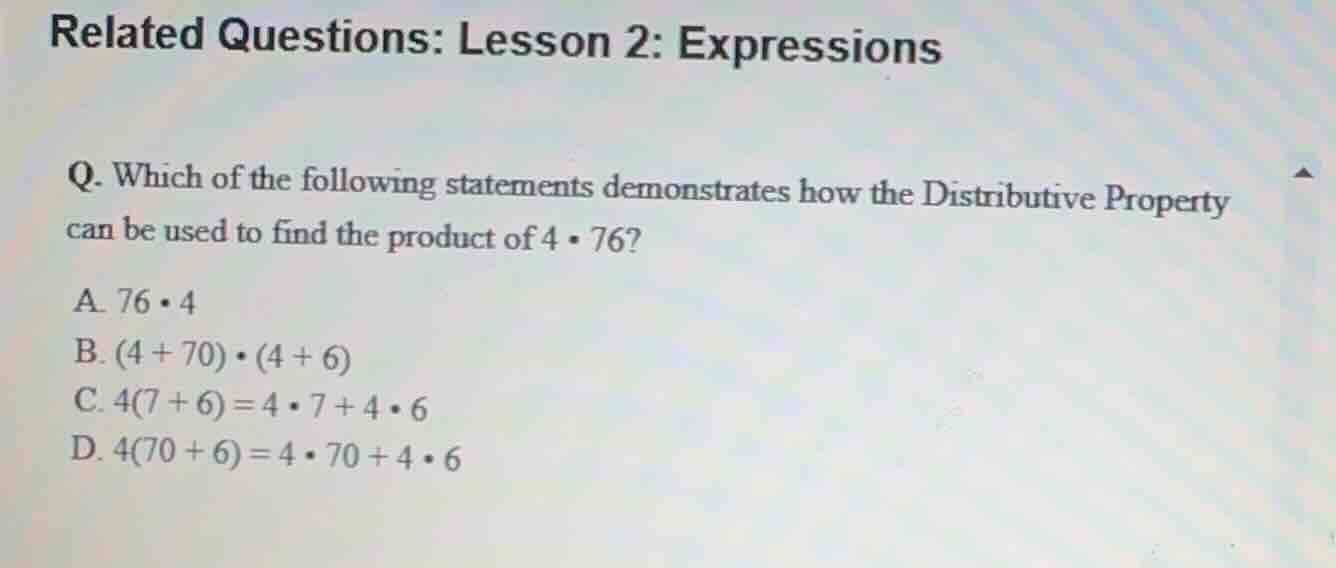
related questions: lesson 2: expressions
q. which of the following statements demonstrates how the distributive property can be used to find the product of \\(4 \cdot 76\\)?
a. \\(76 \cdot 4\\)
b. \\((4 + 70) \cdot (4 + 6)\\)
c. \\(4(7 + 6) = 4 \cdot 7 + 4 \cdot 6\\)
d. \\(4(70 + 6) = 4 \cdot 70 + 4 \cdot 6\\)
<pre_analysis>
{
"quality": "clear",
"question_count": 1,
"skills_matched": [
"step_cot",
"multiple_choice_formatter",
"explain_then_answer",
"tutor"
],
"needs_drawing": false,
"concepts_used": [],
"new_concepts": [
"Distributive Property",
"Numerical Expressions"
],
"current_concepts": [
"Distributive Property",
"Numerical Expressions"
]
}
</pre_analysis>
<reasoning>
Analyze the given product
We need to find the product \(4 \cdot 76\). To use the distributive property, we first decompose one of the factors into a sum of its place values. The number \(76\) can be written as \(70 + 6\).
Apply the distributive property
The distributive property states that \(a(b + c) = a \cdot b + a \cdot c\). Substituting \(a = 4\), \(b = 70\), and \(c = 6\), we get:
\[
4(70 + 6) = 4 \cdot 70 + 4 \cdot 6
\]
Evaluate the given options
- Option A shows \(76 \cdot 4\), which demonstrates the commutative property of multiplication.
- Option B shows \((4 + 70) \cdot (4 + 6)\), which does not equal \(4 \cdot 76\).
- Option C shows \(4(7 + 6) = 4 \cdot 7 + 4 \cdot 6\), which represents \(4 \cdot 13\), not \(4 \cdot 76\).
- Option D shows \(4(70 + 6) = 4 \cdot 70 + 4 \cdot 6\), which correctly represents \(4 \cdot 76\) using the distributive property.
</reasoning>
<answer>
<mcq-option>(A) \(76 \cdot 4\)</mcq-option>
<mcq-option>(B) \((4 + 70) \cdot (4 + 6)\)</mcq-option>
<mcq-option>(C) \(4(7 + 6) = 4 \cdot 7 + 4 \cdot 6\)</mcq-option>
<mcq-correct>(D) \(4(70 + 6) = 4 \cdot 70 + 4 \cdot 6\)</mcq-correct>
</answer>
<post_analysis>
{
"subject": "Mathematics",
"question_type": "Multiple Choice",
"knowledge_point": [
"Mathematics",
"Algebra",
"Distributive Property"
]
}
</post_analysis>
Snap & solve any problem in the app
Get step-by-step solutions on Sovi AI
Photo-based solutions with guided steps
Explore more problems and detailed explanations
<pre_analysis>
{
"quality": "clear",
"question_count": 1,
"skills_matched": [
"step_cot",
"multiple_choice_formatter",
"explain_then_answer",
"tutor"
],
"needs_drawing": false,
"concepts_used": [],
"new_concepts": [
"Distributive Property",
"Numerical Expressions"
],
"current_concepts": [
"Distributive Property",
"Numerical Expressions"
]
}
</pre_analysis>
<reasoning>
Analyze the given product
We need to find the product \(4 \cdot 76\). To use the distributive property, we first decompose one of the factors into a sum of its place values. The number \(76\) can be written as \(70 + 6\).
Apply the distributive property
The distributive property states that \(a(b + c) = a \cdot b + a \cdot c\). Substituting \(a = 4\), \(b = 70\), and \(c = 6\), we get:
\[
4(70 + 6) = 4 \cdot 70 + 4 \cdot 6
\]
Evaluate the given options
- Option A shows \(76 \cdot 4\), which demonstrates the commutative property of multiplication.
- Option B shows \((4 + 70) \cdot (4 + 6)\), which does not equal \(4 \cdot 76\).
- Option C shows \(4(7 + 6) = 4 \cdot 7 + 4 \cdot 6\), which represents \(4 \cdot 13\), not \(4 \cdot 76\).
- Option D shows \(4(70 + 6) = 4 \cdot 70 + 4 \cdot 6\), which correctly represents \(4 \cdot 76\) using the distributive property.
</reasoning>
<answer>
<mcq-option>(A) \(76 \cdot 4\)</mcq-option>
<mcq-option>(B) \((4 + 70) \cdot (4 + 6)\)</mcq-option>
<mcq-option>(C) \(4(7 + 6) = 4 \cdot 7 + 4 \cdot 6\)</mcq-option>
<mcq-correct>(D) \(4(70 + 6) = 4 \cdot 70 + 4 \cdot 6\)</mcq-correct>
</answer>
<post_analysis>
{
"subject": "Mathematics",
"question_type": "Multiple Choice",
"knowledge_point": [
"Mathematics",
"Algebra",
"Distributive Property"
]
}
</post_analysis>