QUESTION IMAGE
Question
read the passage.
word creators
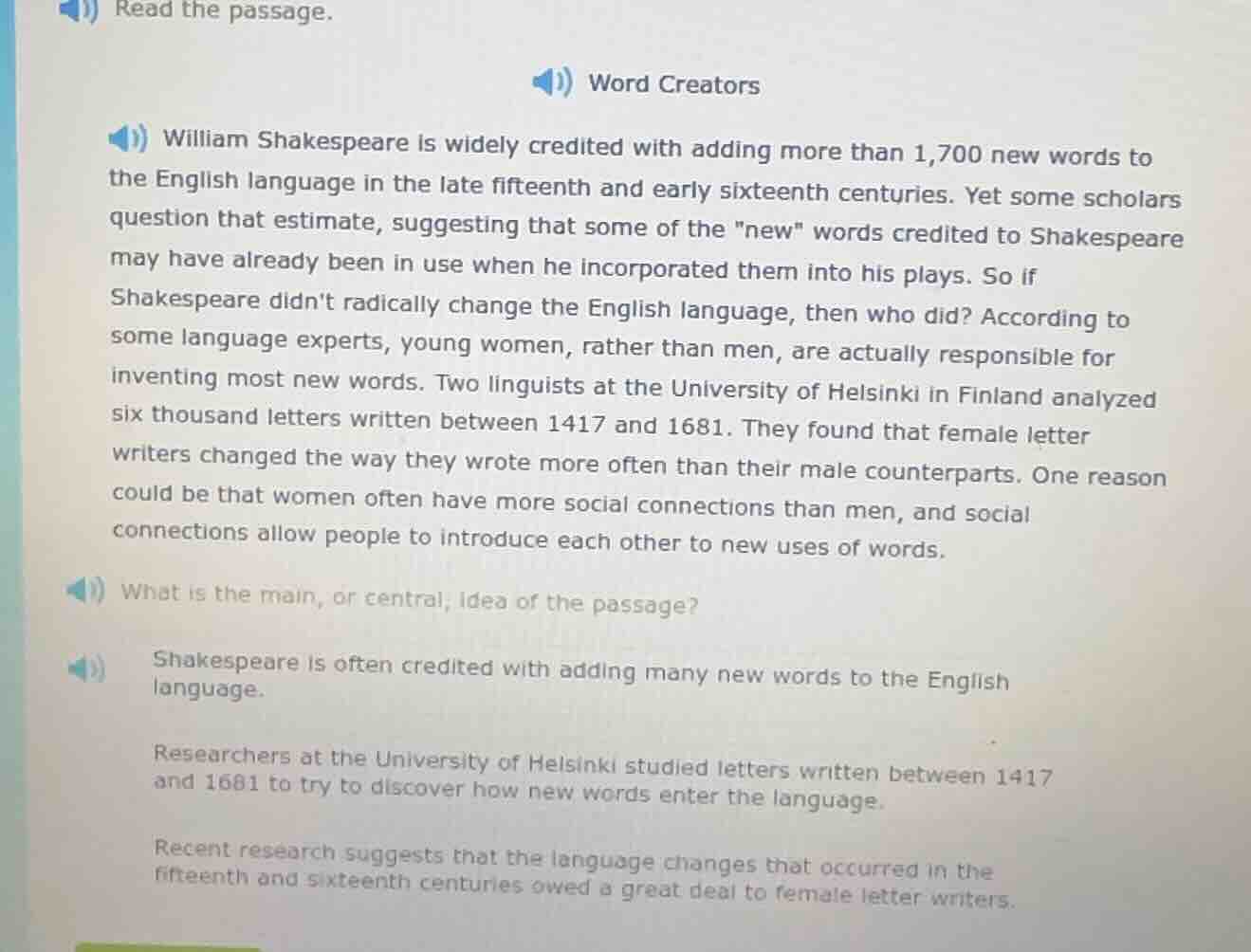
william shakespeare is widely credited with adding more than 1,700 new words to the english language in the late fifteenth and early sixteenth centuries. yet some scholars question that estimate, suggesting that some of the
ew\ words credited to shakespeare may have already been in use when he incorporated them into his plays. so if shakespeare didnt radically change the english language, then who did? according to some language experts, young women, rather than men, are actually responsible for inventing most new words. two linguists at the university of helsinki in finland analyzed six thousand letters written between 1417 and 1681. they found that female letter writers changed the way they wrote more often than their male counterparts. one reason could be that women often have more social connections than men, and social connections allow people to introduce each other to new uses of words.
what is the main, or central, idea of the passage?
shakespeare is often credited with adding many new words to the english language.
researchers at the university of helsinki studied letters written between 1417 and 1681 to try to discover how new words enter the language.
recent research suggests that the language changes that occurred in the fifteenth and sixteenth centuries owed a great deal to female letter writers.
- Analyze the first option: It only focuses on Shakespeare's credit for new words, but the passage also discusses other factors (young women's role) and questions Shakespeare's sole credit, so it's not the main idea.
- Analyze the second option: The Helsinki researchers' study is a supporting detail to show women's role in language change, not the main idea.
- Analyze the third option: The passage questions Shakespeare's role, then presents research showing young women (female letter writers) were responsible for much of the language change in the 15th - 16th centuries, which matches this option.

Snap & solve any problem in the app
Get step-by-step solutions on Sovi AI
Photo-based solutions with guided steps
Explore more problems and detailed explanations
Recent research suggests that the language changes that occurred in the fifteenth and sixteenth centuries owed a great deal to female letter writers.