QUESTION IMAGE
Question
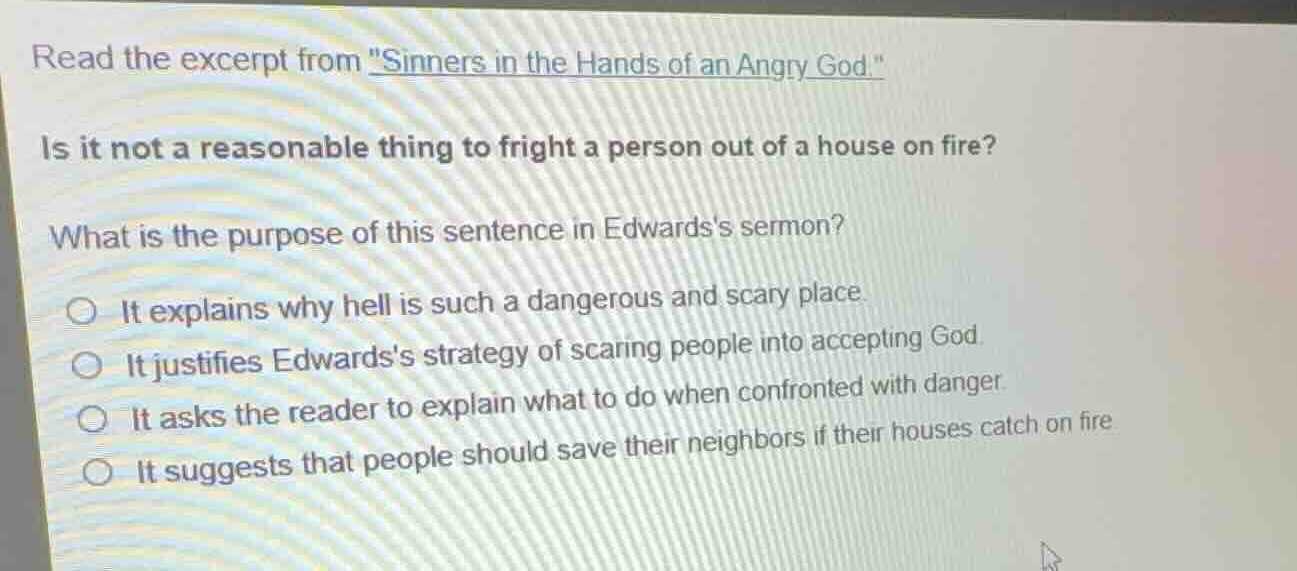
read the excerpt from \sinners in the hands of an angry god.\
is it not a reasonable thing to fright a person out of a house on fire?
what is the purpose of this sentence in edwardss sermon?
it explains why hell is such a dangerous and scary place.
it justifies edwardss strategy of scaring people into accepting god.
it asks the reader to explain what to do when confronted with danger.
it suggests that people should save their neighbors if their houses catch on fire.
<pre_analysis>
{
"quality": "clear",
"question_count": 1,
"skills_matched": [
"direct_cot",
"multiple_choice_formatter",
"explain_then_answer",
"tutor"
],
"needs_drawing": false,
"concepts_used": [
"Textual Analysis"
],
"new_concepts": [
"Rhetorical Analysis",
"Authorial Purpose"
],
"current_concepts": [
"Textual Analysis",
"Rhetorical Analysis",
"Authorial Purpose"
]
}
</pre_analysis>
<reasoning>
Analyze the rhetorical question
The sentence "Is it not a reasonable thing to fright a person out of a house on fire?" uses an analogy. Frightening someone to save them from a burning house is universally seen as a helpful, rational act.
Connect analogy to sermon purpose
Using Textual Analysis, we connect the burning house to the threat of hell. Edwards uses this comparison to defend his intense, fear-based preaching style.
Evaluate the options
- Option 1 focuses only on describing hell, which is incorrect.
- Option 2 correctly identifies that the analogy defends and justifies his strategy of using fear to save souls.
- Option 3 and 4 take the literal meaning of the analogy rather than its symbolic, rhetorical purpose.
</reasoning>
<answer>
<mcq-option>It explains why hell is such a dangerous and scary place.</mcq-option>
<mcq-correct>It justifies Edwards's strategy of scaring people into accepting God.</mcq-correct>
<mcq-option>It asks the reader to explain what to do when confronted with danger.</mcq-option>
<mcq-option>It suggests that people should save their neighbors if their houses catch on fire.</mcq-option>
</answer>
<post_analysis>
{
"subject": "Others",
"question_type": "Multiple Choice",
"knowledge_point": [
"Others",
"English Language Arts",
"Rhetorical Devices and Author's Purpose"
]
}
</post_analysis>
Snap & solve any problem in the app
Get step-by-step solutions on Sovi AI
Photo-based solutions with guided steps
Explore more problems and detailed explanations
<pre_analysis>
{
"quality": "clear",
"question_count": 1,
"skills_matched": [
"direct_cot",
"multiple_choice_formatter",
"explain_then_answer",
"tutor"
],
"needs_drawing": false,
"concepts_used": [
"Textual Analysis"
],
"new_concepts": [
"Rhetorical Analysis",
"Authorial Purpose"
],
"current_concepts": [
"Textual Analysis",
"Rhetorical Analysis",
"Authorial Purpose"
]
}
</pre_analysis>
<reasoning>
Analyze the rhetorical question
The sentence "Is it not a reasonable thing to fright a person out of a house on fire?" uses an analogy. Frightening someone to save them from a burning house is universally seen as a helpful, rational act.
Connect analogy to sermon purpose
Using Textual Analysis, we connect the burning house to the threat of hell. Edwards uses this comparison to defend his intense, fear-based preaching style.
Evaluate the options
- Option 1 focuses only on describing hell, which is incorrect.
- Option 2 correctly identifies that the analogy defends and justifies his strategy of using fear to save souls.
- Option 3 and 4 take the literal meaning of the analogy rather than its symbolic, rhetorical purpose.
</reasoning>
<answer>
<mcq-option>It explains why hell is such a dangerous and scary place.</mcq-option>
<mcq-correct>It justifies Edwards's strategy of scaring people into accepting God.</mcq-correct>
<mcq-option>It asks the reader to explain what to do when confronted with danger.</mcq-option>
<mcq-option>It suggests that people should save their neighbors if their houses catch on fire.</mcq-option>
</answer>
<post_analysis>
{
"subject": "Others",
"question_type": "Multiple Choice",
"knowledge_point": [
"Others",
"English Language Arts",
"Rhetorical Devices and Author's Purpose"
]
}
</post_analysis>