Sovi.AI - AI Math Tutor

Scan to solve math questions

QUESTION IMAGE

question 9 which process allows water to travel from its roots in the g…

Question

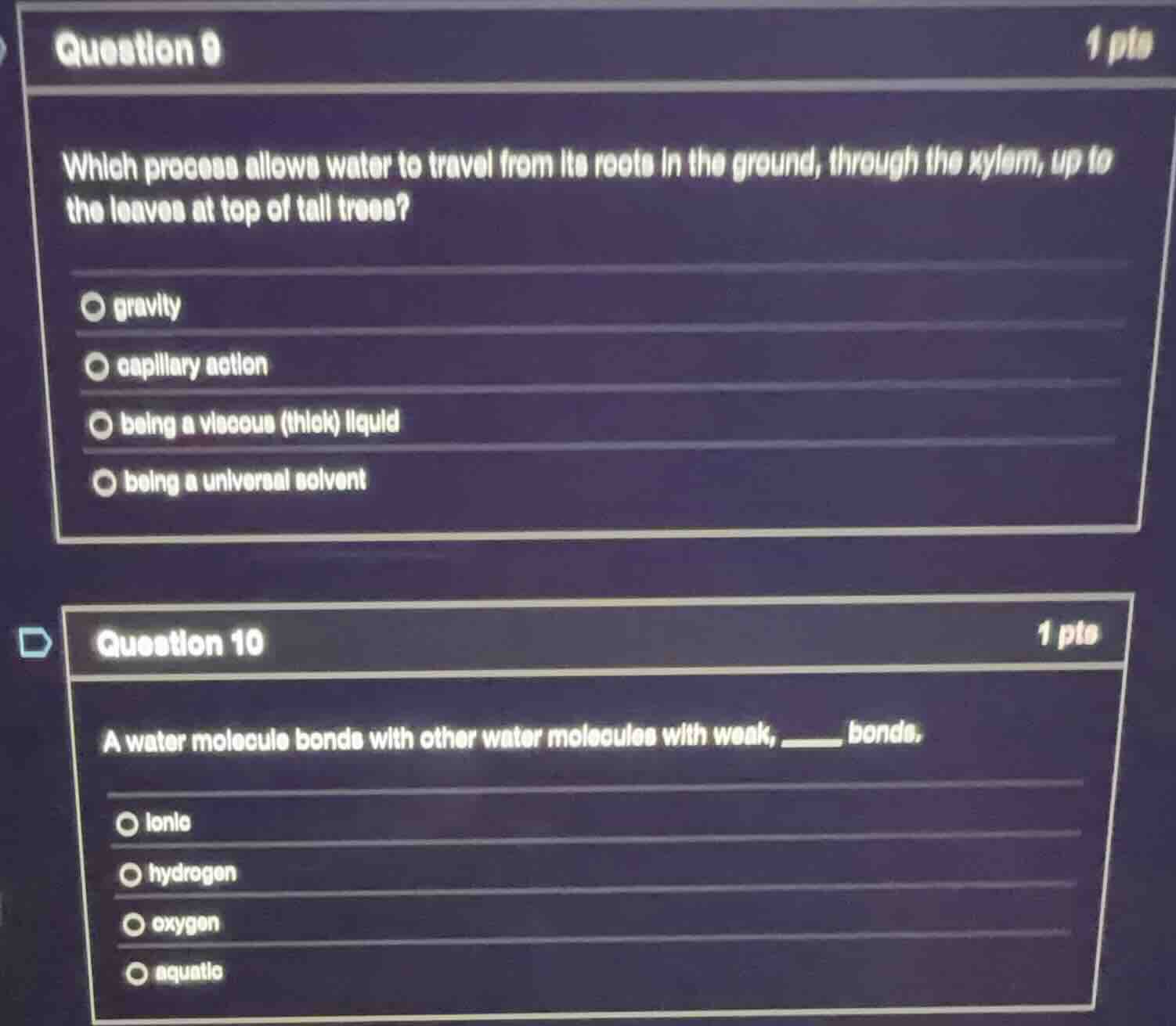
question 9
which process allows water to travel from its roots in the ground, through the xylem, up to the leaves at top of tall trees?

  • gravity
  • capillary action
  • being a viscous (thick) liquid
  • being a universal solvent

question 10
a water molecule bonds with other water molecules with weak, _____ bonds.

  • ionic
  • hydrogen
  • oxygen
  • aquatic

Explanation:

Response

<pre_analysis>
{
"quality": "clear",
"question_count": 2,
"skills_matched": [
"direct_cot",
"multiple_choice_formatter",
"explain_then_answer",
"tutor"
],
"needs_drawing": false,
"concepts_used": [
"Adhesion and Cohesion",
"Hydrogen Bonding"
],
"new_concepts": [],
"current_concepts": [
"Adhesion and Cohesion",
"Hydrogen Bonding",
"Properties of Water"
]
}
</pre_analysis>

<reasoning>

Analyze water transport in plants

To transport water upward against gravity through xylem vessels, plants rely on Adhesion and Cohesion. These properties enable capillary action, where water molecules cling to each other and to the cell walls of the xylem.

Evaluate Question 9 options

  • Gravity pulls water downward, opposing upward transport.
  • Capillary action, driven by cohesion and adhesion, pulls water upward.
  • Viscosity and universal solvent properties do not drive this upward movement.

Analyze intermolecular bonding in water

Water molecules interact with neighboring water molecules via attractive forces between the partial positive charge of hydrogen and the partial negative charge of oxygen. This interaction is known as Hydrogen Bonding.

Evaluate Question 10 options

  • Ionic bonds occur between fully charged ions, not neutral water molecules.
  • Hydrogen bonds are the weak intermolecular attractions between water molecules.
  • Oxygen and aquatic are not types of chemical bonds.

</reasoning>

<answer>

Question 9

<mcq-option>(A) gravity</mcq-option>
<mcq-correct>(B) capillary action</mcq-correct>
<mcq-option>(C) being a viscous (thick) liquid</mcq-option>
<mcq-option>(D) being a universal solvent</mcq-option>

Question 10

<mcq-option>(A) ionic</mcq-option>
<mcq-correct>(B) hydrogen</mcq-correct>
<mcq-option>(C) oxygen</mcq-option>
<mcq-option>(D) aquatic</mcq-option>
</answer>

<post_analysis>
{
"subject": "Natural Science",
"question_type": "Multiple Choice",
"knowledge_point": [
"Natural Science",
"Biology",
"Properties of Water"
]
}
</post_analysis>

Answer:

<pre_analysis>
{
"quality": "clear",
"question_count": 2,
"skills_matched": [
"direct_cot",
"multiple_choice_formatter",
"explain_then_answer",
"tutor"
],
"needs_drawing": false,
"concepts_used": [
"Adhesion and Cohesion",
"Hydrogen Bonding"
],
"new_concepts": [],
"current_concepts": [
"Adhesion and Cohesion",
"Hydrogen Bonding",
"Properties of Water"
]
}
</pre_analysis>

<reasoning>

Analyze water transport in plants

To transport water upward against gravity through xylem vessels, plants rely on Adhesion and Cohesion. These properties enable capillary action, where water molecules cling to each other and to the cell walls of the xylem.

Evaluate Question 9 options

  • Gravity pulls water downward, opposing upward transport.
  • Capillary action, driven by cohesion and adhesion, pulls water upward.
  • Viscosity and universal solvent properties do not drive this upward movement.

Analyze intermolecular bonding in water

Water molecules interact with neighboring water molecules via attractive forces between the partial positive charge of hydrogen and the partial negative charge of oxygen. This interaction is known as Hydrogen Bonding.

Evaluate Question 10 options

  • Ionic bonds occur between fully charged ions, not neutral water molecules.
  • Hydrogen bonds are the weak intermolecular attractions between water molecules.
  • Oxygen and aquatic are not types of chemical bonds.

</reasoning>

<answer>

Question 9

<mcq-option>(A) gravity</mcq-option>
<mcq-correct>(B) capillary action</mcq-correct>
<mcq-option>(C) being a viscous (thick) liquid</mcq-option>
<mcq-option>(D) being a universal solvent</mcq-option>

Question 10

<mcq-option>(A) ionic</mcq-option>
<mcq-correct>(B) hydrogen</mcq-correct>
<mcq-option>(C) oxygen</mcq-option>
<mcq-option>(D) aquatic</mcq-option>
</answer>

<post_analysis>
{
"subject": "Natural Science",
"question_type": "Multiple Choice",
"knowledge_point": [
"Natural Science",
"Biology",
"Properties of Water"
]
}
</post_analysis>