QUESTION IMAGE
Question
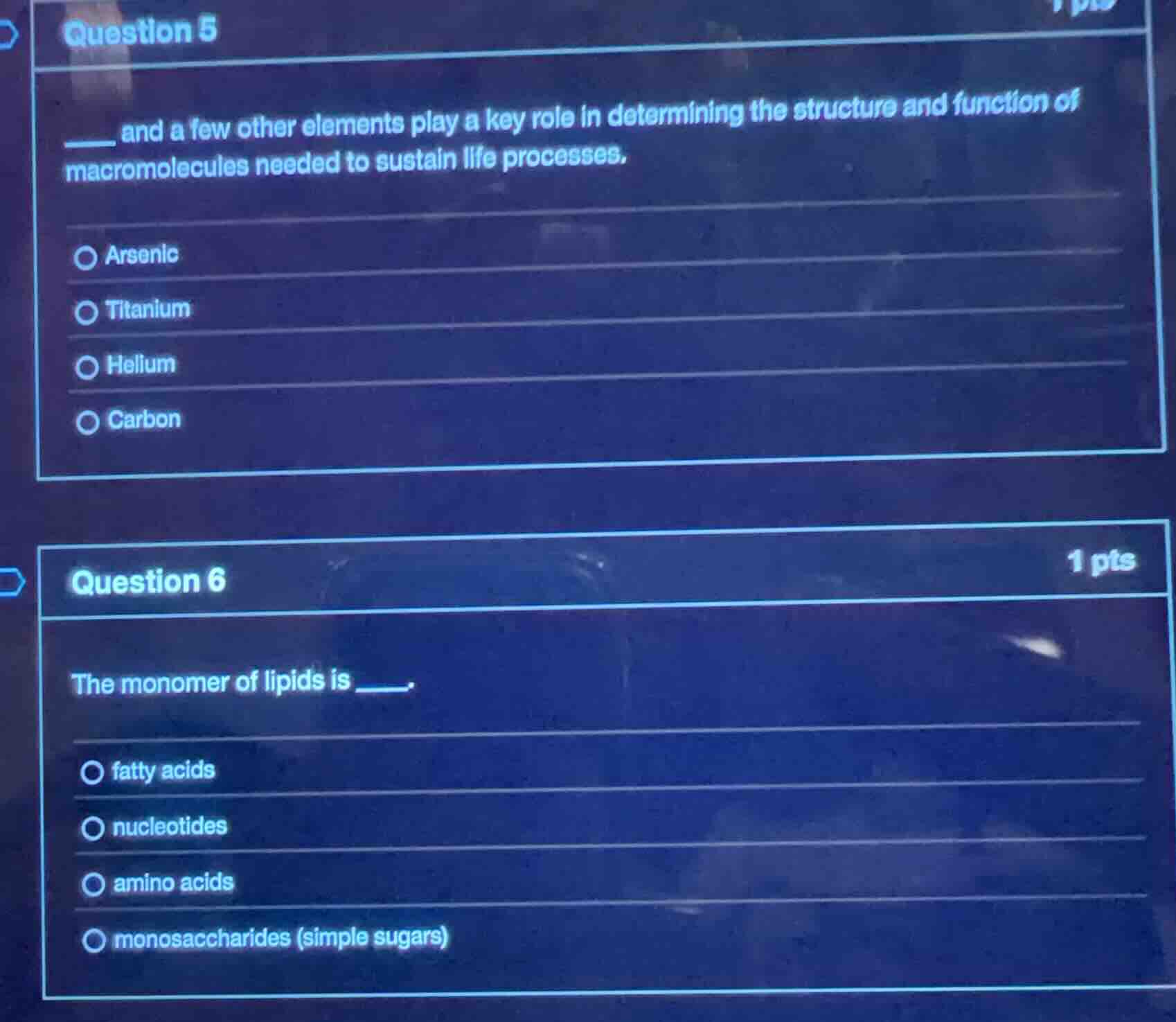
question 5
___ and a few other elements play a key role in determining the structure and function of macromolecules needed to sustain life processes.
arsenic
titanium
helium
carbon
question 6
the monomer of lipids is ___.
fatty acids
nucleotides
amino acids
monosaccharides (simple sugars)
<pre_analysis>
{
"quality": "clear",
"question_count": 2,
"skills_matched": [
"direct_cot",
"multiple_choice_formatter",
"explain_then_answer",
"quick"
],
"needs_drawing": false,
"concepts_used": [
"CHNOPS Elements",
"Biomolecules"
],
"new_concepts": [],
"current_concepts": [
"CHNOPS Elements",
"Biomolecules",
"Organic Molecules",
"Lipid Functions"
]
}
</pre_analysis>
<reasoning>
Analyze Question 5
The question asks which element, along with a few others, plays a key role in determining the structure and function of macromolecules needed to sustain life. Carbon is the fundamental backbone of all organic macromolecules (carbohydrates, lipids, proteins, and nucleic acids) due to its ability to form four stable covalent bonds.
Analyze Question 6
The question asks for the monomer of lipids. Lipids are typically composed of glycerol and fatty acids. Among the choices provided, fatty acids represent the building blocks (monomers/subunits) of lipids. Nucleotides are monomers of nucleic acids, amino acids are monomers of proteins, and monosaccharides are monomers of carbohydrates.
</reasoning>
<answer>
Question 5
<mcq-option>Arsenic</mcq-option>
<mcq-option>Titanium</mcq-option>
<mcq-option>Helium</mcq-option>
<mcq-correct>Carbon</mcq-correct>
Question 6
<mcq-correct>fatty acids</mcq-correct>
<mcq-option>nucleotides</mcq-option>
<mcq-option>amino acids</mcq-option>
<mcq-option>monosaccharides (simple sugars)</mcq-option>
</answer>
<post_analysis>
{
"subject": "Natural Science",
"question_type": "Multiple Choice",
"knowledge_point": [
"Natural Science",
"Biology",
"Biomolecules"
]
}
</post_analysis>
Snap & solve any problem in the app
Get step-by-step solutions on Sovi AI
Photo-based solutions with guided steps
Explore more problems and detailed explanations
<pre_analysis>
{
"quality": "clear",
"question_count": 2,
"skills_matched": [
"direct_cot",
"multiple_choice_formatter",
"explain_then_answer",
"quick"
],
"needs_drawing": false,
"concepts_used": [
"CHNOPS Elements",
"Biomolecules"
],
"new_concepts": [],
"current_concepts": [
"CHNOPS Elements",
"Biomolecules",
"Organic Molecules",
"Lipid Functions"
]
}
</pre_analysis>
<reasoning>
Analyze Question 5
The question asks which element, along with a few others, plays a key role in determining the structure and function of macromolecules needed to sustain life. Carbon is the fundamental backbone of all organic macromolecules (carbohydrates, lipids, proteins, and nucleic acids) due to its ability to form four stable covalent bonds.
Analyze Question 6
The question asks for the monomer of lipids. Lipids are typically composed of glycerol and fatty acids. Among the choices provided, fatty acids represent the building blocks (monomers/subunits) of lipids. Nucleotides are monomers of nucleic acids, amino acids are monomers of proteins, and monosaccharides are monomers of carbohydrates.
</reasoning>
<answer>
Question 5
<mcq-option>Arsenic</mcq-option>
<mcq-option>Titanium</mcq-option>
<mcq-option>Helium</mcq-option>
<mcq-correct>Carbon</mcq-correct>
Question 6
<mcq-correct>fatty acids</mcq-correct>
<mcq-option>nucleotides</mcq-option>
<mcq-option>amino acids</mcq-option>
<mcq-option>monosaccharides (simple sugars)</mcq-option>
</answer>
<post_analysis>
{
"subject": "Natural Science",
"question_type": "Multiple Choice",
"knowledge_point": [
"Natural Science",
"Biology",
"Biomolecules"
]
}
</post_analysis>