QUESTION IMAGE
Question
question 79
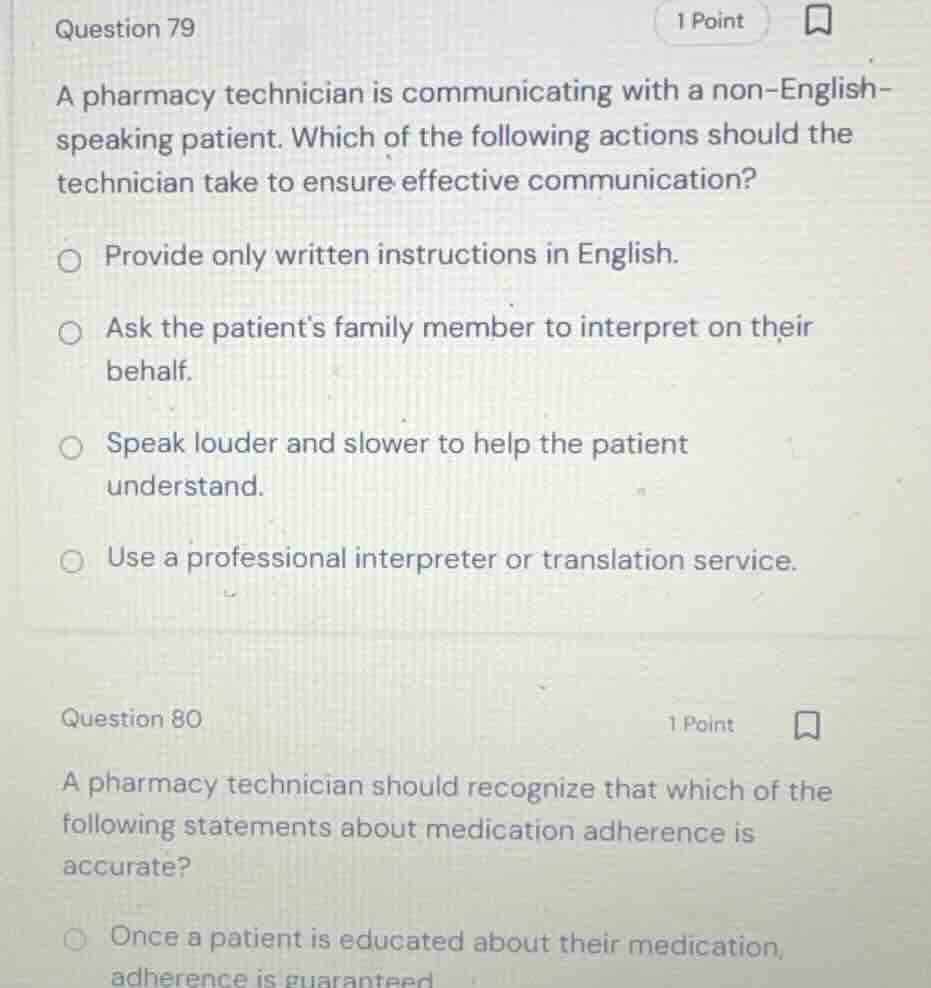
a pharmacy technician is communicating with a non-english-speaking patient. which of the following actions should the technician take to ensure effective communication?
provide only written instructions in english.
ask the patients family member to interpret on their behalf.
speak louder and slower to help the patient understand.
use a professional interpreter or translation service.
Analyze communication with non-English-speaking patients
The first question asks for the best action to ensure effective communication with a non-English-speaking patient.
- Providing only written instructions in English is ineffective because the patient does not speak or read English.
- Relying on family members to interpret can lead to medical errors, breaches of confidentiality, or misinterpretations of complex clinical instructions.
- Speaking louder does not help a patient understand a language they do not speak.
- Using a professional interpreter or translation service is the standard of care to ensure accurate, confidential, and effective communication. This directly applies the Pharmacy Communication concept.
Evaluate statements about medication adherence
The second question asks for an accurate statement regarding medication adherence.
- Education alone does not guarantee adherence, as many factors (cost, side effects, forgetfulness) influence patient behavior. This relates to the Medication Adherence concept.
- Although the full options for Question 80 are cut off, we can fully resolve Question 79 based on standard pharmacy practice and communication guidelines.

Snap & solve any problem in the app
Get step-by-step solutions on Sovi AI
Photo-based solutions with guided steps
Explore more problems and detailed explanations
Question 79
- (A) Provide only written instructions in English.
- (B) Ask the patient's family member to interpret on their behalf.
- (C) Speak louder and slower to help the patient understand.
- (D) Use a professional interpreter or translation service. (Correct answer)