QUESTION IMAGE
Question
question 1 (38)
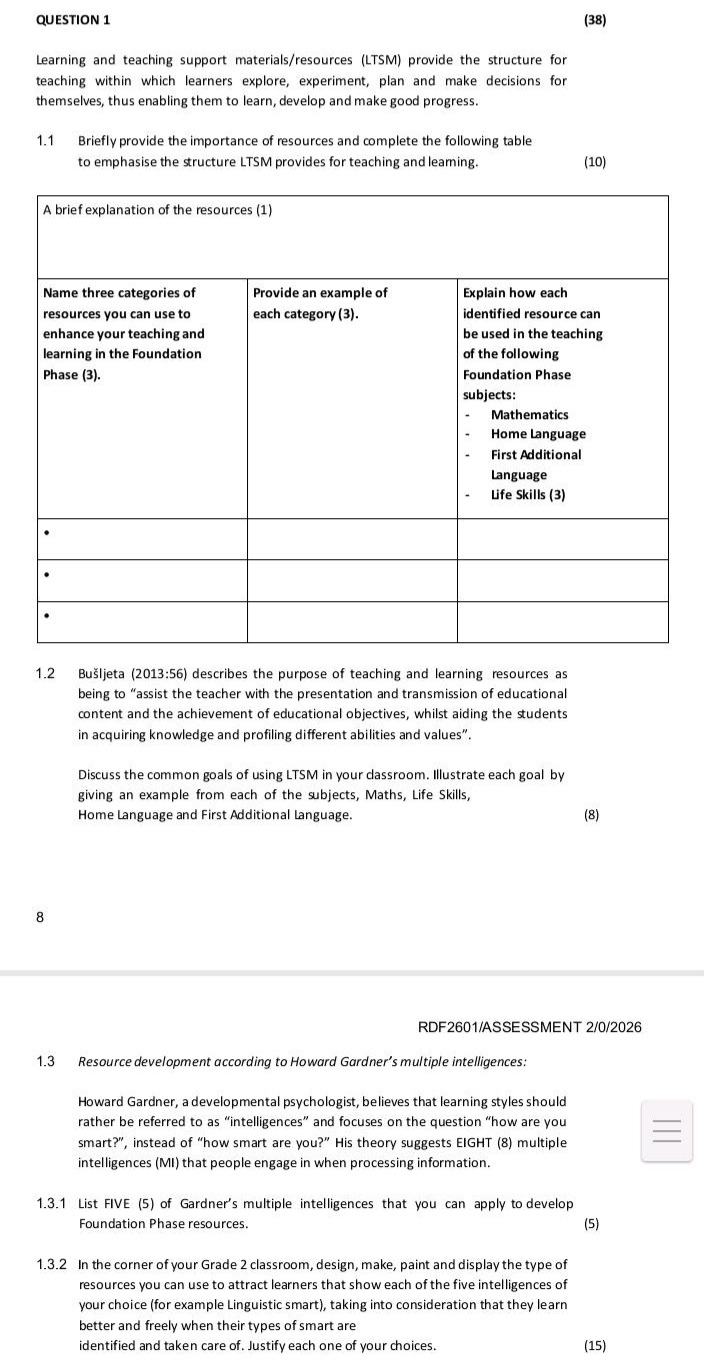
learning and teaching support materials/resources (ltsm) provide the structure for teaching within which learners explore, experiment, plan and make decisions for themselves, thus enabling them to learn, develop and make good progress.
1.1 briefly provide the importance of resources and complete the following table to emphasise the structure ltsm provides for teaching and learning. (10)
| a brief explanation of the resources (1) | ||
|---|---|---|
| - | ||
| - | ||
| - |
1.2 bušljeta (2013:56) describes the purpose of teaching and learning resources as being to \assist the teacher with the presentation and transmission of educational content and the achievement of educational objectives, whilst aiding the students in acquiring knowledge and profiling different abilities and values\.
discuss the common goals of using ltsm in your classroom. illustrate each goal by giving an example from each of the subjects, maths, life skills, home language and first additional language. (8)
1.3 resource development according to howard gardners multiple intelligences:
howard gardner, a developmental psychologist, believes that learning styles should rather be referred to as \intelligences\ and focuses on the question \how are you smart?\, instead of \how smart are you?\ his theory suggests eight (8) multiple intelligences (mi) that people engage in when processing information.
1.3.1 list five (5) of gardners multiple intelligences that you can apply to develop foundation phase resources. (5)
1.3.2 in the corner of your grade 2 classroom, design, make, paint and display the type of resources you can use to attract learners that show each of the five intelligences of your choice (for example linguistic smart), taking into consideration that they learn better and freely when their types of smart are identified and taken care of. justify each one of your choices. (15)
The questions address the selection, categorization, and application of Learning and Teaching Support Materials (LTSM) within the Foundation Phase curriculum. The responses are grounded in educational theory, specifically utilizing Howard Gardner's Multiple Intelligences to design inclusive classroom environments. By aligning concrete, visual, auditory, and kinesthetic resources with specific subject areas (Mathematics, Languages, and Life Skills), teachers can accommodate diverse learning styles, thereby enhancing learner engagement and academic progress.

Snap & solve any problem in the app
Get step-by-step solutions on Sovi AI
Photo-based solutions with guided steps
Explore more problems and detailed explanations
1.1
A brief explanation of the resources:
Learning and teaching support materials (LTSM) are essential tools that make abstract concepts concrete, stimulate learners' senses, encourage active participation, and accommodate diverse learning styles to enhance understanding and retention.
| Name three categories of resources you can use to enhance your teaching and learning in the Foundation Phase (3). | Provide an example of each category (3). | Explain how each identified resource can be used in the teaching of the following Foundation Phase subjects: Mathematics, Home Language, First Additional Language, Life Skills (3). |
|---|---|---|
| • Visual Resources | Flashcards with pictures and words | Home Language / First Additional Language: Learners match picture flashcards with corresponding word cards to build vocabulary and phonics skills. |
| • Auditory/Kinesthetic Resources | Educational songs and movement games | Life Skills: Learners sing songs about healthy habits (e.g., washing hands) accompanied by physical actions to reinforce personal hygiene concepts. |
***
1.2
Common goals of using LTSM in the classroom:
- To make learning concrete and meaningful: LTSM helps bridge the gap between abstract concepts and real-world understanding.
- Example (Maths): Using 3D geometric shapes (like wooden blocks) to help learners identify faces, edges, and vertices physically.
- To stimulate interest and motivation: Engaging materials capture learners' attention and foster a positive attitude toward learning.
- Example (Life Skills): Using colorful puppets to role-play social scenarios, helping learners discuss emotions and conflict resolution.
- To support language acquisition and communication: Visual and textual aids provide context clues that facilitate vocabulary development.
- Example (Home Language): Using a big storybook with large illustrations to conduct shared reading, helping learners predict outcomes and learn new words.
- To facilitate independent learning and practice: Resources allow learners to experiment and practice skills at their own pace.
- Example (First Additional Language): Using simple matching puzzle cards (matching pictures to English words) in small groups to practice vocabulary independently.
***
1.3.1
Five of Gardner's multiple intelligences applicable to Foundation Phase resources:
- Linguistic intelligence (Word smart)
- Logical-Mathematical intelligence (Number/Reasoning smart)
- Spatial/Visual intelligence (Picture smart)
- Bodily-Kinesthetic intelligence (Body smart)
- Musical intelligence (Music smart)
***
1.3.2
Grade 2 Classroom Corner Resource Designs and Justifications:
- Linguistic Intelligence (Word Smart)
- Resource Design: A colorful "Storytelling Wall" featuring a felt board with movable felt characters, letters, and sight-word cards.
- Justification: This resource allows linguistic learners to physically manipulate words and characters to construct sentences and narrate stories, supporting their natural strength in reading, writing, and speaking.
- Logical-Mathematical Intelligence (Number Smart)
- Resource Design: A "Pattern and Sorting Station" containing painted wooden geometric blocks, abacuses, and laminated number-line tracks.
- Justification: It provides logical learners with hands-on opportunities to categorize, sequence, and solve numerical problems, which aligns with their need for order, patterns, and reasoning.
- Spatial/Visual Intelligence (Picture Smart)
- Resource Design: A "Visual Art and Map Easel" displaying brightly painted mind maps, color-coded charts, and drawing materials for illustrating concepts.
- Justification: Visual learners process information best through images and spatial layouts; this display helps them organize ideas visually and express their understanding through drawing and color.
- Bodily-Kinesthetic Intelligence (Body Smart)
- Resource Design: A "Tactile Action Bin" containing textured letters, playdough for sculpting numbers, and floor-mat games (like hopscotch with sight words).
- Justification: Kinesthetic learners require physical movement and tactile feedback to process information; interacting with these physical objects helps cement their learning through muscle memory.
- Musical Intelligence (Music Smart)
- Resource Design: A "Rhythm and Rhyme Box" containing simple homemade instruments (shakers, triangles) and laminated cards with phonics chants and mathematical songs.
- Justification: Musical learners easily grasp patterns, rhythms, and sounds; using instruments and rhythmic chants helps them memorize facts, phonics rules, and sequences through auditory patterns.