Sovi.AI - AI Math Tutor

Scan to solve math questions

QUESTION IMAGE

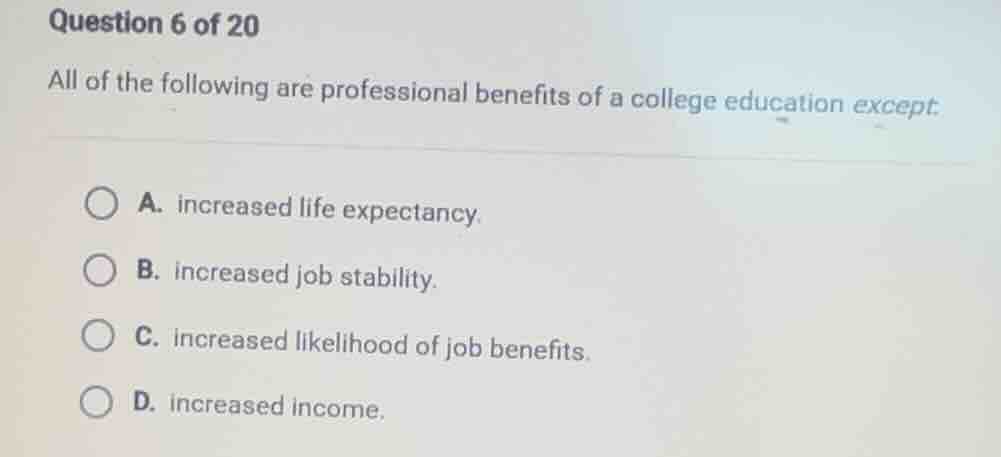
question 6 of 20 all of the following are professional benefits of a co…

Question

question 6 of 20

all of the following are professional benefits of a college education except:

a. increased life expectancy.
b. increased job stability.
c. increased likelihood of job benefits.
d. increased income.

Explanation:

Response

<pre_analysis>
{
"quality": "clear",
"question_count": 1,
"skills_matched": [
"direct_cot",
"multiple_choice_formatter",
"explain_then_answer",
"tutor",
"mastery_adaptive_brevity"
],
"needs_drawing": false,
"concepts_used": [
"Higher Education Economics"
],
"new_concepts": [],
"current_concepts": [
"Higher Education Economics"
]
}
</pre_analysis>

<reasoning>

Analyze the question prompt

The question asks to identify which option is NOT a professional benefit of a college education.

Evaluate the options

Using the Higher Education Economics knowledge point:

  • Option A: Increased life expectancy is a personal or health benefit, not a professional one.
  • Option B: Increased job stability is directly related to employment and career security.
  • Option C: Increased likelihood of job benefits (like health insurance or retirement plans) is a professional perk.
  • Option D: Increased income is a direct financial and professional return on career advancement.

Identify the correct choice

Since increased life expectancy is a personal health outcome rather than a professional or career-related benefit, Option A is the correct exception.
</reasoning>

<answer>
<mcq-correct>(A) increased life expectancy.</mcq-correct>
<mcq-option>(B) increased job stability.</mcq-option>
<mcq-option>(C) increased likelihood of job benefits.</mcq-option>
<mcq-option>(D) increased income.</mcq-option>
</answer>

<post_analysis>
{
"subject": "Social Science",
"question_type": "Multiple Choice",
"knowledge_point": [
"Social Science",
"Economics",
"Higher Education Economics"
]
}
</post_analysis>

Answer:

<pre_analysis>
{
"quality": "clear",
"question_count": 1,
"skills_matched": [
"direct_cot",
"multiple_choice_formatter",
"explain_then_answer",
"tutor",
"mastery_adaptive_brevity"
],
"needs_drawing": false,
"concepts_used": [
"Higher Education Economics"
],
"new_concepts": [],
"current_concepts": [
"Higher Education Economics"
]
}
</pre_analysis>

<reasoning>

Analyze the question prompt

The question asks to identify which option is NOT a professional benefit of a college education.

Evaluate the options

Using the Higher Education Economics knowledge point:

  • Option A: Increased life expectancy is a personal or health benefit, not a professional one.
  • Option B: Increased job stability is directly related to employment and career security.
  • Option C: Increased likelihood of job benefits (like health insurance or retirement plans) is a professional perk.
  • Option D: Increased income is a direct financial and professional return on career advancement.

Identify the correct choice

Since increased life expectancy is a personal health outcome rather than a professional or career-related benefit, Option A is the correct exception.
</reasoning>

<answer>
<mcq-correct>(A) increased life expectancy.</mcq-correct>
<mcq-option>(B) increased job stability.</mcq-option>
<mcq-option>(C) increased likelihood of job benefits.</mcq-option>
<mcq-option>(D) increased income.</mcq-option>
</answer>

<post_analysis>
{
"subject": "Social Science",
"question_type": "Multiple Choice",
"knowledge_point": [
"Social Science",
"Economics",
"Higher Education Economics"
]
}
</post_analysis>