QUESTION IMAGE
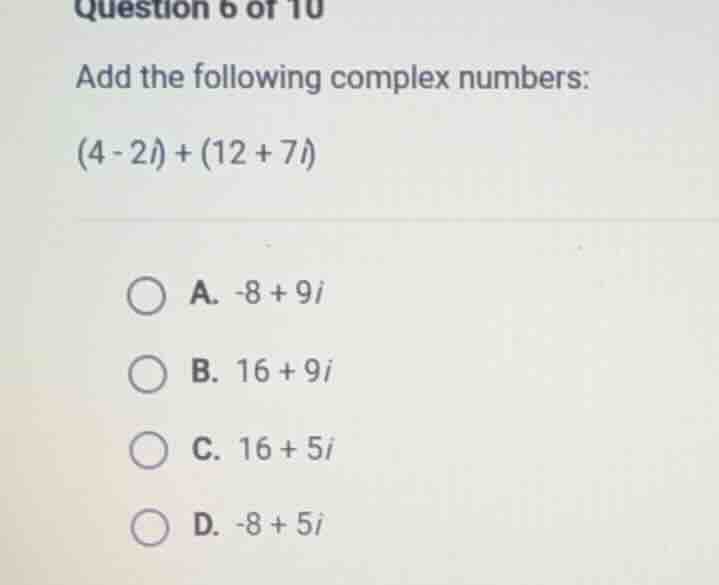
Question
question 6 of 10
add the following complex numbers:
(4 - 2i) + (12 + 7i)
a. -8 + 9i
b. 16 + 9i
c. 16 + 5i
d. -8 + 5i
Step1: Add the real parts
The real parts are 4 and 12. So, \(4 + 12 = 16\).
Step2: Add the imaginary parts
The imaginary parts are \(-2i\) and \(7i\). So, \(-2i + 7i = 5i\)? Wait, no, wait: \(-2i + 7i=( - 2 + 7)i = 5i\)? Wait, no, wait, let's recalculate. Wait, \(-2i + 7i\): the coefficients are -2 and 7. So \(-2 + 7 = 5\), so the imaginary part is \(5i\)? Wait, no, wait, the original problem is \((4 - 2i)+(12 + 7i)\). So real parts: 4 + 12 = 16. Imaginary parts: -2i + 7i = ( - 2 + 7)i = 5i? Wait, no, 7 - 2 is 5? Wait, -2 + 7 is 5? Yes. Wait, but let's check again. 4 + 12 is 16. -2i + 7i: combine like terms. The imaginary unit i is common, so we add the coefficients: -2 + 7 = 5. So the imaginary part is 5i? Wait, but wait, the options: option C is 16 + 5i, option B is 16 + 9i. Wait, did I make a mistake? Wait, -2 + 7: -2 + 7 is 5? Wait, 7 - 2 is 5, yes. So -2i + 7i = 5i. Then real part 16, imaginary part 5i. So the sum is 16 + 5i, which is option C. Wait, but let me check again. (4 - 2i) + (12 + 7i) = (4 + 12) + (-2i + 7i) = 16 + 5i. Yes, that's correct. So the answer is C.

Snap & solve any problem in the app
Get step-by-step solutions on Sovi AI
Photo-based solutions with guided steps
Explore more problems and detailed explanations
C. 16 + 5i