Sovi.AI - AI Math Tutor

Scan to solve math questions

QUESTION IMAGE

\in order to create a fair and prosperous society for businesses and wo…

Question

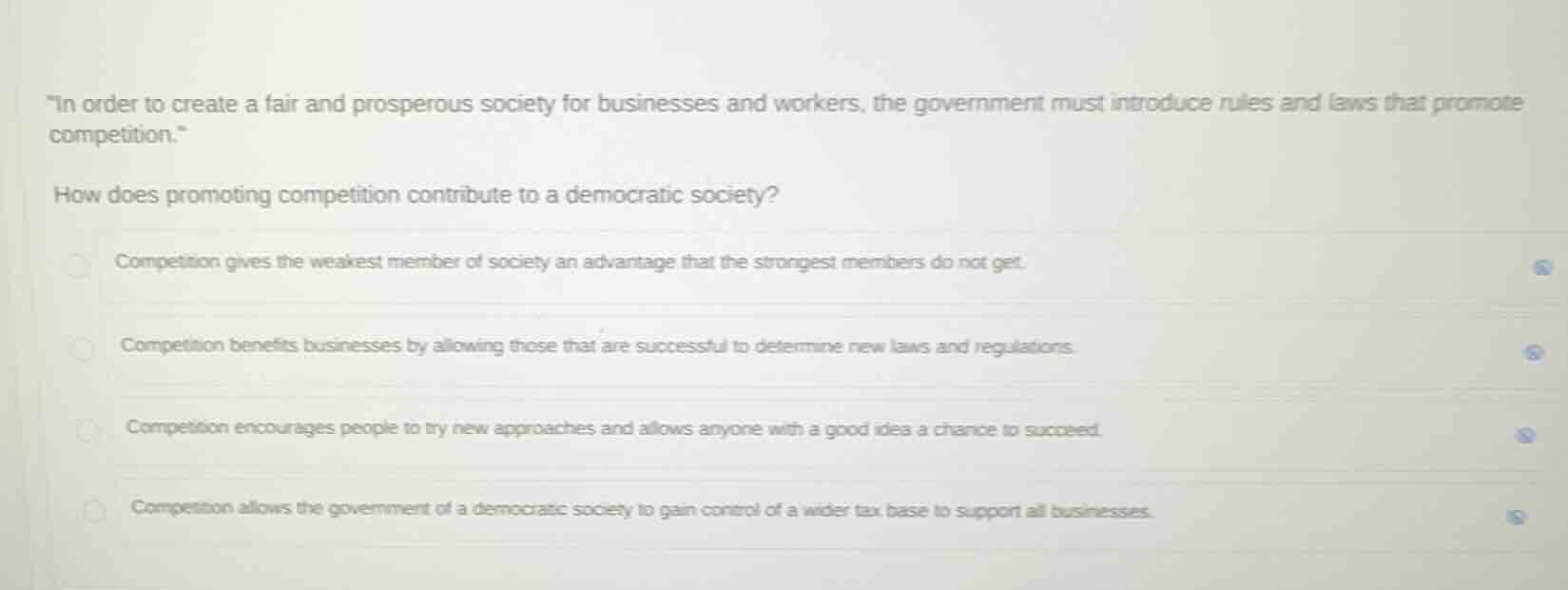
\in order to create a fair and prosperous society for businesses and workers, the government must introduce rules and laws that promote competition.\

how does promoting competition contribute to a democratic society?

competition gives the weakest member of society an advantage that the strongest members do not get.
competition benefits businesses by allowing those that are successful to determine new laws and regulations.
competition encourages people to try new approaches and allows anyone with a good idea a chance to succeed.
competition allows the government of a democratic society to gain control of a wider tax base to support all businesses.

Explanation:

Response

<pre_analysis>
{
"quality": "clear",
"question_count": 1,
"skills_matched": [
"direct_cot",
"multiple_choice_formatter",
"explain_then_answer",
"tutor",
"mastery_adaptive_brevity"
],
"needs_drawing": false,
"concepts_used": [
"Market Competition"
],
"new_concepts": [
"Democratic Society Principles"
],
"current_concepts": [
"Market Competition",
"Democratic Society Principles"
]
}
</pre_analysis>

<reasoning>

Analyze the prompt and question

The prompt states that governments must introduce rules and laws that promote competition to create a fair and prosperous society. The question asks how promoting competition contributes specifically to a democratic society.

Evaluate the options

Using the Market Competition knowledge point:

  • Option 1 suggests competition gives the weakest members an advantage over the strongest. This is incorrect as competition aims for a level playing field, not an unequal advantage.
  • Option 2 suggests successful businesses determine laws. This describes an oligarchy or corporatocracy, which is undemocratic.
  • Option 3 states competition encourages new approaches and gives anyone with a good idea a chance to succeed. This aligns with democratic values of equal opportunity, individual initiative, and meritocracy.
  • Option 4 suggests competition is about expanding the government's tax base to support all businesses, which is not the primary democratic purpose of promoting competition.

Select the correct option

The third option directly connects the economic freedom of competition to the democratic principle of equal opportunity and individual empowerment.
</reasoning>

<answer>
<mcq-option>(A) Competition gives the weakest member of society an advantage that the strongest members do not get.</mcq-option>
<mcq-option>(B) Competition benefits businesses by allowing those that are successful to determine new laws and regulations.</mcq-option>
<mcq-correct>(C) Competition encourages people to try new approaches and allows anyone with a good idea a chance to succeed.</mcq-correct>
<mcq-option>(D) Competition allows the government of a democratic society to gain control of a wider tax base to support all businesses.</mcq-option>
</answer>

<post_analysis>
{
"subject": "Social Science",
"question_type": "Multiple Choice",
"knowledge_point": [
"Social Science",
"Political Science",
"Democratic Society Principles"
]
}
</post_analysis>

Answer:

<pre_analysis>
{
"quality": "clear",
"question_count": 1,
"skills_matched": [
"direct_cot",
"multiple_choice_formatter",
"explain_then_answer",
"tutor",
"mastery_adaptive_brevity"
],
"needs_drawing": false,
"concepts_used": [
"Market Competition"
],
"new_concepts": [
"Democratic Society Principles"
],
"current_concepts": [
"Market Competition",
"Democratic Society Principles"
]
}
</pre_analysis>

<reasoning>

Analyze the prompt and question

The prompt states that governments must introduce rules and laws that promote competition to create a fair and prosperous society. The question asks how promoting competition contributes specifically to a democratic society.

Evaluate the options

Using the Market Competition knowledge point:

  • Option 1 suggests competition gives the weakest members an advantage over the strongest. This is incorrect as competition aims for a level playing field, not an unequal advantage.
  • Option 2 suggests successful businesses determine laws. This describes an oligarchy or corporatocracy, which is undemocratic.
  • Option 3 states competition encourages new approaches and gives anyone with a good idea a chance to succeed. This aligns with democratic values of equal opportunity, individual initiative, and meritocracy.
  • Option 4 suggests competition is about expanding the government's tax base to support all businesses, which is not the primary democratic purpose of promoting competition.

Select the correct option

The third option directly connects the economic freedom of competition to the democratic principle of equal opportunity and individual empowerment.
</reasoning>

<answer>
<mcq-option>(A) Competition gives the weakest member of society an advantage that the strongest members do not get.</mcq-option>
<mcq-option>(B) Competition benefits businesses by allowing those that are successful to determine new laws and regulations.</mcq-option>
<mcq-correct>(C) Competition encourages people to try new approaches and allows anyone with a good idea a chance to succeed.</mcq-correct>
<mcq-option>(D) Competition allows the government of a democratic society to gain control of a wider tax base to support all businesses.</mcq-option>
</answer>

<post_analysis>
{
"subject": "Social Science",
"question_type": "Multiple Choice",
"knowledge_point": [
"Social Science",
"Political Science",
"Democratic Society Principles"
]
}
</post_analysis>