Sovi.AI - AI Math Tutor

Scan to solve math questions

QUESTION IMAGE

an open tube manometer is 7.6 inches higher (h) on the open end (see di…

Question

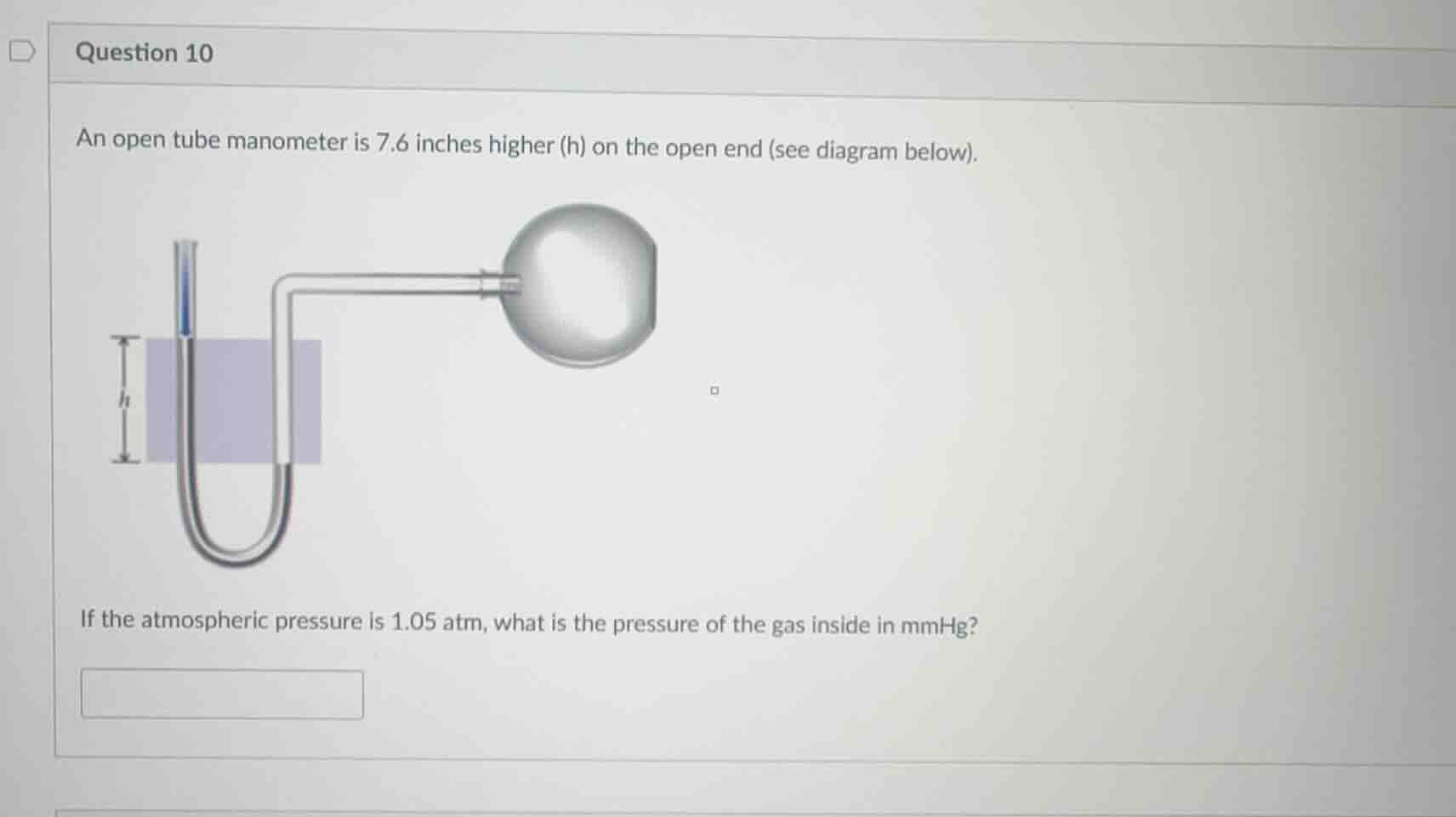
an open tube manometer is 7.6 inches higher (h) on the open end (see diagram below).

if the atmospheric pressure is 1.05 atm, what is the pressure of the gas inside in mmhg?

Explanation:

Response

<pre_analysis>
{
"quality": "clear",
"question_count": 1,
"skills_matched": [
"step_cot",
"blank_filling_formatter",
"explain_then_answer",
"tutor"
],
"needs_drawing": false,
"concepts_used": [],
"new_concepts": [
"Manometer Calculations",
"Pressure Unit Conversion"
],
"current_concepts": [
"Manometer Calculations",
"Pressure Unit Conversion"
]
}
</pre_analysis>

<reasoning>

Identify the given values and target unknown

We are given:

  • Height difference in the open-tube manometer: \(h = 7.6\text{ inches}\) of mercury (\(\text{inHg}\)).
  • The open end is higher, meaning the gas pressure inside the bulb is greater than the atmospheric pressure: \(P_{\text{gas}} = P_{\text{atm}} + h\).
  • Atmospheric pressure: \(P_{\text{atm}} = 1.05\text{ atm}\).
  • Target: Find the gas pressure inside the bulb (\(P_{\text{gas}}\)) in units of \(\text{mmHg}\).

Convert atmospheric pressure to mmHg

We use the standard conversion factor where \(1\text{ atm} = 760\text{ mmHg}\):
\[
P_{\text{atm}} = 1.05\text{ atm} \times \frac{760\text{ mmHg}}{1\text{ atm}} = 798\text{ mmHg}
\]

Convert the height difference to mmHg

The height difference is given in inches of mercury (\(\text{inHg}\)). Since \(1\text{ inch} = 2.54\text{ cm} = 25.4\text{ mm}\), we convert \(\text{inHg}\) to \(\text{mmHg}\):
\[
h = 7.6\text{ inHg} \times \frac{25.4\text{ mmHg}}{1\text{ inHg}} = 193.04\text{ mmHg}
\]

Calculate the gas pressure inside the bulb

Since the liquid level on the open end is higher, the gas pressure is pushing harder than the atmosphere:
\[
P_{\text{gas}} = P_{\text{atm}} + h
\]
\[
P_{\text{gas}} = 798\text{ mmHg} + 193.04\text{ mmHg} = 991.04\text{ mmHg}
\]

Round to appropriate significant figures

  • The atmospheric pressure \(1.05\text{ atm}\) has 3 significant figures.
  • The height \(7.6\text{ inches}\) has 2 significant figures.
  • Following standard rules for addition and multiplication, the final value is rounded to 2 significant figures or standard decimal precision. Let's provide the value rounded to the nearest whole number or standard decimal:

\[
P_{\text{gas}} \approx 991\text{ mmHg}
\]
</reasoning>

<answer>
An open tube manometer is 7.6 inches higher (h) on the open end (see diagram below). If the atmospheric pressure is 1.05 atm, what is the pressure of the gas inside in mmHg? <blank>\(991\)</blank>
</answer>

<post_analysis>
{
"subject": "Natural Science",
"question_type": "Fill-in-the-blank",
"knowledge_point": [
"Natural Science",
"Chemistry",
"Manometer Calculations"
]
}
</post_analysis>

Answer:

<pre_analysis>
{
"quality": "clear",
"question_count": 1,
"skills_matched": [
"step_cot",
"blank_filling_formatter",
"explain_then_answer",
"tutor"
],
"needs_drawing": false,
"concepts_used": [],
"new_concepts": [
"Manometer Calculations",
"Pressure Unit Conversion"
],
"current_concepts": [
"Manometer Calculations",
"Pressure Unit Conversion"
]
}
</pre_analysis>

<reasoning>

Identify the given values and target unknown

We are given:

  • Height difference in the open-tube manometer: \(h = 7.6\text{ inches}\) of mercury (\(\text{inHg}\)).
  • The open end is higher, meaning the gas pressure inside the bulb is greater than the atmospheric pressure: \(P_{\text{gas}} = P_{\text{atm}} + h\).
  • Atmospheric pressure: \(P_{\text{atm}} = 1.05\text{ atm}\).
  • Target: Find the gas pressure inside the bulb (\(P_{\text{gas}}\)) in units of \(\text{mmHg}\).

Convert atmospheric pressure to mmHg

We use the standard conversion factor where \(1\text{ atm} = 760\text{ mmHg}\):
\[
P_{\text{atm}} = 1.05\text{ atm} \times \frac{760\text{ mmHg}}{1\text{ atm}} = 798\text{ mmHg}
\]

Convert the height difference to mmHg

The height difference is given in inches of mercury (\(\text{inHg}\)). Since \(1\text{ inch} = 2.54\text{ cm} = 25.4\text{ mm}\), we convert \(\text{inHg}\) to \(\text{mmHg}\):
\[
h = 7.6\text{ inHg} \times \frac{25.4\text{ mmHg}}{1\text{ inHg}} = 193.04\text{ mmHg}
\]

Calculate the gas pressure inside the bulb

Since the liquid level on the open end is higher, the gas pressure is pushing harder than the atmosphere:
\[
P_{\text{gas}} = P_{\text{atm}} + h
\]
\[
P_{\text{gas}} = 798\text{ mmHg} + 193.04\text{ mmHg} = 991.04\text{ mmHg}
\]

Round to appropriate significant figures

  • The atmospheric pressure \(1.05\text{ atm}\) has 3 significant figures.
  • The height \(7.6\text{ inches}\) has 2 significant figures.
  • Following standard rules for addition and multiplication, the final value is rounded to 2 significant figures or standard decimal precision. Let's provide the value rounded to the nearest whole number or standard decimal:

\[
P_{\text{gas}} \approx 991\text{ mmHg}
\]
</reasoning>

<answer>
An open tube manometer is 7.6 inches higher (h) on the open end (see diagram below). If the atmospheric pressure is 1.05 atm, what is the pressure of the gas inside in mmHg? <blank>\(991\)</blank>
</answer>

<post_analysis>
{
"subject": "Natural Science",
"question_type": "Fill-in-the-blank",
"knowledge_point": [
"Natural Science",
"Chemistry",
"Manometer Calculations"
]
}
</post_analysis>