QUESTION IMAGE
Question
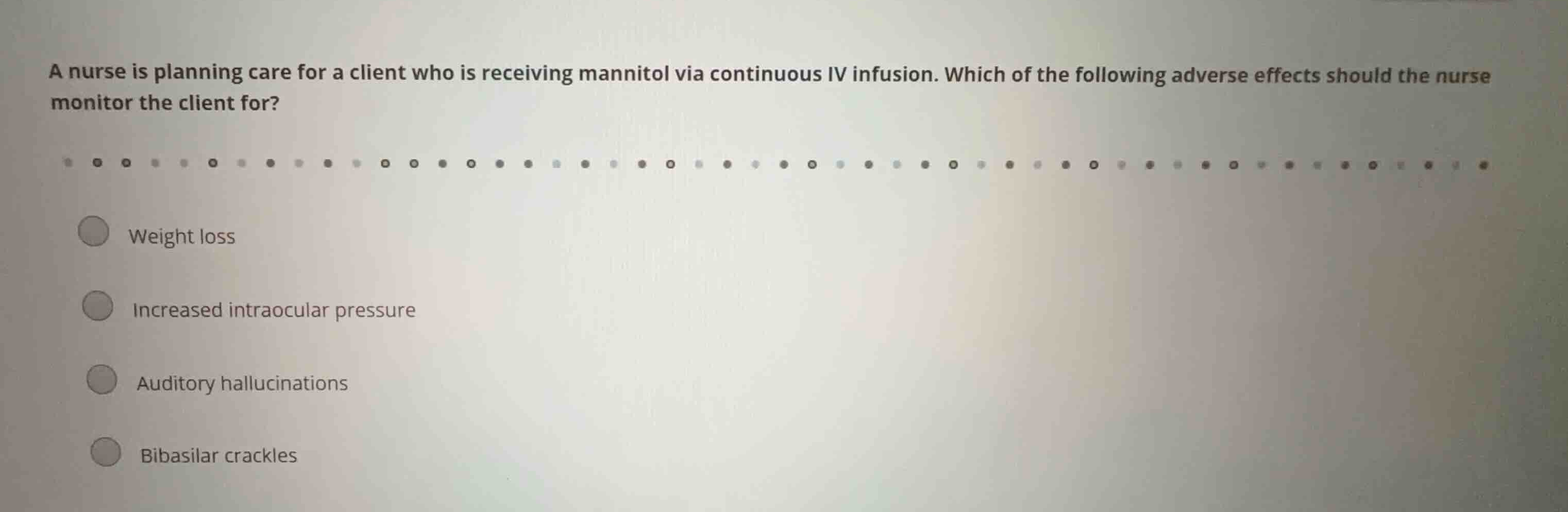
a nurse is planning care for a client who is receiving mannitol via continuous iv infusion. which of the following adverse effects should the nurse monitor the client for?
weight loss
increased intraocular pressure
auditory hallucinations
bibasilar crackles
Analyze the mechanism of mannitol
Mannitol is an osmotic diuretic that draws fluid from the intracellular and interstitial spaces into the intravascular compartment. This rapid expansion of intravascular volume can lead to fluid overload, heart failure, and pulmonary edema.
Evaluate the clinical manifestations of fluid overload
When intravascular volume increases rapidly, the heart may struggle to pump the excess fluid, leading to pulmonary congestion. A key clinical sign of pulmonary edema or fluid accumulation in the lungs is the presence of bibasilar crackles upon auscultation.
Assess the incorrect options
- Weight loss: Mannitol administration can cause rapid fluid shifts and subsequent diuresis, which would more likely lead to acute weight changes, but weight loss itself is not a critical acute adverse effect requiring immediate monitoring compared to pulmonary congestion.
- Increased intraocular pressure: Mannitol is actually used therapeutically to decrease intraocular pressure and intracranial pressure.
- Auditory hallucinations: This is not a recognized adverse effect of mannitol therapy.
Determine the priority monitoring parameter
The nurse must closely monitor the client for signs of heart failure and pulmonary edema, such as dyspnea, jugular venous distention, and bibasilar crackles, due to the risk of severe fluid volume expansion.

Snap & solve any problem in the app
Get step-by-step solutions on Sovi AI
Photo-based solutions with guided steps
Explore more problems and detailed explanations
- Weight loss
- Increased intraocular pressure
- Auditory hallucinations
- Bibasilar crackles (Correct answer)