Sovi.AI - AI Math Tutor

Scan to solve math questions

QUESTION IMAGE

multiple choice question weight-bearing and strength-training exercises…

Question

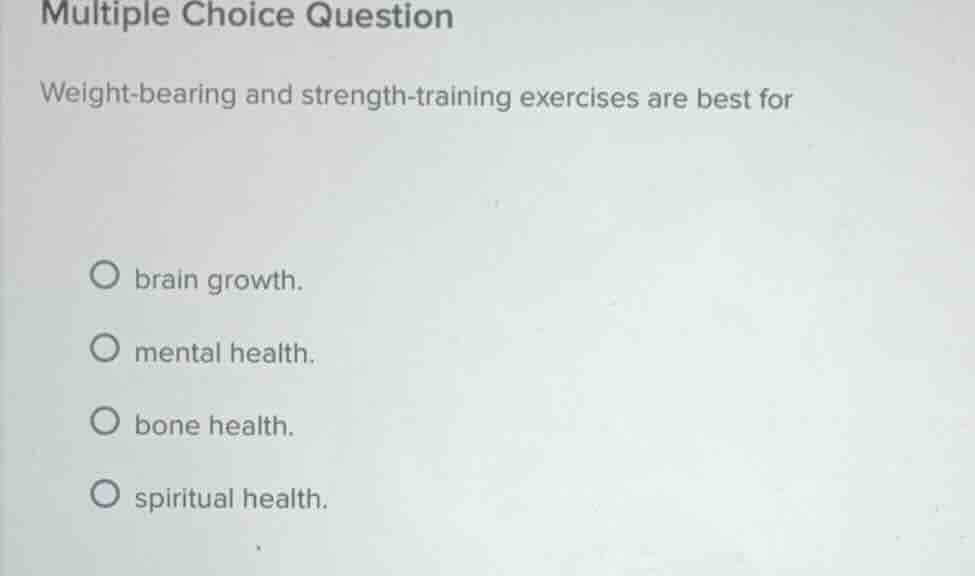
multiple choice question

weight-bearing and strength-training exercises are best for

brain growth.
mental health.
bone health.
spiritual health.

Explanation:

Response

<pre_analysis>
{
"quality": "clear",
"question_count": 1,
"skills_matched": [
"direct_cot",
"multiple_choice_formatter",
"explain_then_answer",
"tutor",
"mastery_adaptive_brevity"
],
"needs_drawing": false,
"concepts_used": [
"Mechanical Loading on Bone",
"Osteogenic Exercises"
],
"new_concepts": [],
"current_concepts": [
"Mechanical Loading on Bone",
"Osteogenic Exercises",
"Bone Functions"
]
}
</pre_analysis>

<reasoning>

Analyze the physiological effects of exercise

Using the Mechanical Loading on Bone and Osteogenic Exercises knowledge points
\[
\text{Mechanical Stress}
ightarrow \text{Osteoblast Activity}
ightarrow \text{Bone Mineral Density Increase}
\]
Weight-bearing and resistance training apply physical stress to bones, stimulating remodeling and strengthening bone tissue.

Evaluate the given options

  • brain growth: While exercise supports neuroplasticity, weight-bearing is not specifically targeted for brain growth.
  • mental health: Exercise benefits mood, but strength training is physiologically characterized as "best for" structural skeletal adaptations.
  • bone health: Direct mechanical loading stimulates bone deposition, making it the primary physiological target.
  • spiritual health: This is a subjective dimension of wellness, not a direct physiological outcome of mechanical loading.

</reasoning>

<answer>
<mcq-option>brain growth.</mcq-option>
<mcq-option>mental health.</mcq-option>
<mcq-correct>bone health.</mcq-correct>
<mcq-option>spiritual health.</mcq-option>
</answer>

<post_analysis>
{
"subject": "Natural Science",
"question_type": "Multiple Choice",
"knowledge_point": [
"Natural Science",
"Biology",
"Skeletal System"
]
}
</post_analysis>

Answer:

<pre_analysis>
{
"quality": "clear",
"question_count": 1,
"skills_matched": [
"direct_cot",
"multiple_choice_formatter",
"explain_then_answer",
"tutor",
"mastery_adaptive_brevity"
],
"needs_drawing": false,
"concepts_used": [
"Mechanical Loading on Bone",
"Osteogenic Exercises"
],
"new_concepts": [],
"current_concepts": [
"Mechanical Loading on Bone",
"Osteogenic Exercises",
"Bone Functions"
]
}
</pre_analysis>

<reasoning>

Analyze the physiological effects of exercise

Using the Mechanical Loading on Bone and Osteogenic Exercises knowledge points
\[
\text{Mechanical Stress}
ightarrow \text{Osteoblast Activity}
ightarrow \text{Bone Mineral Density Increase}
\]
Weight-bearing and resistance training apply physical stress to bones, stimulating remodeling and strengthening bone tissue.

Evaluate the given options

  • brain growth: While exercise supports neuroplasticity, weight-bearing is not specifically targeted for brain growth.
  • mental health: Exercise benefits mood, but strength training is physiologically characterized as "best for" structural skeletal adaptations.
  • bone health: Direct mechanical loading stimulates bone deposition, making it the primary physiological target.
  • spiritual health: This is a subjective dimension of wellness, not a direct physiological outcome of mechanical loading.

</reasoning>

<answer>
<mcq-option>brain growth.</mcq-option>
<mcq-option>mental health.</mcq-option>
<mcq-correct>bone health.</mcq-correct>
<mcq-option>spiritual health.</mcq-option>
</answer>

<post_analysis>
{
"subject": "Natural Science",
"question_type": "Multiple Choice",
"knowledge_point": [
"Natural Science",
"Biology",
"Skeletal System"
]
}
</post_analysis>