QUESTION IMAGE
Question
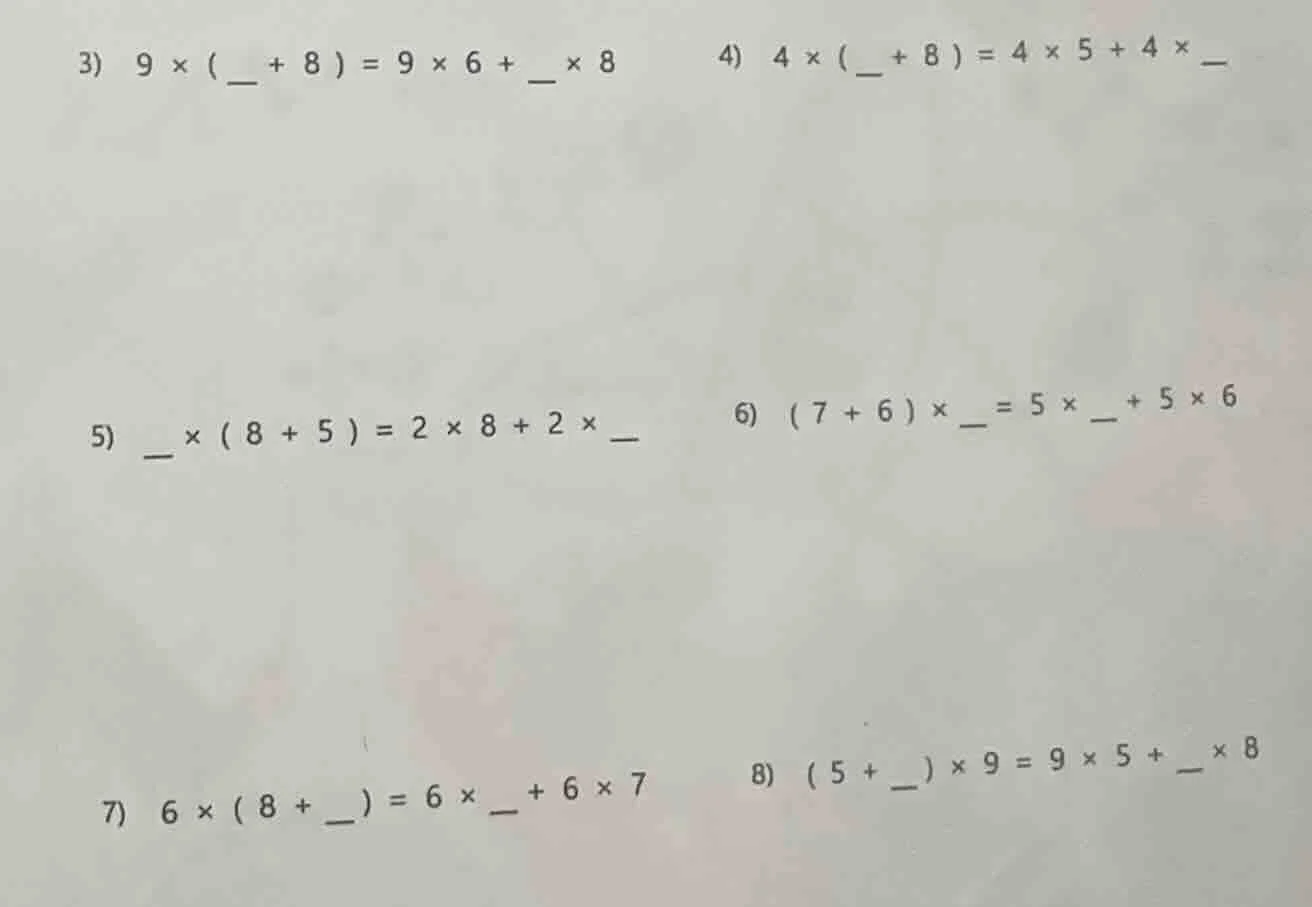
- $9 \times (\\_\\_ + 8) = 9 \times 6 + \\_\\_ \times 8$ 4) $4 \times (\\_\\_ + 8) = 4 \times 5 + 4 \times \\_\\_$ 5) $\\_\\_ \times (8 + 5) = 2 \times 8 + 2 \times \\_\\_$ 6) $(7 + 6) \times \\_\\_ = 5 \times \\_\\_ + 5 \times 6$ 7) $6 \times (8 + \\_\\_) = 6 \times \\_\\_ + 6 \times 7$ 8) $(5 + \\_\\_) \times 9 = 9 \times 5 + \\_\\_ \times 8$
Problem 3
Step1: Recall distributive property
The distributive property is \(a\times(b + c)=a\times b+a\times c\). For \(9\times(\underline{\quad}+ 8)=9\times6+\underline{\quad}\times8\), by comparing with \(a\times(b + c)=a\times b+a\times c\), we can see that \(a = 9\) and \(b=6\). So the first blank is \(6\) and the second blank is \(9\).
Step1: Apply distributive property
Using \(a\times(b + c)=a\times b+a\times c\) for \(4\times(\underline{\quad}+ 8)=4\times5 + 4\times\underline{\quad}\), we can see that \(a = 4\), \(b = 5\) and \(c=8\). So the first blank is \(5\) and the second blank is \(8\).
Step1: Use distributive property
From \(a\times(b + c)=a\times b+a\times c\), for \(\underline{\quad}\times(8 + 5)=2\times8+2\times\underline{\quad}\), we can see that \(a = 2\), \(b = 8\) and \(c = 5\). So the first blank is \(2\) and the second blank is \(5\).

Snap & solve any problem in the app
Get step-by-step solutions on Sovi AI
Photo-based solutions with guided steps
Explore more problems and detailed explanations
First blank: \(6\), Second blank: \(9\)