Sovi.AI - AI Math Tutor

Scan to solve math questions

QUESTION IMAGE

7) jenny needs to rent a car for a day. the graph shows the daily cost,…

Question

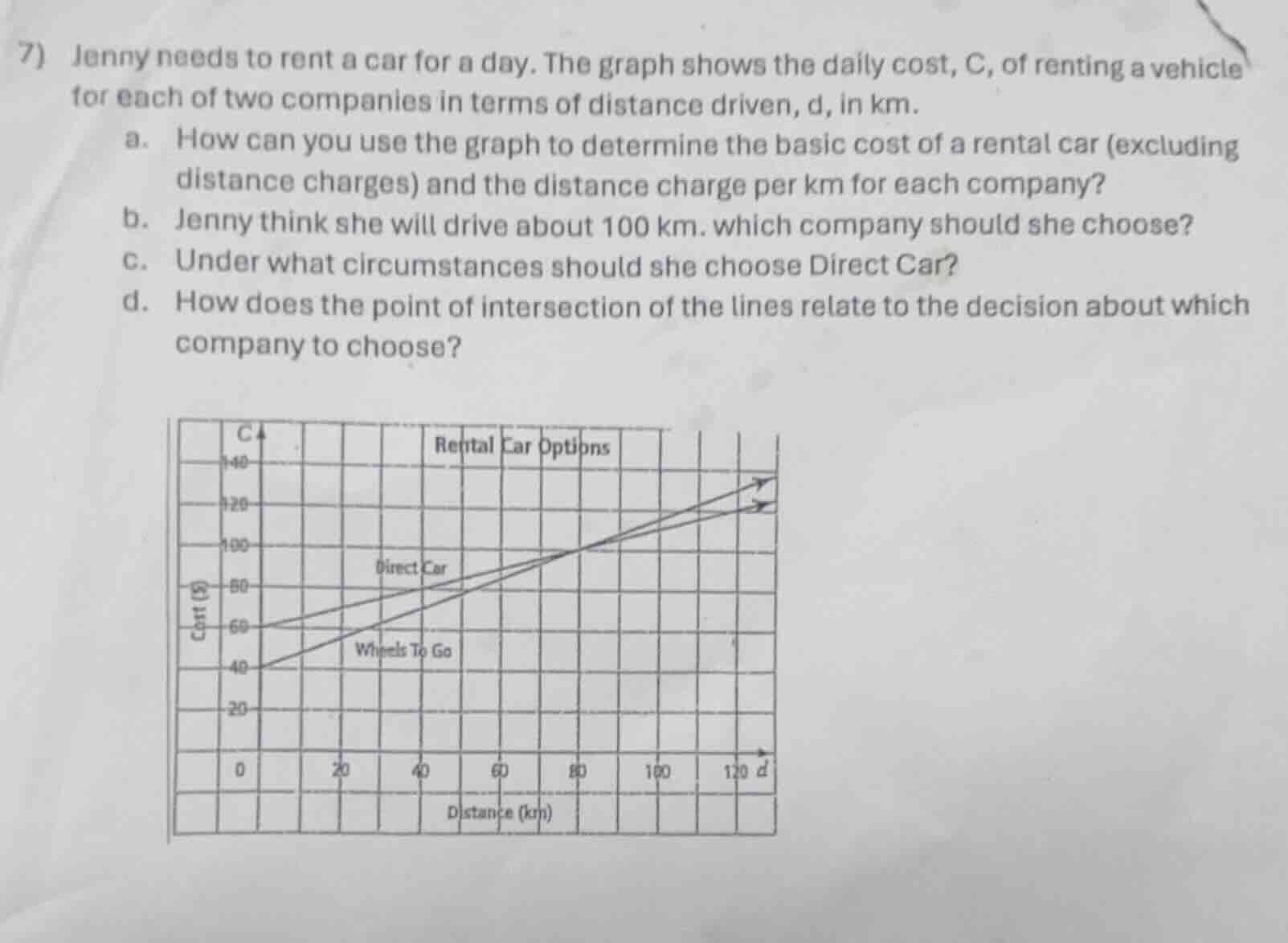
  1. jenny needs to rent a car for a day. the graph shows the daily cost, c, of renting a vehicle for each of two companies in terms of distance driven, d, in km.

a. how can you use the graph to determine the basic cost of a rental car (excluding distance charges) and the distance charge per km for each company?
b. jenny think she will drive about 100 km. which company should she choose?
c. under what circumstances should she choose direct car?
d. how does the point of intersection of the lines relate to the decision about which company to choose?

Explanation:

Response

<pre_analysis>
{
"quality": "clear",
"question_count": 4,
"skills_matched": [
"step_cot",
"explain_then_answer",
"quick"
],
"needs_drawing": false,
"concepts_used": [
"Slope-Intercept Form",
"Slope Formula",
"System of Equations"
],
"new_concepts": [
"Linear Modeling",
"Graphical Interpretation"
],
"current_concepts": [
"Slope-Intercept Form",
"Slope Formula",
"System of Equations",
"Linear Modeling",
"Graphical Interpretation"
]
}
</pre_analysis>

<reasoning>

Determine basic cost and distance charge per km

\[

$$\begin{aligned} &\text{Basic Cost (y-intercept at } d = 0\text{):}\\ &\text{Direct Car: } C = \$60\\ &\text{Wheels To Go: } C = \$40\\\\ &\text{Distance Charge per km (Slope } m = \frac{\Delta C}{\Delta d}\text{):}\\ &\text{Direct Car: } m = \frac{100 - 60}{100 - 0} = \$0.40\text{/km}\\ &\text{Wheels To Go: } m = \frac{100 - 40}{100 - 0} = \$0.60\text{/km} \end{aligned}$$

\]

Compare costs at 100 km

\[

$$\begin{aligned} &\text{At } d = 100\text{ km:}\\ &\text{Direct Car: } C = 60 + 0.40(100) = \$100\\ &\text{Wheels To Go: } C = 40 + 0.60(100) = \$100\\ &\text{Both companies cost the same (\$100), so she can choose either.} \end{aligned}$$

\]

Determine circumstances for choosing Direct Car

\[

$$\begin{aligned} &\text{For } d > 100\text{ km:}\\ &C_{\text{Direct Car}} < C_{\text{Wheels To Go}}\\ &\text{She should choose Direct Car if she plans to drive more than 100 km.} \end{aligned}$$

\]

Relate point of intersection to the decision

\[

$$\begin{aligned} &\text{Intersection Point: } (100, 100)\\ &\text{At } d < 100\text{ km: Wheels To Go is cheaper (lower line).}\\ &\text{At } d = 100\text{ km: Both cost the same.}\\ &\text{At } d > 100\text{ km: Direct Car is cheaper (lower line).} \end{aligned}$$

\]
</reasoning>

<answer>

Question 7a

The basic cost is the vertical intercept (\(C\)-intercept) where distance \(d = 0\).

  • Direct Car: Basic cost is \(\$60\).
  • Wheels To Go: Basic cost is \(\$40\).

The distance charge per km is the slope of each line:

  • Direct Car: \(\frac{\$100 - \$60}{100\text{ km} - 0\text{ km}} = \$0.40\text{/km}\)
  • Wheels To Go: \(\frac{\$100 - \$40}{100\text{ km} - 0\text{ km}} = \$0.60\text{/km}\)

Question 7b

At \(100\text{ km}\), both lines intersect at a cost of \(\$100\). Since the cost is identical for both companies, Jenny can choose either company.

Question 7c

Jenny should choose Direct Car if she plans to drive more than \(100\text{ km}\), as its line is lower (cheaper) than Wheels To Go for distances greater than \(100\text{ km}\).

Question 7d

The point of intersection \((100, 100)\) represents the break-even point where both options cost the same. It serves as the decision threshold: for distances less than \(100\text{ km}\), the company with the lower y-intercept (Wheels To Go) is cheaper; for distances greater than \(100\text{ km}\), the company with the lower rate per km (Direct Car) is cheaper.
</answer>

<post_analysis>
{
"subject": "Mathematics",
"question_type": "Multi-part",
"knowledge_point": [
"Mathematics",
"Algebra",
"Slope-Intercept Form"
]
}
</post_analysis>

Answer:

<pre_analysis>
{
"quality": "clear",
"question_count": 4,
"skills_matched": [
"step_cot",
"explain_then_answer",
"quick"
],
"needs_drawing": false,
"concepts_used": [
"Slope-Intercept Form",
"Slope Formula",
"System of Equations"
],
"new_concepts": [
"Linear Modeling",
"Graphical Interpretation"
],
"current_concepts": [
"Slope-Intercept Form",
"Slope Formula",
"System of Equations",
"Linear Modeling",
"Graphical Interpretation"
]
}
</pre_analysis>

<reasoning>

Determine basic cost and distance charge per km

\[

$$\begin{aligned} &\text{Basic Cost (y-intercept at } d = 0\text{):}\\ &\text{Direct Car: } C = \$60\\ &\text{Wheels To Go: } C = \$40\\\\ &\text{Distance Charge per km (Slope } m = \frac{\Delta C}{\Delta d}\text{):}\\ &\text{Direct Car: } m = \frac{100 - 60}{100 - 0} = \$0.40\text{/km}\\ &\text{Wheels To Go: } m = \frac{100 - 40}{100 - 0} = \$0.60\text{/km} \end{aligned}$$

\]

Compare costs at 100 km

\[

$$\begin{aligned} &\text{At } d = 100\text{ km:}\\ &\text{Direct Car: } C = 60 + 0.40(100) = \$100\\ &\text{Wheels To Go: } C = 40 + 0.60(100) = \$100\\ &\text{Both companies cost the same (\$100), so she can choose either.} \end{aligned}$$

\]

Determine circumstances for choosing Direct Car

\[

$$\begin{aligned} &\text{For } d > 100\text{ km:}\\ &C_{\text{Direct Car}} < C_{\text{Wheels To Go}}\\ &\text{She should choose Direct Car if she plans to drive more than 100 km.} \end{aligned}$$

\]

Relate point of intersection to the decision

\[

$$\begin{aligned} &\text{Intersection Point: } (100, 100)\\ &\text{At } d < 100\text{ km: Wheels To Go is cheaper (lower line).}\\ &\text{At } d = 100\text{ km: Both cost the same.}\\ &\text{At } d > 100\text{ km: Direct Car is cheaper (lower line).} \end{aligned}$$

\]
</reasoning>

<answer>

Question 7a

The basic cost is the vertical intercept (\(C\)-intercept) where distance \(d = 0\).

  • Direct Car: Basic cost is \(\$60\).
  • Wheels To Go: Basic cost is \(\$40\).

The distance charge per km is the slope of each line:

  • Direct Car: \(\frac{\$100 - \$60}{100\text{ km} - 0\text{ km}} = \$0.40\text{/km}\)
  • Wheels To Go: \(\frac{\$100 - \$40}{100\text{ km} - 0\text{ km}} = \$0.60\text{/km}\)

Question 7b

At \(100\text{ km}\), both lines intersect at a cost of \(\$100\). Since the cost is identical for both companies, Jenny can choose either company.

Question 7c

Jenny should choose Direct Car if she plans to drive more than \(100\text{ km}\), as its line is lower (cheaper) than Wheels To Go for distances greater than \(100\text{ km}\).

Question 7d

The point of intersection \((100, 100)\) represents the break-even point where both options cost the same. It serves as the decision threshold: for distances less than \(100\text{ km}\), the company with the lower y-intercept (Wheels To Go) is cheaper; for distances greater than \(100\text{ km}\), the company with the lower rate per km (Direct Car) is cheaper.
</answer>

<post_analysis>
{
"subject": "Mathematics",
"question_type": "Multi-part",
"knowledge_point": [
"Mathematics",
"Algebra",
"Slope-Intercept Form"
]
}
</post_analysis>