QUESTION IMAGE
Question
Question was provided via image upload.
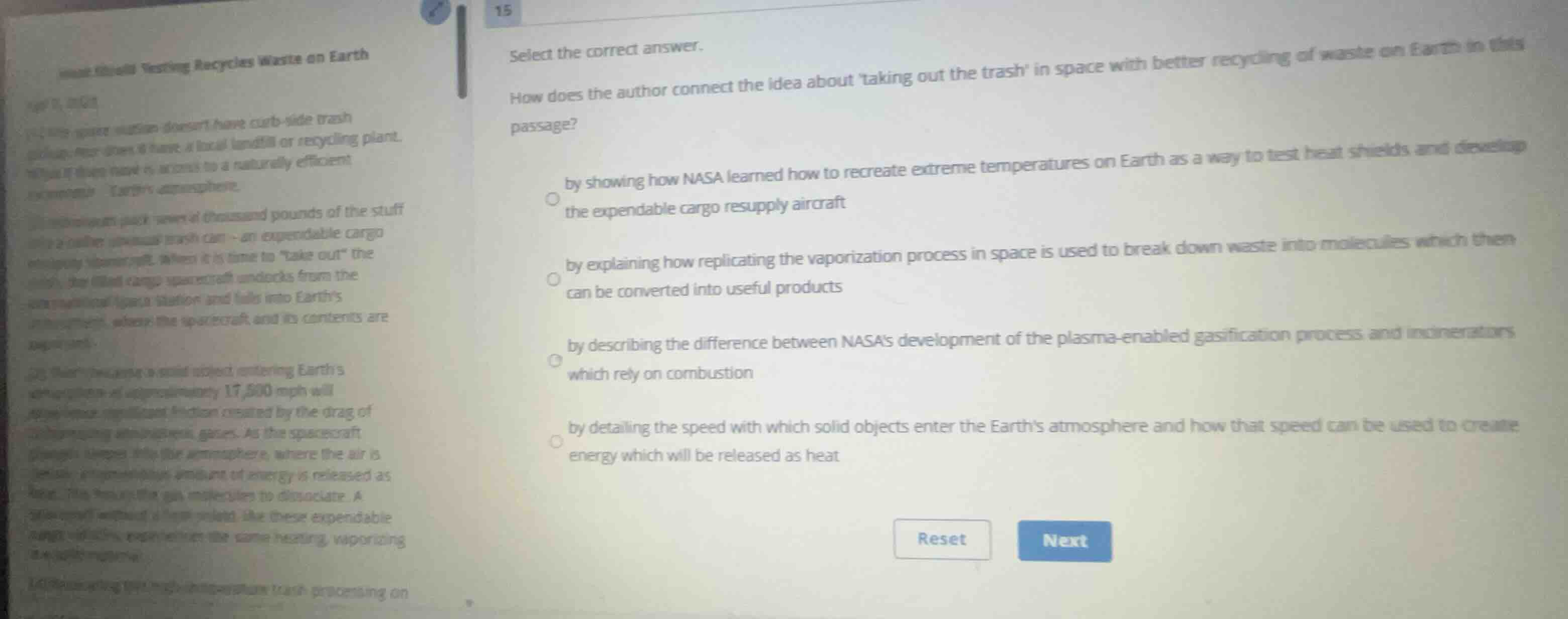
Analyze the connection between space waste disposal and Earth recycling
The passage describes how expendable cargo spacecraft filled with trash from the International Space Station burn up upon entering Earth's atmosphere. This entry at high speeds (approximately 17,500 mph) creates extreme friction and heat, causing gas molecules to dissociate and vaporize the materials. The author connects this natural vaporization process in space to high-temperature waste processing on Earth (plasma-enabled gasification), which replicates these extreme conditions to break down waste into molecular components that can then be converted into useful products.
Evaluate the given options
- Option 1 suggests NASA learned to recreate extreme temperatures to test heat shields, which does not connect to waste recycling on Earth.
- Option 2 correctly states that replicating the high-temperature vaporization process in space is used on Earth to break down waste into molecules that can be converted into useful products.
- Option 3 focuses on the difference between plasma gasification and incinerators, which is a detail rather than the primary connection between space trash disposal and Earth recycling.
- Option 4 discusses using the speed of entry to create energy released as heat, which is not how the Earth-based recycling technology functions.

Snap & solve any problem in the app
Get step-by-step solutions on Sovi AI
Photo-based solutions with guided steps
Explore more problems and detailed explanations
- by showing how NASA learned how to recreate extreme temperatures on Earth as a way to test heat shields and develop the expendable cargo resupply aircraft
- by explaining how replicating the vaporization process in space is used to break down waste into molecules which then can be converted into useful products (Correct answer)
- by describing the difference between NASA's development of the plasma-enabled gasification process and incinerators which rely on combustion
- by detailing the speed with which solid objects enter the Earth's atmosphere and how that speed can be used to create energy which will be released as heat