QUESTION IMAGE
Question
Question was provided via image upload.
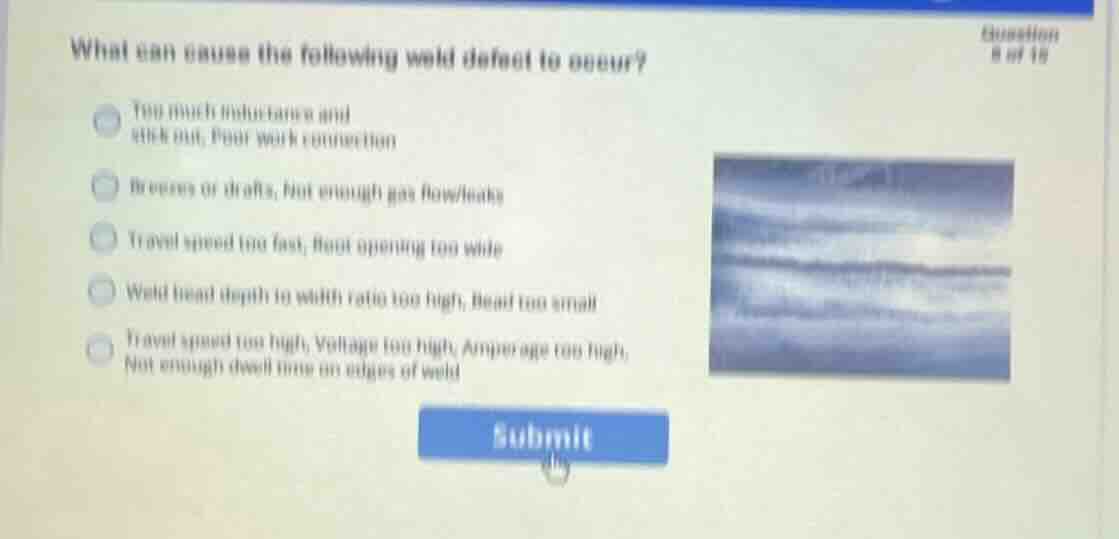
Identify the weld defect in the image
Using the Undercut Defect knowledge point
The image shows a groove or depression melted into the base metal adjacent to the toe of the weld bead, left unfilled by weld metal. This visual characteristic represents an undercut defect.
Analyze the causes of undercutting
Using the Undercut Defect knowledge point
Undercutting is primarily caused by:
- Excessive travel speed (not allowing enough time for the weld puddle to fill the melted groove)
- Excessive voltage or amperage (creating a larger, more aggressive arc that melts too much base metal)
- Incorrect torch manipulation, specifically not dwelling long enough on the edges of a weave bead to deposit filler metal where the arc has melted the base metal.
Match with the correct option
Using the Undercut Defect knowledge point
Let's evaluate the given options:
- Option 1: "Too much inductance and stick out, Poor work connection" (causes spatter or arc instability)
- Option 2: "Breezes or drafts, Not enough gas flow/leaks" (causes porosity)
- Option 3: "Travel speed too fast, Root opening too wide" (causes lack of penetration or burn-through)
- Option 4: "Weld bead depth to width ratio too high, Bead too small" (causes solidification cracking)
- Option 5: "Travel speed too high, Voltage too high, Amperage too high, Not enough dwell time on edges of weld" (matches the exact causes of undercutting)

Snap & solve any problem in the app
Get step-by-step solutions on Sovi AI
Photo-based solutions with guided steps
Explore more problems and detailed explanations
- (A) Too much inductance and stick out, Poor work connection
- (B) Breezes or drafts, Not enough gas flow/leaks
- (C) Travel speed too fast, Root opening too wide
- (D) Weld bead depth to width ratio too high, Bead too small
- (E) Travel speed too high, Voltage too high, Amperage too high, Not enough dwell time on edges of weld (Correct answer)