QUESTION IMAGE
Question
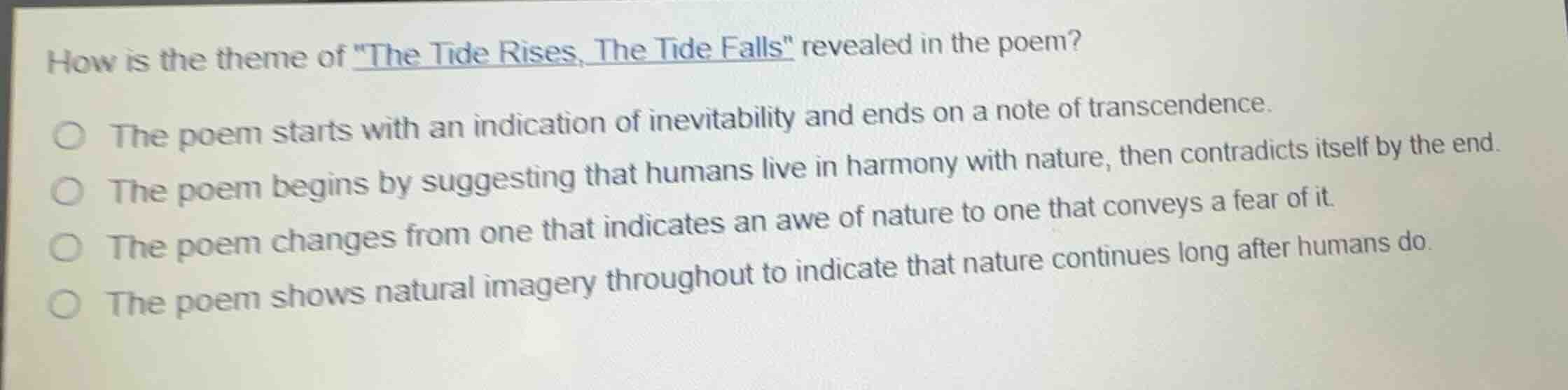
how is the theme of \the tide rises, the tide falls\ revealed in the poem?
the poem starts with an indication of inevitability and ends on a note of transcendence.
the poem begins by suggesting that humans live in harmony with nature, then contradicts itself by the end.
the poem changes from one that indicates an awe of nature to one that conveys a fear of it.
the poem shows natural imagery throughout to indicate that nature continues long after humans do.
<pre_analysis>
{
"quality": "clear",
"question_count": 1,
"skills_matched": [
"direct_cot",
"multiple_choice_formatter",
"explain_then_answer",
"tutor"
],
"needs_drawing": false,
"concepts_used": [
"Fireside Poetry Analysis",
"Thematic Analysis"
],
"new_concepts": [
"Transcendentalist Poetry"
],
"current_concepts": [
"Fireside Poetry Analysis",
"Thematic Analysis",
"Transcendentalist Poetry"
]
}
</pre_analysis>
<reasoning>
Analyze the poem's core theme
Using the Fireside Poetry Analysis and Thematic Analysis knowledge points, we examine Henry Wadsworth Longfellow's poem "The Tide Rises, The Tide Falls." The central theme of this Fireside poem is the contrast between the fleeting nature of human life and the eternal, cyclical nature of the natural world.
Evaluate the natural imagery
The poem repeatedly uses the cyclical imagery of the rising and falling tide, alongside the progression of twilight, night, and morning. While a human traveler hastens toward town and eventually disappears (never returning to the shore), the natural cycle of the tide continues uninterrupted.
Assess the multiple-choice options
- Option 1 suggests a progression from inevitability to transcendence, which does not align with the poem's focus on mortal finality versus natural eternity.
- Option 2 claims the poem contradicts itself regarding human harmony with nature, which is incorrect.
- Option 3 suggests a shift from awe to fear, but the tone remains calm, accepting, and meditative rather than fearful.
- Option 4 states that natural imagery is shown throughout to indicate that nature continues long after humans do. This perfectly captures the contrast between the traveler's temporary footprint erased by the waves and the eternal cycle of the tide.
</reasoning>
<answer>
<mcq-option>(A) The poem starts with an indication of inevitability and ends on a note of transcendence.</mcq-option>
<mcq-option>(B) The poem begins by suggesting that humans live in harmony with nature, then contradicts itself by the end.</mcq-option>
<mcq-option>(C) The poem changes from one that indicates an awe of nature to one that conveys a fear of it.</mcq-option>
<mcq-correct>(D) The poem shows natural imagery throughout to indicate that nature continues long after humans do.</mcq-correct>
</answer>
<post_analysis>
{
"subject": "Arts",
"question_type": "Multiple Choice",
"knowledge_point": [
"Arts",
"Literature",
"Poetry Analysis"
]
}
</post_analysis>
Snap & solve any problem in the app
Get step-by-step solutions on Sovi AI
Photo-based solutions with guided steps
Explore more problems and detailed explanations
<pre_analysis>
{
"quality": "clear",
"question_count": 1,
"skills_matched": [
"direct_cot",
"multiple_choice_formatter",
"explain_then_answer",
"tutor"
],
"needs_drawing": false,
"concepts_used": [
"Fireside Poetry Analysis",
"Thematic Analysis"
],
"new_concepts": [
"Transcendentalist Poetry"
],
"current_concepts": [
"Fireside Poetry Analysis",
"Thematic Analysis",
"Transcendentalist Poetry"
]
}
</pre_analysis>
<reasoning>
Analyze the poem's core theme
Using the Fireside Poetry Analysis and Thematic Analysis knowledge points, we examine Henry Wadsworth Longfellow's poem "The Tide Rises, The Tide Falls." The central theme of this Fireside poem is the contrast between the fleeting nature of human life and the eternal, cyclical nature of the natural world.
Evaluate the natural imagery
The poem repeatedly uses the cyclical imagery of the rising and falling tide, alongside the progression of twilight, night, and morning. While a human traveler hastens toward town and eventually disappears (never returning to the shore), the natural cycle of the tide continues uninterrupted.
Assess the multiple-choice options
- Option 1 suggests a progression from inevitability to transcendence, which does not align with the poem's focus on mortal finality versus natural eternity.
- Option 2 claims the poem contradicts itself regarding human harmony with nature, which is incorrect.
- Option 3 suggests a shift from awe to fear, but the tone remains calm, accepting, and meditative rather than fearful.
- Option 4 states that natural imagery is shown throughout to indicate that nature continues long after humans do. This perfectly captures the contrast between the traveler's temporary footprint erased by the waves and the eternal cycle of the tide.
</reasoning>
<answer>
<mcq-option>(A) The poem starts with an indication of inevitability and ends on a note of transcendence.</mcq-option>
<mcq-option>(B) The poem begins by suggesting that humans live in harmony with nature, then contradicts itself by the end.</mcq-option>
<mcq-option>(C) The poem changes from one that indicates an awe of nature to one that conveys a fear of it.</mcq-option>
<mcq-correct>(D) The poem shows natural imagery throughout to indicate that nature continues long after humans do.</mcq-correct>
</answer>
<post_analysis>
{
"subject": "Arts",
"question_type": "Multiple Choice",
"knowledge_point": [
"Arts",
"Literature",
"Poetry Analysis"
]
}
</post_analysis>