QUESTION IMAGE
Question
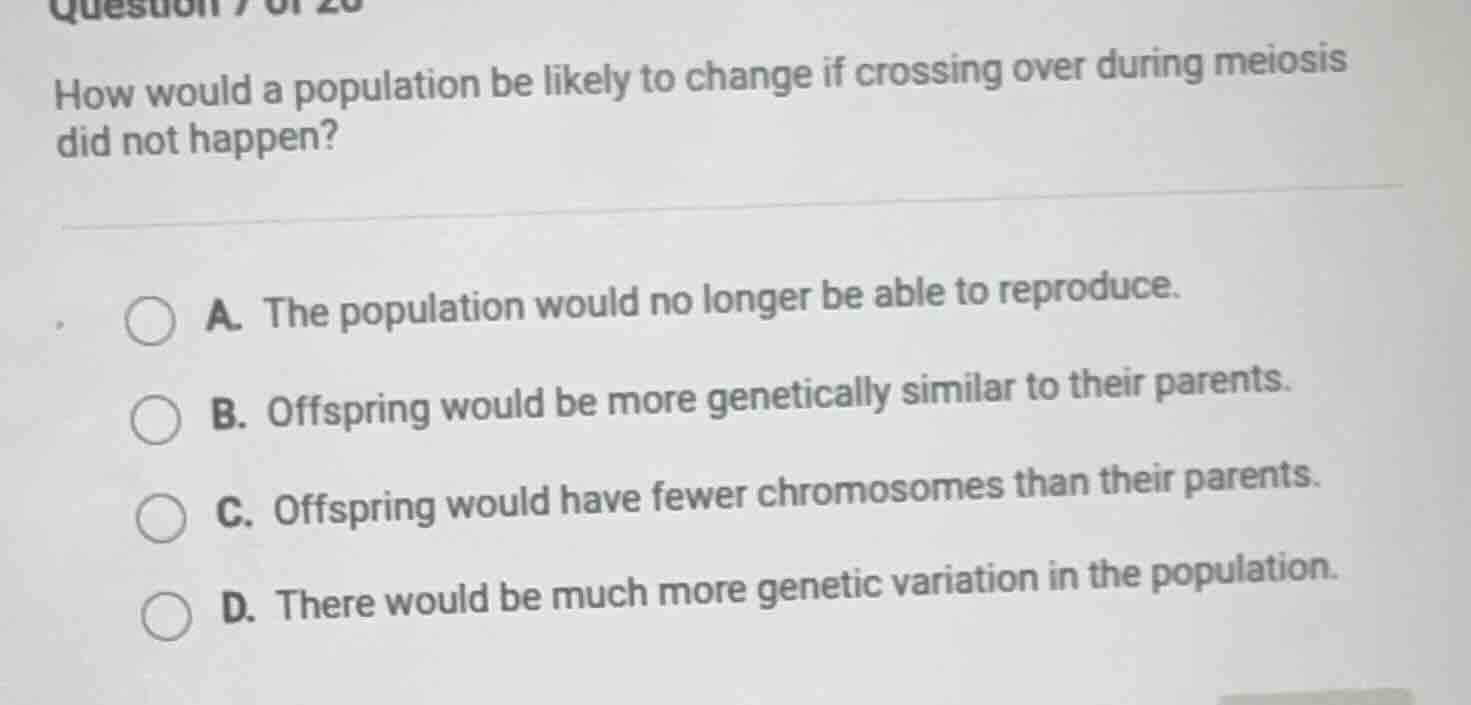
how would a population be likely to change if crossing over during meiosis did not happen?
a. the population would no longer be able to reproduce.
b. offspring would be more genetically similar to their parents.
c. offspring would have fewer chromosomes than their parents.
d. there would be much more genetic variation in the population.
<pre_analysis>
{
"quality": "clear",
"question_count": 1,
"skills_matched": [
"direct_cot",
"multiple_choice_formatter",
"explain_then_answer",
"tutor"
],
"needs_drawing": false,
"concepts_used": [
"Crossing Over"
],
"new_concepts": [
"Genetic Variation"
],
"current_concepts": [
"Crossing Over",
"Genetic Variation",
"Meiotic Recombination"
]
}
</pre_analysis>
<reasoning>
Understand the role of crossing over
Crossing Over is a vital process during prophase I of meiosis. It involves the exchange of genetic material between homologous chromosomes.
Analyze the effect of its absence
Without Crossing Over, chromosomes do not swap segments. This prevents the creation of recombinant chromosomes, which directly reduces genetic diversity.
Evaluate the given options
- Option A is incorrect because reproduction can still occur.
- Option B is correct because less recombination means offspring inherit intact parental chromosomes, making them more genetically similar to their parents.
- Option C is incorrect because chromosome number is unaffected by crossing over.
- Option D is incorrect because genetic variation would decrease, not increase.
</reasoning>
<answer>
<mcq-option>(A) The population would no longer be able to reproduce.</mcq-option>
<mcq-correct>(B) Offspring would be more genetically similar to their parents.</mcq-correct>
<mcq-option>(C) Offspring would have fewer chromosomes than their parents.</mcq-option>
<mcq-option>(D) There would be much more genetic variation in the population.</mcq-option>
</answer>
<post_analysis>
{
"subject": "Natural Science",
"question_type": "Multiple Choice",
"knowledge_point": [
"Natural Science",
"Biology",
"Meiosis and Genetic Variation"
]
}
</post_analysis>
Snap & solve any problem in the app
Get step-by-step solutions on Sovi AI
Photo-based solutions with guided steps
Explore more problems and detailed explanations
<pre_analysis>
{
"quality": "clear",
"question_count": 1,
"skills_matched": [
"direct_cot",
"multiple_choice_formatter",
"explain_then_answer",
"tutor"
],
"needs_drawing": false,
"concepts_used": [
"Crossing Over"
],
"new_concepts": [
"Genetic Variation"
],
"current_concepts": [
"Crossing Over",
"Genetic Variation",
"Meiotic Recombination"
]
}
</pre_analysis>
<reasoning>
Understand the role of crossing over
Crossing Over is a vital process during prophase I of meiosis. It involves the exchange of genetic material between homologous chromosomes.
Analyze the effect of its absence
Without Crossing Over, chromosomes do not swap segments. This prevents the creation of recombinant chromosomes, which directly reduces genetic diversity.
Evaluate the given options
- Option A is incorrect because reproduction can still occur.
- Option B is correct because less recombination means offspring inherit intact parental chromosomes, making them more genetically similar to their parents.
- Option C is incorrect because chromosome number is unaffected by crossing over.
- Option D is incorrect because genetic variation would decrease, not increase.
</reasoning>
<answer>
<mcq-option>(A) The population would no longer be able to reproduce.</mcq-option>
<mcq-correct>(B) Offspring would be more genetically similar to their parents.</mcq-correct>
<mcq-option>(C) Offspring would have fewer chromosomes than their parents.</mcq-option>
<mcq-option>(D) There would be much more genetic variation in the population.</mcq-option>
</answer>
<post_analysis>
{
"subject": "Natural Science",
"question_type": "Multiple Choice",
"knowledge_point": [
"Natural Science",
"Biology",
"Meiosis and Genetic Variation"
]
}
</post_analysis>