QUESTION IMAGE
Question
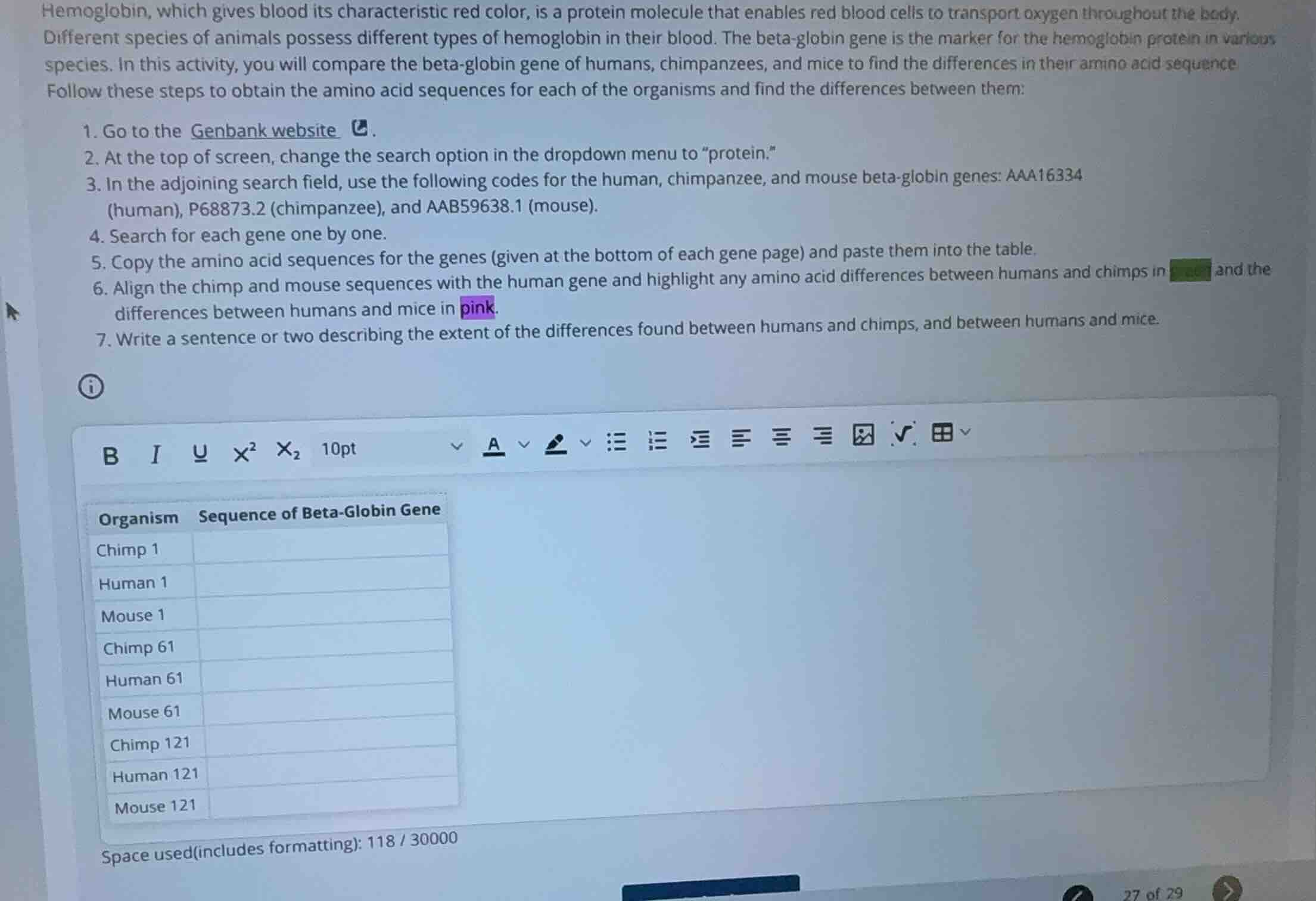
hemoglobin, which gives blood its characteristic red color, is a protein molecule that enables red blood cells to transport oxygen throughout the body. different species of animals possess different types of hemoglobin in their blood. the beta-globin gene is the marker for the hemoglobin protein in various species. in this activity, you will compare the beta-globin gene of humans, chimpanzees, and mice to find the differences in their amino acid sequence. follow these steps to obtain the amino acid sequences for each of the organisms and find the differences between them:
- go to the genbank website.
- at the top of screen, change the search option in the dropdown menu to \protein.\
- in the adjoining search field, use the following codes for the human, chimpanzee, and mouse beta-globin genes: aaa16334 (human), p68873.2 (chimpanzee), and aab59638.1 (mouse).
- search for each gene one by one.
- copy the amino acid sequences for the genes (given at the bottom of each gene page) and paste them into the table.
- align the chimp and mouse sequences with the human gene and highlight any amino acid differences between humans and chimps in green and the differences between humans and mice in pink.
- write a sentence or two describing the extent of the differences found between humans and chimps, and between humans and mice.
Identificar los códigos de acceso
Para completar la tabla de alineación de la secuencia de la proteína beta-globina, primero identificamos los códigos de acceso de GenBank proporcionados en las instrucciones:
- Humano (Human):
AAA16334 - Chimpancé (Chimp):
P68873.2 - Ratón (Mouse):
AAB59638.1
Obtener las secuencias de aminoácidos
Al buscar estos códigos en la base de datos de proteínas de NCBI (GenBank), obtenemos las secuencias de aminoácidos correspondientes en formato FASTA (cada letra representa un aminoácido):
- Humano (147 aa):
MVHLTPEEKSAVTALWGKVNVDEVGGEALGRLLVVYPWTQRFFESFGDLSTPDAVMGNPKVKAHGKKVLGAFSDGLAHLDNLKGTFATLSELHCDKLHVDPENFRLLGNVLVCVLAHHFGKEFTPPVQAAYQKVVAGVANALAHKYH
- Chimpancé (147 aa):
MVHLTPEEKSAVTALWGKVNVDEVGGEALGRLLVVYPWTQRFFESFGDLSTPDAVMGNPKVKAHGKKVLGAFSDGLAHLDNLKGTFATLSELHCDKLHVDPENFRLLGNVLVCVLAHHFGKEFTPPVQAAYQKVVAGVANALAHKYH
(Nota: La secuencia de la beta-globina del chimpancé es idéntica a la del humano).
- Ratón (147 aa):
MVHLTDAEKAAVNGLWGKVNPDDVGGEALGRLLVVYPWTQRYFDSFGDLSSASAIMGNPKVKAHGKKVINAFNDGLKHLDNLKGTFAHLSELHCDKLHVDPENFRLLGNMIVIVLGHHLGKEFTPCAQAAFQKVVAGVASALAHKYH
Alinear y dividir las secuencias
Para llenar la tabla del editor, dividimos las secuencias en bloques de 60 aminoácidos (según las filas indicadas: 1-60, 61-120, 121-147):
Bloque 1 (Posiciones 1 a 60):
- Chimp 1:
MVHLTPEEKSAVTALWGKVNVDEVGGEALGRLLVVYPWTQRFFESFGDLSTPDAVMGNPK - Human 1:
MVHLTPEEKSAVTALWGKVNVDEVGGEALGRLLVVYPWTQRFFESFGDLSTPDAVMGNPK - Mouse 1:
MVHLTDAEKAAVNGLWGKVNPDDVGGEALGRLLVVYPWTQRYFDSFGDLSSASAIMGNPK
Bloque 2 (Posiciones 61 a 120):
- Chimp 61:
VKAHGKKVLGAFSDGLAHLDNLKGTFATLSELHCDKLHVDPENFRLLGNVLVCVLAHHFG - Human 61:
VKAHGKKVLGAFSDGLAHLDNLKGTFATLSELHCDKLHVDPENFRLLGNVLVCVLAHHFG - Mouse 61:
VKAHGKKVINAFNDGLKHLDNLKGTFAHLSELHCDKLHVDPENFRLLGNMIVIVLGHHLG
Bloque 3 (Posiciones 121 a 147):
- Chimp 121:
KEFTPPVQAAYQKVVAGVANALAHKYH - Human 121:
KEFTPPVQAAYQKVVAGVANALAHKYH - Mouse 121:
KEFTPCAQAAFQKVVAGVASALAHKYH
Analizar las diferencias
- Humanos vs. Chimpancés: No hay diferencias en la secuencia de aminoácidos de la beta-globina (0 diferencias de 147 aminoácidos, \(100\%\) de identidad). Esto refleja una relación evolutiva extremadamente cercana.
- Humanos vs. Ratones: Existen varias diferencias distribuidas a lo largo de la secuencia (aproximadamente 27 diferencias de 147 aminoácidos, alrededor de \(81.6\%\) de identidad), lo que indica una divergencia evolutiva mucho más antigua.

Snap & solve any problem in the app
Get step-by-step solutions on Sovi AI
Photo-based solutions with guided steps
Explore more problems and detailed explanations
A continuación se presenta la tabla completada con las secuencias de aminoácidos correspondientes a cada organismo, divididas según las posiciones indicadas en la actividad:
| Organism | Sequence of Beta-Globin Gene |
|---|---|
| Human 1 | MVHLTPEEKSAVTALWGKVNVDEVGGEALGRLLVVYPWTQRFFESFGDLSTPDAVMGNPK |
| Mouse 1 | MVHLTDAEKAAVNGLWGKVNPDDVGGEALGRLLVVYPWTQRYFDSFGDLSSASAIMGNPK |
| Chimp 61 | VKAHGKKVLGAFSDGLAHLDNLKGTFATLSELHCDKLHVDPENFRLLGNVLVCVLAHHFG |
| Human 61 | VKAHGKKVLGAFSDGLAHLDNLKGTFATLSELHCDKLHVDPENFRLLGNVLVCVLAHHFG |
| Mouse 61 | VKAHGKKVINAFNDGLKHLDNLKGTFAHLSELHCDKLHVDPENFRLLGNMIVIVLGHHLG |
| Chimp 121 | KEFTPPVQAAYQKVVAGVANALAHKYH |
| Human 121 | KEFTPPVQAAYQKVVAGVANALAHKYH |
| Mouse 121 | KEFTPCAQAAFQKVVAGVASALAHKYH |
Descripción de las diferencias (Paso 7)
La secuencia de aminoácidos de la beta-globina entre humanos y chimpancés es idéntica (\(100\%\) de similitud), lo que demuestra un parentesco evolutivo muy reciente. Por el contrario, al comparar la secuencia humana con la del ratón se observan múltiples diferencias en los tres bloques (aproximadamente un \(18\%\) de divergencia), lo que refleja un ancestro común mucho más lejano en el tiempo.