QUESTION IMAGE
Question
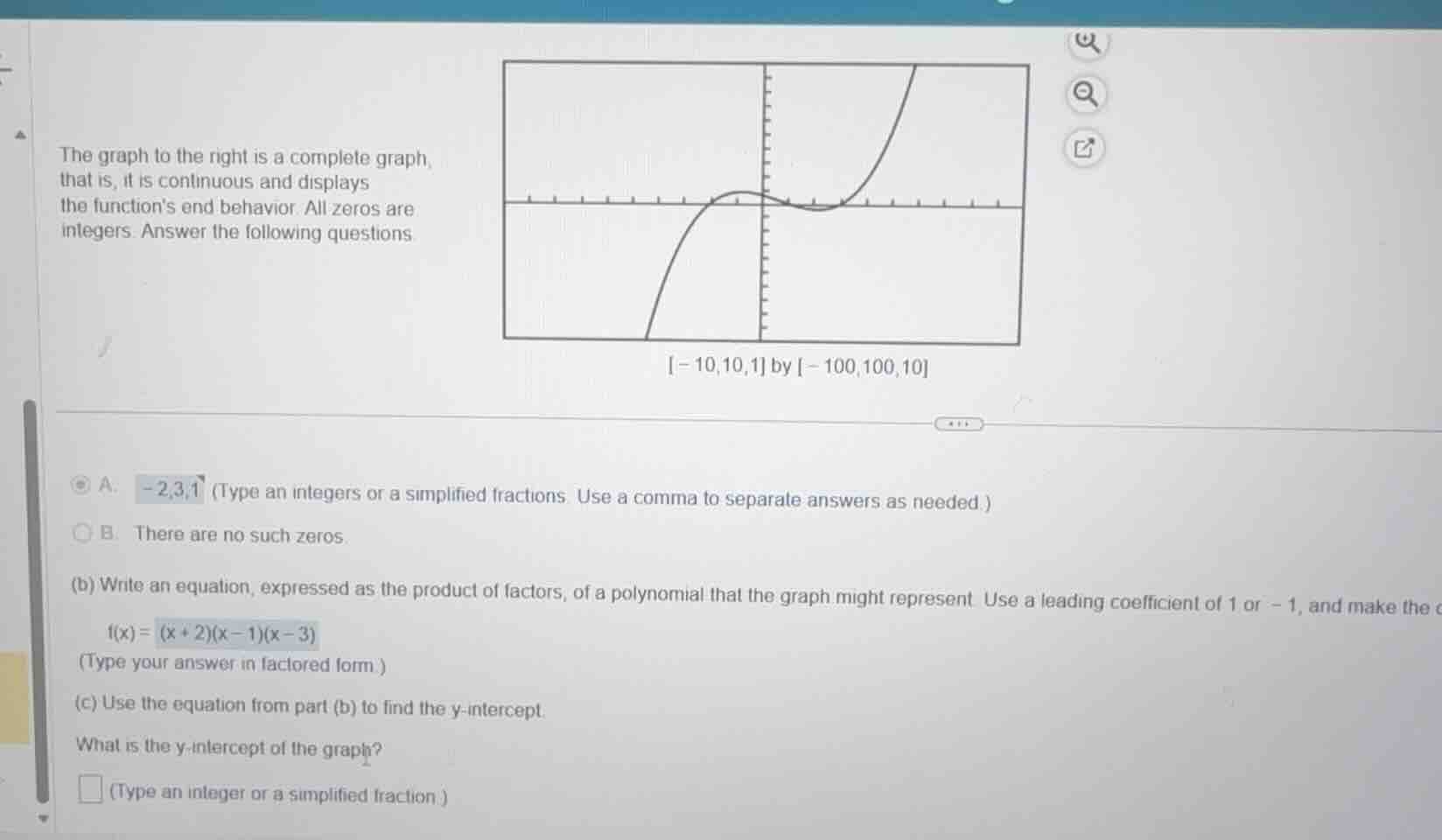
the graph to the right is a complete graph, that is, it is continuous and displays the functions end behavior. all zeros are integers. answer the following questions.
-10, 10, 1 by -100, 100, 10
a. -2, 3, 1 (type an integers or a simplified fractions. use a comma to separate answers as needed.)
b. there are no such zeros.
(b) write an equation, expressed as the product of factors, of a polynomial that the graph might represent. use a leading coefficient of 1 or -1, and make the degree as small as possible.
\\(f(x) = (x+2)(x-1)(x-3)\\)
(type your answer in factored form.)
(c) use the equation from part (b) to find the y-intercept.
what is the y-intercept of the graph?
(type an integer or a simplified fraction.)
Identify the zeros and their multiplicities
Using the Multiplicity of Zeros and Graph Behavior at Zeros knowledge points
Determine the leading coefficient sign
Using the End Behavior of Polynomials knowledge point
Formulate the polynomial equation
Using the Polynomial Functions knowledge point
Calculate the y-intercept
Evaluate the function at \(x = 0\):

Snap & solve any problem in the app
Get step-by-step solutions on Sovi AI
Photo-based solutions with guided steps
Explore more problems and detailed explanations
(c) Use the equation from part (b) to find the y-intercept.
What is the y-intercept of the graph?
<blank>6</blank>