Sovi.AI - AI Math Tutor

Scan to solve math questions

QUESTION IMAGE

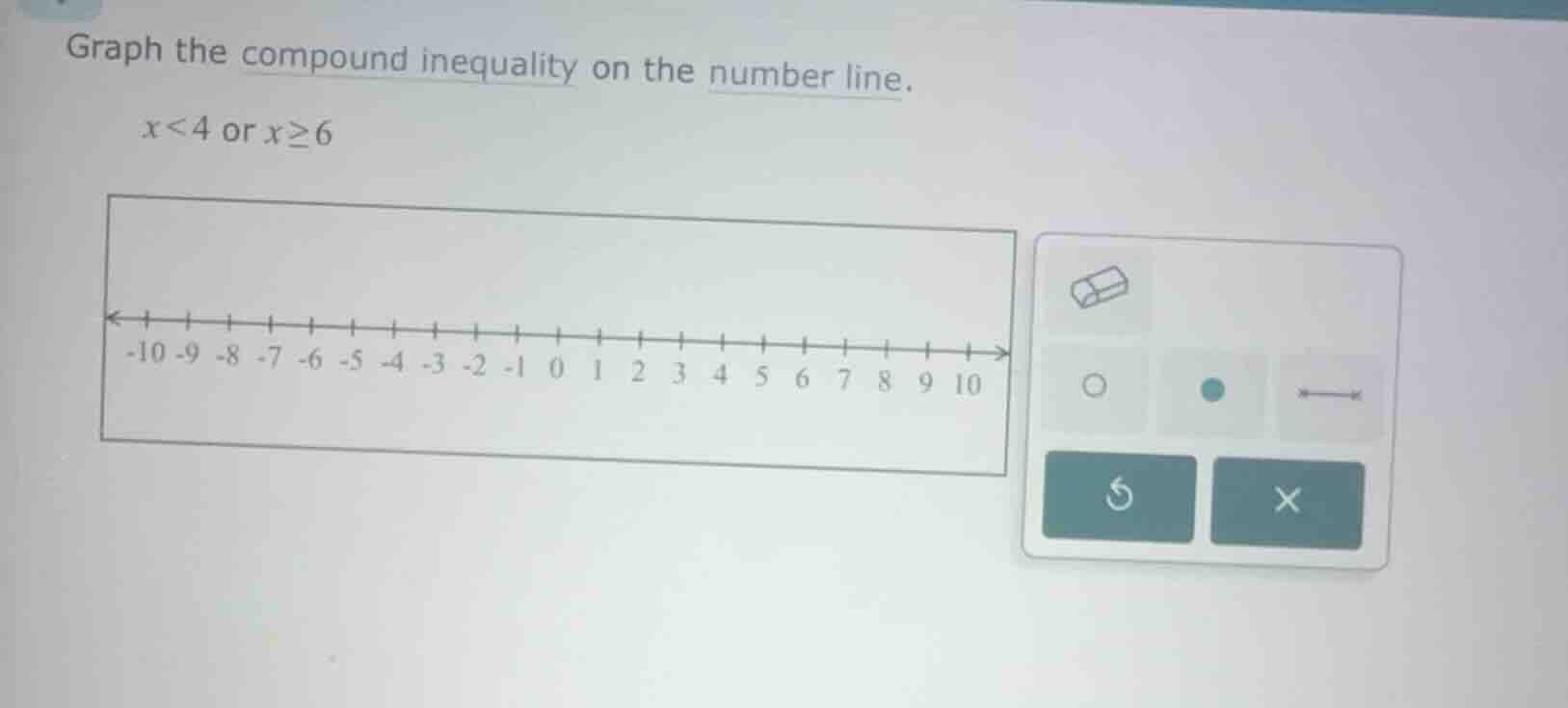
graph the compound inequality on the number line. (x < 4) or (x ge 6)

Question

graph the compound inequality on the number line.

(x < 4) or (x ge 6)

Explanation:

Response

<pre_analysis>
{
"quality": "clear",
"question_count": 1,
"skills_matched": [
"step_cot",
"explain_then_answer",
"quick"
],
"needs_drawing": true,
"concepts_used": [
"Compound Inequalities",
"Number Line Graphing"
],
"new_concepts": [],
"current_concepts": [
"Compound Inequalities",
"Number Line Graphing"
]
}
</pre_analysis>

<reasoning>

Analyze the individual inequalities

\[
x < 4 \quad \text{or} \quad x \ge 6
\]

Determine the boundary points and interval types

  • For \(x < 4\): An open circle is placed at \(4\), and the arrow points to the left.
  • For \(x \ge 6\): A solid (closed) circle is placed at \(6\), and the arrow points to the right.

Combine the graphs on the number line

The compound inequality uses "or", which represents the union of both individual inequality graphs.
</reasoning>

<answer>
To graph the compound inequality \(x < 4\) or \(x \ge 6\) on the number line:

  1. Place an open circle at \(4\) and draw an arrow pointing to the left (towards negative infinity).
  2. Place a solid (closed) circle at \(6\) and draw an arrow pointing to the right (towards positive infinity).

</answer>

<plot>
{
"elements": [
{
"type": "line",
"params": [[-10, 0], [10, 0]],
"properties": {
"strokeColor": "#583C87",
"strokeWidth": 2,
"fixed": true
}
},
{
"type": "bentinequality",
"params": [{ "x": 4, "operator": "<" }],
"properties": {
"strokeColor": "#8C55F2",
"strokeWidth": 4
}
},
{
"type": "bentinequality",
"params": [{ "x": 6, "operator": ">=" }],
"properties": {
"strokeColor": "#8C55F2",
"strokeWidth": 4
}
},
{
"type": "point",
"params": [[4, 0]],
"properties": {
"name": "4",
"size": 4,
"fillColor": "white",
"strokeColor": "#8C55F2",
"strokeWidth": 2,
"withLabel": true,
"labelPosition": [0, -15]
}
},
{
"type": "point",
"params": [[6, 0]],
"properties": {
"name": "6",
"size": 4,
"fillColor": "#8C55F2",
"strokeColor": "#8C55F2",
"withLabel": true,
"labelPosition": [0, -15]
}
}
],
"timestamps": [0.5, 1.0]
}
</plot>

<post_analysis>
{
"subject": "Mathematics",
"question_type": "Free Response",
"knowledge_point": [
"Mathematics",
"Algebra",
"Compound Inequalities"
]
}
</post_analysis>

Answer:

<pre_analysis>
{
"quality": "clear",
"question_count": 1,
"skills_matched": [
"step_cot",
"explain_then_answer",
"quick"
],
"needs_drawing": true,
"concepts_used": [
"Compound Inequalities",
"Number Line Graphing"
],
"new_concepts": [],
"current_concepts": [
"Compound Inequalities",
"Number Line Graphing"
]
}
</pre_analysis>

<reasoning>

Analyze the individual inequalities

\[
x < 4 \quad \text{or} \quad x \ge 6
\]

Determine the boundary points and interval types

  • For \(x < 4\): An open circle is placed at \(4\), and the arrow points to the left.
  • For \(x \ge 6\): A solid (closed) circle is placed at \(6\), and the arrow points to the right.

Combine the graphs on the number line

The compound inequality uses "or", which represents the union of both individual inequality graphs.
</reasoning>

<answer>
To graph the compound inequality \(x < 4\) or \(x \ge 6\) on the number line:

  1. Place an open circle at \(4\) and draw an arrow pointing to the left (towards negative infinity).
  2. Place a solid (closed) circle at \(6\) and draw an arrow pointing to the right (towards positive infinity).

</answer>

<plot>
{
"elements": [
{
"type": "line",
"params": [[-10, 0], [10, 0]],
"properties": {
"strokeColor": "#583C87",
"strokeWidth": 2,
"fixed": true
}
},
{
"type": "bentinequality",
"params": [{ "x": 4, "operator": "<" }],
"properties": {
"strokeColor": "#8C55F2",
"strokeWidth": 4
}
},
{
"type": "bentinequality",
"params": [{ "x": 6, "operator": ">=" }],
"properties": {
"strokeColor": "#8C55F2",
"strokeWidth": 4
}
},
{
"type": "point",
"params": [[4, 0]],
"properties": {
"name": "4",
"size": 4,
"fillColor": "white",
"strokeColor": "#8C55F2",
"strokeWidth": 2,
"withLabel": true,
"labelPosition": [0, -15]
}
},
{
"type": "point",
"params": [[6, 0]],
"properties": {
"name": "6",
"size": 4,
"fillColor": "#8C55F2",
"strokeColor": "#8C55F2",
"withLabel": true,
"labelPosition": [0, -15]
}
}
],
"timestamps": [0.5, 1.0]
}
</plot>

<post_analysis>
{
"subject": "Mathematics",
"question_type": "Free Response",
"knowledge_point": [
"Mathematics",
"Algebra",
"Compound Inequalities"
]
}
</post_analysis>