QUESTION IMAGE
Question
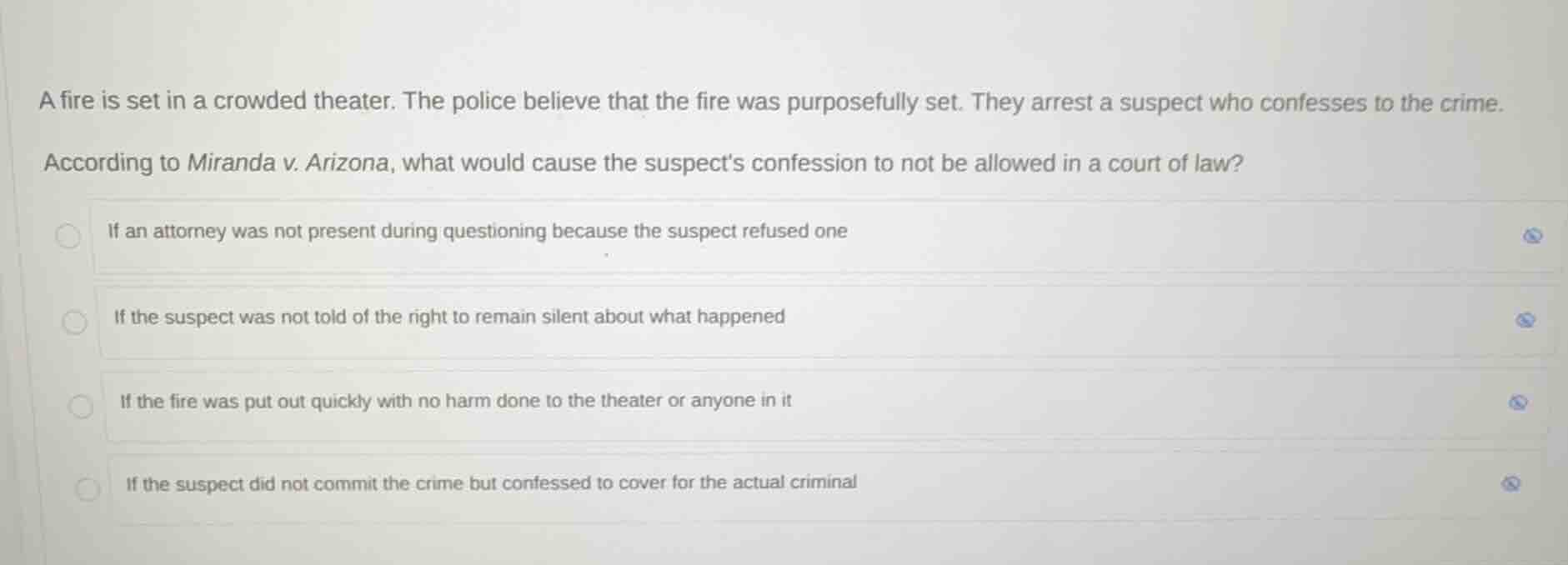
a fire is set in a crowded theater. the police believe that the fire was purposefully set. they arrest a suspect who confesses to the crime.
according to miranda v. arizona, what would cause the suspects confession to not be allowed in a court of law?
if an attorney was not present during questioning because the suspect refused one
if the suspect was not told of the right to remain silent about what happened
if the fire was put out quickly with no harm done to the theater or anyone in it
if the suspect did not commit the crime but confessed to cover for the actual criminal
<pre_analysis>
{
"quality": "clear",
"question_count": 1,
"skills_matched": [
"direct_cot",
"multiple_choice_formatter",
"explain_then_answer",
"tutor"
],
"needs_drawing": false,
"concepts_used": [],
"new_concepts": [
"Miranda Rights",
"Fifth Amendment",
"Constitutional Law"
],
"current_concepts": [
"Miranda Rights",
"Fifth Amendment",
"Constitutional Law"
]
}
</pre_analysis>
<reasoning>
Analyze the core legal issue
The question asks what would cause a suspect's confession to be inadmissible in court under the precedent set by the landmark Supreme Court case Miranda v. Arizona (1966).
Examine the Miranda precedent
Under Miranda v. Arizona, the Fifth Amendment privilege against self-incrimination requires law enforcement to advise suspects in custody of their constitutional rights before interrogation. These rights include the right to remain silent and the right to have an attorney present.
Evaluate the given options
- Option 1: If the suspect refused an attorney, they waived that right voluntarily, which does not make the confession inadmissible.
- Option 2: If the suspect was not informed of their right to remain silent, this is a direct violation of the Miranda warning requirement, making the confession inadmissible.
- Option 3: The speed of putting out the fire or lack of harm does not affect the admissibility of a confession under Miranda.
- Option 4: Confessing to cover for someone else goes to the truthfulness of the confession, not its admissibility under Miranda procedural rules.
</reasoning>
<answer>
<mcq-option>If an attorney was not present during questioning because the suspect refused one</mcq-option>
<mcq-correct>If the suspect was not told of the right to remain silent about what happened</mcq-correct>
<mcq-option>If the fire was put out quickly with no harm done to the theater or anyone in it</mcq-option>
<mcq-option>If the suspect did not commit the crime but confessed to cover for the actual criminal</mcq-option>
</answer>
<post_analysis>
{
"subject": "Social Science",
"question_type": "Multiple Choice",
"knowledge_point": [
"Social Science",
"U.S. Government & Civics",
"Miranda Rights"
]
}
</post_analysis>
Snap & solve any problem in the app
Get step-by-step solutions on Sovi AI
Photo-based solutions with guided steps
Explore more problems and detailed explanations
<pre_analysis>
{
"quality": "clear",
"question_count": 1,
"skills_matched": [
"direct_cot",
"multiple_choice_formatter",
"explain_then_answer",
"tutor"
],
"needs_drawing": false,
"concepts_used": [],
"new_concepts": [
"Miranda Rights",
"Fifth Amendment",
"Constitutional Law"
],
"current_concepts": [
"Miranda Rights",
"Fifth Amendment",
"Constitutional Law"
]
}
</pre_analysis>
<reasoning>
Analyze the core legal issue
The question asks what would cause a suspect's confession to be inadmissible in court under the precedent set by the landmark Supreme Court case Miranda v. Arizona (1966).
Examine the Miranda precedent
Under Miranda v. Arizona, the Fifth Amendment privilege against self-incrimination requires law enforcement to advise suspects in custody of their constitutional rights before interrogation. These rights include the right to remain silent and the right to have an attorney present.
Evaluate the given options
- Option 1: If the suspect refused an attorney, they waived that right voluntarily, which does not make the confession inadmissible.
- Option 2: If the suspect was not informed of their right to remain silent, this is a direct violation of the Miranda warning requirement, making the confession inadmissible.
- Option 3: The speed of putting out the fire or lack of harm does not affect the admissibility of a confession under Miranda.
- Option 4: Confessing to cover for someone else goes to the truthfulness of the confession, not its admissibility under Miranda procedural rules.
</reasoning>
<answer>
<mcq-option>If an attorney was not present during questioning because the suspect refused one</mcq-option>
<mcq-correct>If the suspect was not told of the right to remain silent about what happened</mcq-correct>
<mcq-option>If the fire was put out quickly with no harm done to the theater or anyone in it</mcq-option>
<mcq-option>If the suspect did not commit the crime but confessed to cover for the actual criminal</mcq-option>
</answer>
<post_analysis>
{
"subject": "Social Science",
"question_type": "Multiple Choice",
"knowledge_point": [
"Social Science",
"U.S. Government & Civics",
"Miranda Rights"
]
}
</post_analysis>