QUESTION IMAGE
Question
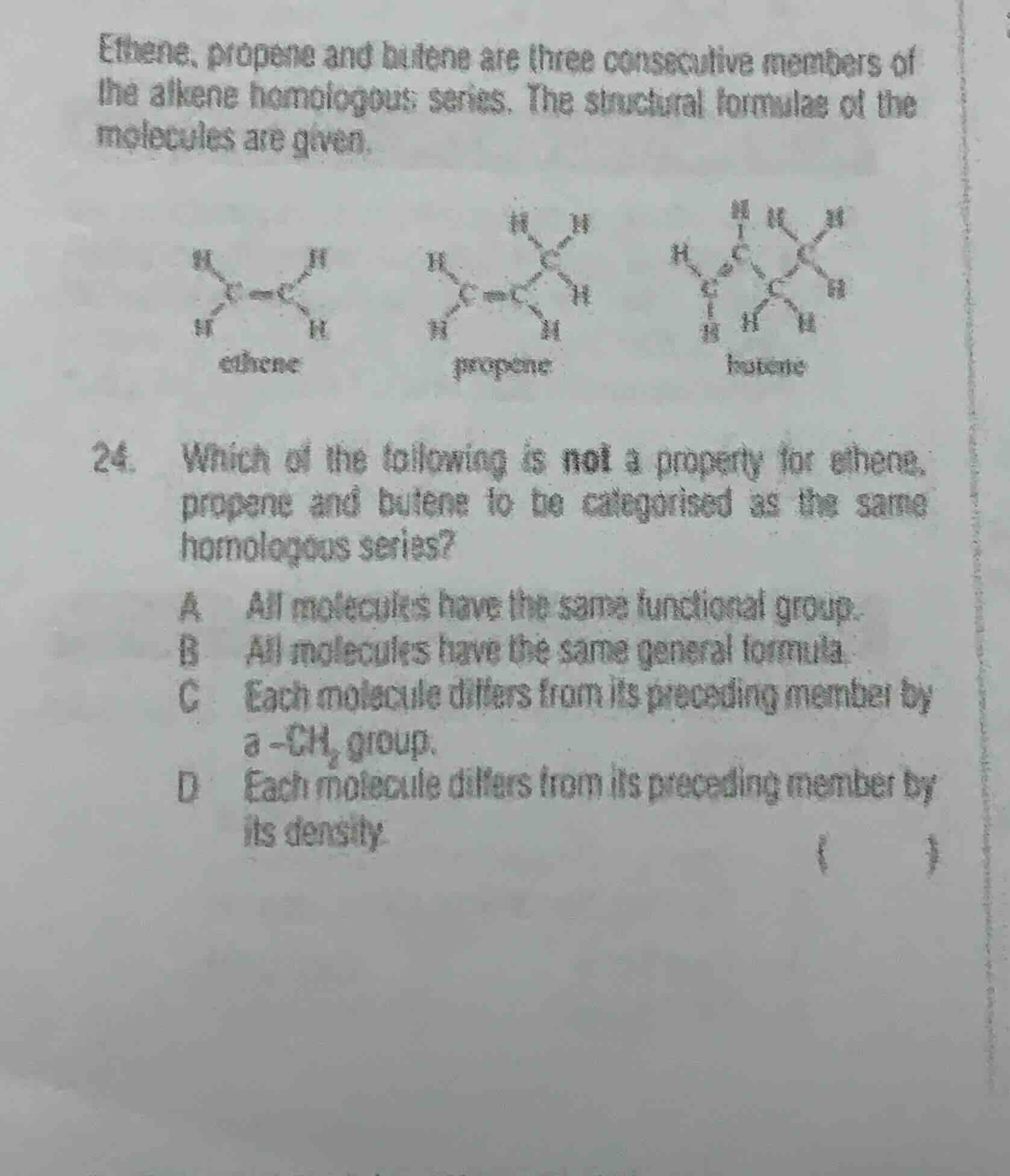
ethene, propene and butene are three consecutive members of the alkene homologous series. the structural formulas of the molecules are given.
- which of the following is not a property for ethene, propene and butene to be categorised as the same homologous series?
a all molecules have the same functional group.
b all molecules have the same general formula.
c each molecule differs from its preceding member by a \\(-\text{ch}_2\\) group.
d each molecule differs from its preceding member by its density.
<pre_analysis>
{
"quality": "clear",
"question_count": 1,
"skills_matched": [
"direct_cot",
"multiple_choice_formatter",
"explain_then_answer",
"quick"
],
"needs_drawing": false,
"concepts_used": [],
"new_concepts": [
"Homologous Series",
"Alkene Properties"
],
"current_concepts": [
"Homologous Series",
"Alkene Properties"
]
}
</pre_analysis>
<reasoning>
Analyze characteristics of a homologous series
- Members share the same functional group (carbon-carbon double bond \(C=C\) for alkenes).
- Members share the same general formula (\(C_nH_{2n}\) for alkenes).
- Consecutive members differ by a structural unit of \(-\text{CH}_2-\).
Evaluate the given options
- Option A is a true property of a homologous series.
- Option B is a true property of a homologous series.
- Option C is a true property of a homologous series.
- Option D is not a defining property for categorizing compounds into the same homologous series, as physical properties like density change gradually rather than remaining a constant defining rule for categorization.
</reasoning>
<answer>
<mcq-option>(A) All molecules have the same functional group.</mcq-option>
<mcq-option>(B) All molecules have the same general formula.</mcq-option>
<mcq-option>(C) Each molecule differs from its preceding member by a \(-\text{CH}_2-\) group.</mcq-option>
<mcq-correct>(D) Each molecule differs from its preceding member by its density.</mcq-correct>
</answer>
<post_analysis>
{
"subject": "Natural Science",
"question_type": "Multiple Choice",
"knowledge_point": [
"Natural Science",
"Chemistry",
"Homologous Series"
]
}
</post_analysis>
Snap & solve any problem in the app
Get step-by-step solutions on Sovi AI
Photo-based solutions with guided steps
Explore more problems and detailed explanations
<pre_analysis>
{
"quality": "clear",
"question_count": 1,
"skills_matched": [
"direct_cot",
"multiple_choice_formatter",
"explain_then_answer",
"quick"
],
"needs_drawing": false,
"concepts_used": [],
"new_concepts": [
"Homologous Series",
"Alkene Properties"
],
"current_concepts": [
"Homologous Series",
"Alkene Properties"
]
}
</pre_analysis>
<reasoning>
Analyze characteristics of a homologous series
- Members share the same functional group (carbon-carbon double bond \(C=C\) for alkenes).
- Members share the same general formula (\(C_nH_{2n}\) for alkenes).
- Consecutive members differ by a structural unit of \(-\text{CH}_2-\).
Evaluate the given options
- Option A is a true property of a homologous series.
- Option B is a true property of a homologous series.
- Option C is a true property of a homologous series.
- Option D is not a defining property for categorizing compounds into the same homologous series, as physical properties like density change gradually rather than remaining a constant defining rule for categorization.
</reasoning>
<answer>
<mcq-option>(A) All molecules have the same functional group.</mcq-option>
<mcq-option>(B) All molecules have the same general formula.</mcq-option>
<mcq-option>(C) Each molecule differs from its preceding member by a \(-\text{CH}_2-\) group.</mcq-option>
<mcq-correct>(D) Each molecule differs from its preceding member by its density.</mcq-correct>
</answer>
<post_analysis>
{
"subject": "Natural Science",
"question_type": "Multiple Choice",
"knowledge_point": [
"Natural Science",
"Chemistry",
"Homologous Series"
]
}
</post_analysis>