QUESTION IMAGE
Question
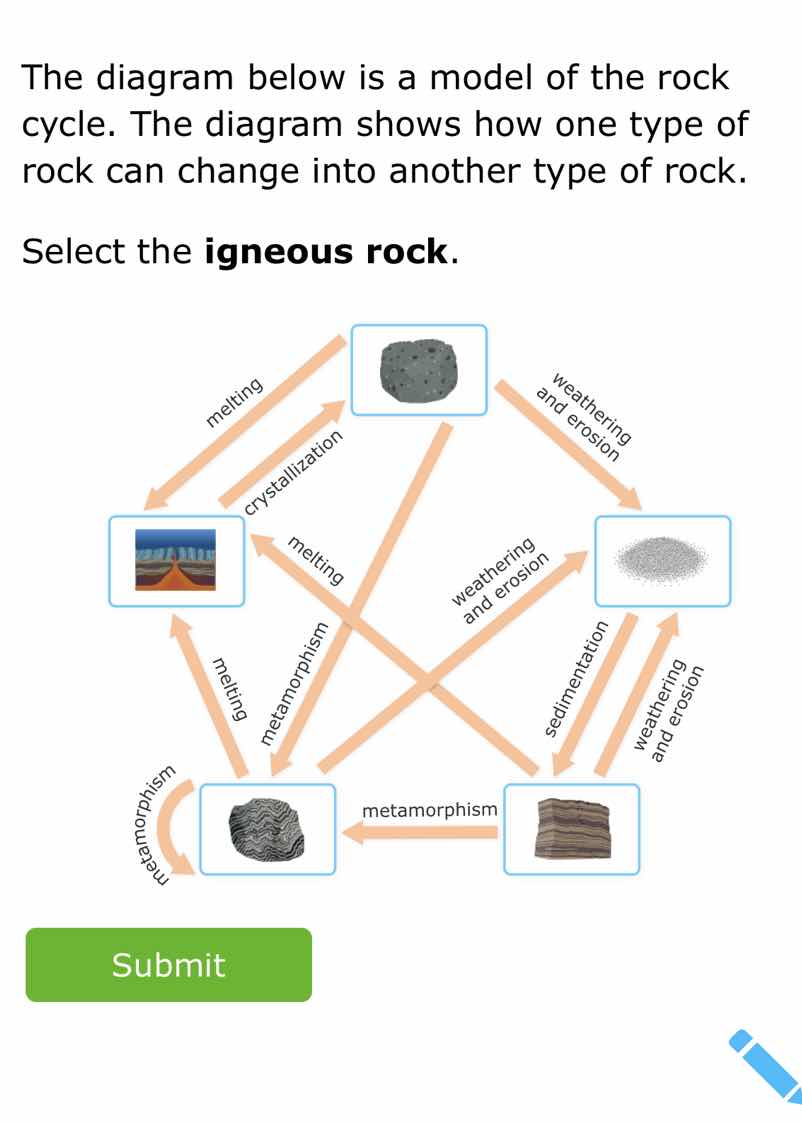
the diagram below is a model of the rock cycle. the diagram shows how one type of rock can change into another type of rock.
select the igneous rock.
Igneous rocks form from the cooling and solidification of magma or lava. In the rock cycle, the rock that is the result of crystallization (from magma/lava cooling) is igneous. Looking at the diagram, the rock that has the "crystallization" arrow pointing to it (or the one formed from melting material cooling) is the igneous rock. Typically, in rock cycle diagrams, the rock formed via crystallization (after melting) is the igneous one. From the diagram, the rock with the "crystallization" process leading to it (or the one that is formed when magma/lava cools) is the appropriate choice. Assuming the diagram's labels: the rock that is produced by crystallization (from the molten material) is igneous. So the correct igneous rock is the one that is formed through crystallization (the one with the crystallization arrow towards it, likely the one that is the product of the molten rock cooling).
Snap & solve any problem in the app
Get step-by-step solutions on Sovi AI
Photo-based solutions with guided steps
Explore more problems and detailed explanations
(Assuming the diagram's standard rock cycle: the rock formed by crystallization, e.g., if the top - right rock has crystallization leading to it, then that is the igneous rock. Since the exact diagram's labels are a bit unclear, but based on rock cycle knowledge, the igneous rock is the one formed from magma/lava cooling (crystallization), so the answer would be the rock associated with crystallization in the diagram, e.g., the top - right rock in the given diagram layout.)