Sovi.AI - AI Math Tutor

Scan to solve math questions

QUESTION IMAGE

a city council decides that if a business changes its buildings or sign…

Question

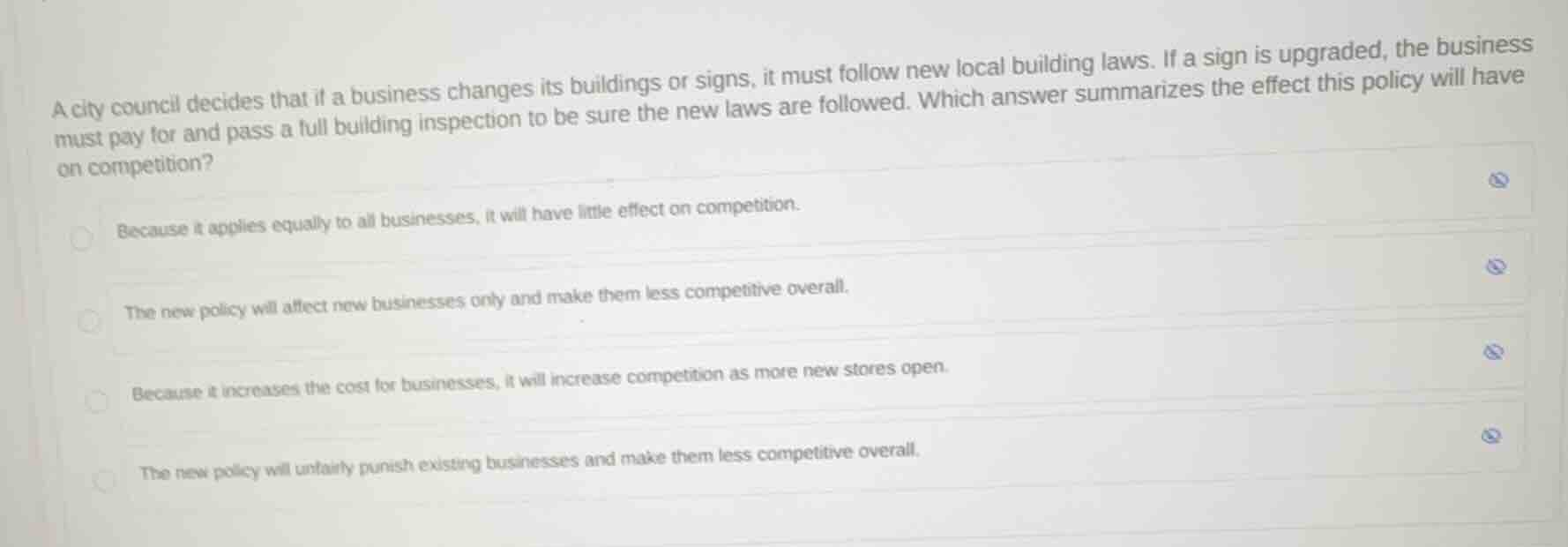
a city council decides that if a business changes its buildings or signs, it must follow new local building laws. if a sign is upgraded, the business must pay for and pass a full building inspection to be sure the new laws are followed. which answer summarizes the effect this policy will have on competition?

because it applies equally to all businesses, it will have little effect on competition.
the new policy will affect new businesses only and make them less competitive overall.
because it increases the cost for businesses, it will increase competition as more new stores open.
the new policy will unfairly punish existing businesses and make them less competitive overall.

Explanation:

Response

<pre_analysis>
{
"quality": "clear",
"question_count": 1,
"skills_matched": [
"direct_cot",
"multiple_choice_formatter",
"explain_then_answer",
"tutor",
"mastery_adaptive_brevity"
],
"needs_drawing": false,
"concepts_used": [
"Market Competition"
],
"new_concepts": [
"Regulatory Barriers to Entry",
"Compliance Costs"
],
"current_concepts": [
"Market Competition",
"Regulatory Barriers to Entry",
"Compliance Costs"
]
}
</pre_analysis>

<reasoning>

Analyze the policy requirements

The city council policy states that if a business changes its buildings or signs, it must follow new local building laws. Furthermore, if a sign is upgraded, the business must pay for and pass a full building inspection. This introduces compliance costs (both direct inspection fees and potential renovation costs to meet new standards) specifically triggered by upgrades or changes.

Evaluate the impact on different business types

Using the Market Competition knowledge point

  • Existing businesses only face these costs if they choose to change their buildings or signs. They can avoid the immediate cost by keeping their current setup.
  • New businesses entering the market must build or set up signs from scratch, meaning they have no choice but to comply with the new laws and pay for the full inspection. This creates an asymmetric cost burden.

Determine the effect on market entry and competition

Using the Market Competition knowledge point
Because the policy imposes mandatory compliance and inspection costs on any new physical setup, it acts as a barrier to entry for new firms. This disproportionately affects new businesses, making it more expensive for them to start up and compete against established, existing businesses that do not need to make immediate changes.

Assess the given multiple-choice options

  • Option 1: "Because it applies equally to all businesses, it will have little effect on competition." Incorrect, because it does not affect all businesses equally in practice (existing businesses can defer changes).
  • Option 2: "The new policy will affect new businesses only and make them less competitive overall." Correct, as new businesses must comply immediately to establish their physical presence, raising their startup costs and reducing their competitive edge.
  • Option 3: "Because it increases the cost for businesses, it will increase competition as more new stores open." Incorrect, higher costs discourage new entrants, decreasing competition.
  • Option 4: "The new policy will unfairly punish existing businesses and make them less competitive overall." Incorrect, existing businesses can avoid the costs by not upgrading immediately.

</reasoning>

<answer>
<mcq-option>(A) Because it applies equally to all businesses, it will have little effect on competition.</mcq-option>
<mcq-correct>(B) The new policy will affect new businesses only and make them less competitive overall.</mcq-correct>
<mcq-option>(C) Because it increases the cost for businesses, it will increase competition as more new stores open.</mcq-option>
<mcq-option>(D) The new policy will unfairly punish existing businesses and make them less competitive overall.</mcq-option>
</answer>

<post_analysis>
{
"subject": "Business",
"question_type": "Multiple Choice",
"knowledge_point": [
"Business",
"Market Competition",
"Regulatory Barriers to Entry"
]
}
</post_analysis>

Answer:

<pre_analysis>
{
"quality": "clear",
"question_count": 1,
"skills_matched": [
"direct_cot",
"multiple_choice_formatter",
"explain_then_answer",
"tutor",
"mastery_adaptive_brevity"
],
"needs_drawing": false,
"concepts_used": [
"Market Competition"
],
"new_concepts": [
"Regulatory Barriers to Entry",
"Compliance Costs"
],
"current_concepts": [
"Market Competition",
"Regulatory Barriers to Entry",
"Compliance Costs"
]
}
</pre_analysis>

<reasoning>

Analyze the policy requirements

The city council policy states that if a business changes its buildings or signs, it must follow new local building laws. Furthermore, if a sign is upgraded, the business must pay for and pass a full building inspection. This introduces compliance costs (both direct inspection fees and potential renovation costs to meet new standards) specifically triggered by upgrades or changes.

Evaluate the impact on different business types

Using the Market Competition knowledge point

  • Existing businesses only face these costs if they choose to change their buildings or signs. They can avoid the immediate cost by keeping their current setup.
  • New businesses entering the market must build or set up signs from scratch, meaning they have no choice but to comply with the new laws and pay for the full inspection. This creates an asymmetric cost burden.

Determine the effect on market entry and competition

Using the Market Competition knowledge point
Because the policy imposes mandatory compliance and inspection costs on any new physical setup, it acts as a barrier to entry for new firms. This disproportionately affects new businesses, making it more expensive for them to start up and compete against established, existing businesses that do not need to make immediate changes.

Assess the given multiple-choice options

  • Option 1: "Because it applies equally to all businesses, it will have little effect on competition." Incorrect, because it does not affect all businesses equally in practice (existing businesses can defer changes).
  • Option 2: "The new policy will affect new businesses only and make them less competitive overall." Correct, as new businesses must comply immediately to establish their physical presence, raising their startup costs and reducing their competitive edge.
  • Option 3: "Because it increases the cost for businesses, it will increase competition as more new stores open." Incorrect, higher costs discourage new entrants, decreasing competition.
  • Option 4: "The new policy will unfairly punish existing businesses and make them less competitive overall." Incorrect, existing businesses can avoid the costs by not upgrading immediately.

</reasoning>

<answer>
<mcq-option>(A) Because it applies equally to all businesses, it will have little effect on competition.</mcq-option>
<mcq-correct>(B) The new policy will affect new businesses only and make them less competitive overall.</mcq-correct>
<mcq-option>(C) Because it increases the cost for businesses, it will increase competition as more new stores open.</mcq-option>
<mcq-option>(D) The new policy will unfairly punish existing businesses and make them less competitive overall.</mcq-option>
</answer>

<post_analysis>
{
"subject": "Business",
"question_type": "Multiple Choice",
"knowledge_point": [
"Business",
"Market Competition",
"Regulatory Barriers to Entry"
]
}
</post_analysis>