QUESTION IMAGE
Question
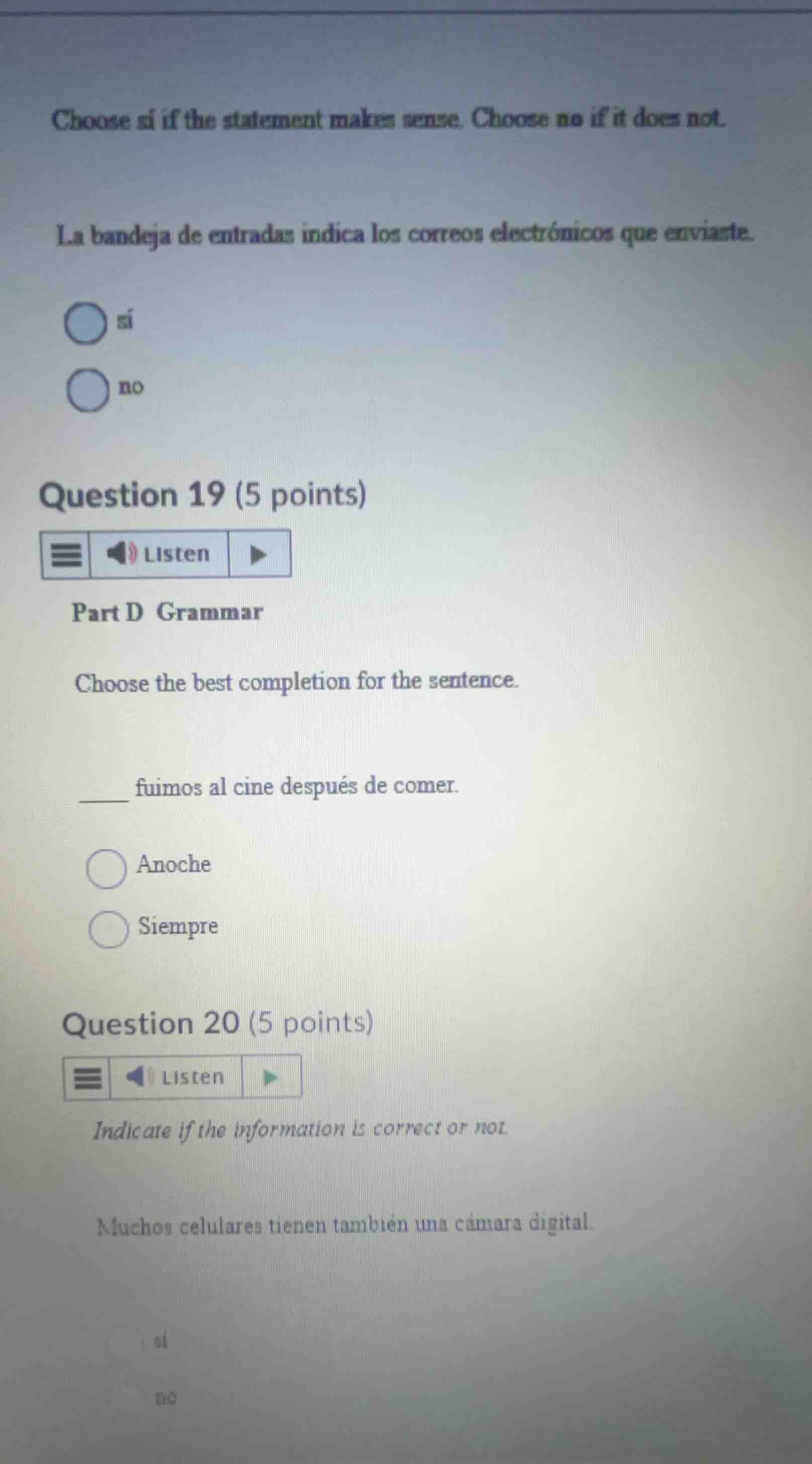
choose sí if the statement makes sense. choose no if it does not.
la bandeja de entradas indica los correos electrónicos que enviaste.
- sí
- no
question 19 (5 points)
part d grammar
choose the best completion for the sentence.
______ fuimos al cine después de comer.
- anoche
- siempre
question 20 (5 points)
indicate if the information is correct or not.
muchos celulares tienen también una cámara digital.
- sí
- no
<pre_analysis>
{
"quality": "clear",
"question_count": 3,
"skills_matched": [
"direct_cot",
"multiple_choice_formatter",
"explain_then_answer",
"quick"
],
"needs_drawing": false,
"concepts_used": [
"Spanish Vocabulary",
"Spanish Technology Vocabulary",
"Spanish Time Expressions"
],
"new_concepts": [],
"current_concepts": [
"Spanish Vocabulary",
"Spanish Technology Vocabulary",
"Spanish Time Expressions"
]
}
</pre_analysis>
<reasoning>
Analyze the first statement
"La bandeja de entrada indica los correos electrónicos que enviaste."
This translates to: "The inbox indicates the emails that you sent."
An inbox ("bandeja de entrada") displays received emails, not sent ones ("correos enviados"). Therefore, the statement does not make sense.
Analyze Question 19
"____ fuimos al cine después de comer."
The verb "fuimos" is in the preterite tense ("we went").
"Anoche" (last night) is a specific time marker that triggers the preterite tense.
"Siempre" (always) typically triggers the imperfect tense ("íbamos") for habitual actions.
Thus, "Anoche" is the correct completion.
Analyze Question 20
"Muchos celulares tienen también una cámara digital."
This translates to: "Many cell phones also have a digital camera."
This is a true and correct statement in modern technology context.
</reasoning>
<answer>
Question 1
<mcq-option>sí</mcq-option>
<mcq-correct>no</mcq-correct>
Question 19
<mcq-correct>Anoche</mcq-correct>
<mcq-option>Siempre</mcq-option>
Question 20
<mcq-correct>sí</mcq-correct>
<mcq-option>no</mcq-option>
</answer>
<post_analysis>
{
"subject": "Others",
"question_type": "Multiple Choice",
"knowledge_point": [
"Others",
"Spanish",
"Spanish Grammar and Vocabulary"
]
}
</post_analysis>
Snap & solve any problem in the app
Get step-by-step solutions on Sovi AI
Photo-based solutions with guided steps
Explore more problems and detailed explanations
<pre_analysis>
{
"quality": "clear",
"question_count": 3,
"skills_matched": [
"direct_cot",
"multiple_choice_formatter",
"explain_then_answer",
"quick"
],
"needs_drawing": false,
"concepts_used": [
"Spanish Vocabulary",
"Spanish Technology Vocabulary",
"Spanish Time Expressions"
],
"new_concepts": [],
"current_concepts": [
"Spanish Vocabulary",
"Spanish Technology Vocabulary",
"Spanish Time Expressions"
]
}
</pre_analysis>
<reasoning>
Analyze the first statement
"La bandeja de entrada indica los correos electrónicos que enviaste."
This translates to: "The inbox indicates the emails that you sent."
An inbox ("bandeja de entrada") displays received emails, not sent ones ("correos enviados"). Therefore, the statement does not make sense.
Analyze Question 19
"____ fuimos al cine después de comer."
The verb "fuimos" is in the preterite tense ("we went").
"Anoche" (last night) is a specific time marker that triggers the preterite tense.
"Siempre" (always) typically triggers the imperfect tense ("íbamos") for habitual actions.
Thus, "Anoche" is the correct completion.
Analyze Question 20
"Muchos celulares tienen también una cámara digital."
This translates to: "Many cell phones also have a digital camera."
This is a true and correct statement in modern technology context.
</reasoning>
<answer>
Question 1
<mcq-option>sí</mcq-option>
<mcq-correct>no</mcq-correct>
Question 19
<mcq-correct>Anoche</mcq-correct>
<mcq-option>Siempre</mcq-option>
Question 20
<mcq-correct>sí</mcq-correct>
<mcq-option>no</mcq-option>
</answer>
<post_analysis>
{
"subject": "Others",
"question_type": "Multiple Choice",
"knowledge_point": [
"Others",
"Spanish",
"Spanish Grammar and Vocabulary"
]
}
</post_analysis>