QUESTION IMAGE
Question
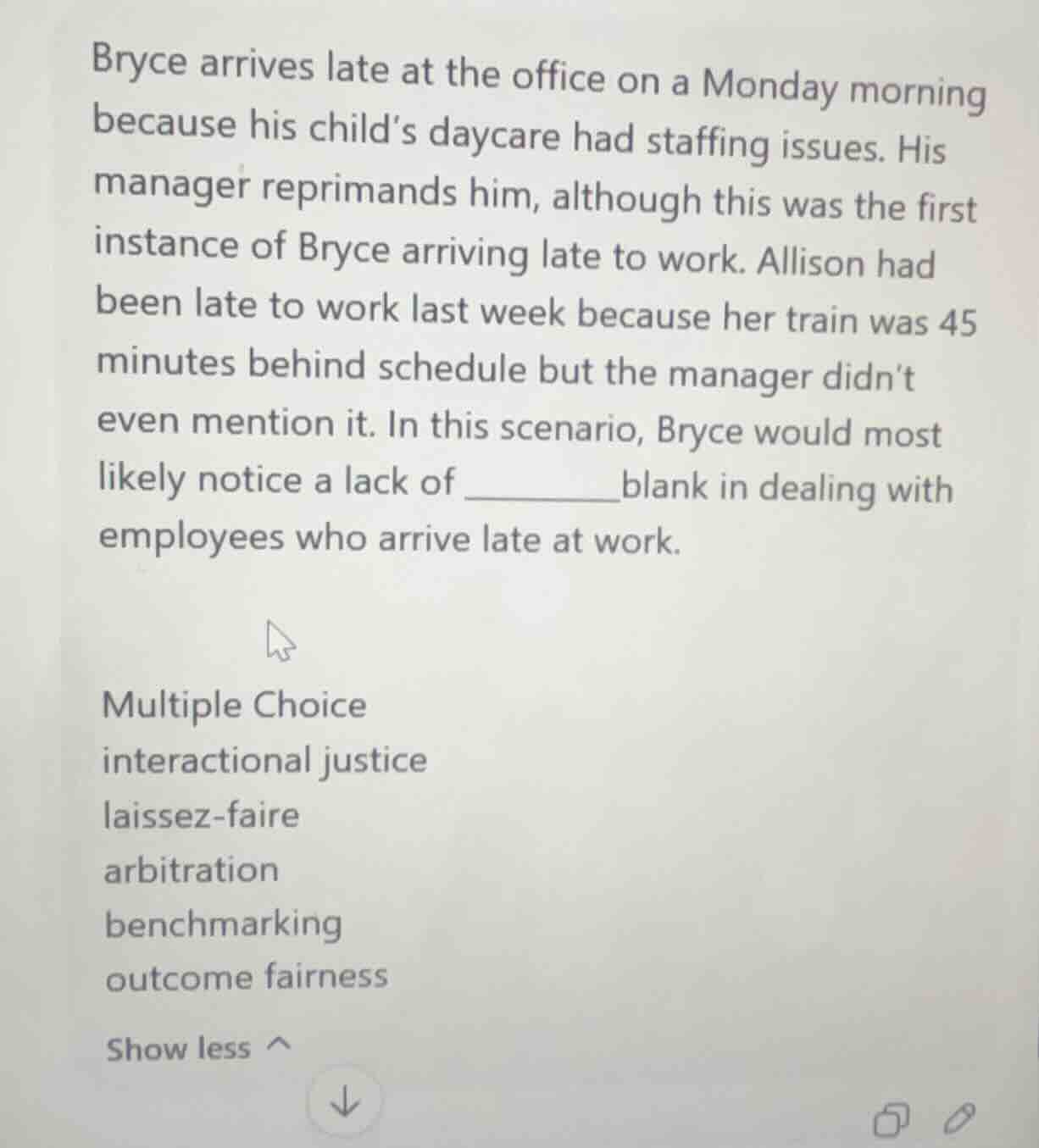
bryce arrives late at the office on a monday morning because his childs daycare had staffing issues. his manager reprimands him, although this was the first instance of bryce arriving late to work. allison had been late to work last week because her train was 45 minutes behind schedule but the manager didnt even mention it. in this scenario, bryce would most likely notice a lack of ________blank in dealing with employees who arrive late at work.
multiple choice
interactional justice
laissez-faire
arbitration
benchmarking
outcome fairness
<pre_analysis>
{
"quality": "clear",
"question_count": 1,
"skills_matched": [
"direct_cot",
"multiple_choice_formatter",
"explain_then_answer",
"tutor"
],
"needs_drawing": false,
"concepts_used": [
"Human Resource Management"
],
"new_concepts": [
"Outcome Fairness",
"Organizational Justice"
],
"current_concepts": [
"Human Resource Management",
"Outcome Fairness",
"Organizational Justice"
]
}
</pre_analysis>
<reasoning>
Analyze the scenario
The scenario describes two employees, Bryce and Allison, who both arrived late to work due to external circumstances beyond their control. Bryce was late because of daycare staffing issues, and Allison was late because her train was delayed. Despite both being late, the manager reprimanded Bryce (his first offense) but did not mention the lateness to Allison.
Define organizational justice concepts
In Human Resource Management, organizational justice refers to employee perceptions of fairness in the workplace. It is categorized into three main types:
- Outcome Fairness: The judgment that people make regarding the outcomes they receive relative to the outcomes received by others. It requires consistent consequences for the same behaviors.
- Procedural Justice: The perceived fairness of the processes and methods used to determine the outcomes.
- Interactional Justice: The perceived fairness of the interpersonal treatment and communication received from authorities.
Evaluate the options
- interactional justice: This refers to being treated with dignity and respect. While Bryce might feel hurt, the core issue is the difference in the actual outcomes (reprimand vs. no action) for the same behavior.
- laissez-faire: A hands-off leadership style, which does not fit the specific lack of fairness described.
- arbitration: A conflict resolution process involving a third party, not applicable here.
- benchmarking: Comparing business processes and performance metrics to industry best practices.
- outcome fairness: Bryce received a reprimand while Allison received no consequence for the same behavior. This inconsistency in outcomes directly represents a lack of outcome fairness.
Determine the correct choice
Because Bryce and Allison received different consequences for the same behavior, Bryce would most likely notice a lack of outcome fairness in how the manager deals with late arrivals.
</reasoning>
<answer>
<mcq-option>interactional justice</mcq-option>
<mcq-option>laissez-faire</mcq-option>
<mcq-option>arbitration</mcq-option>
<mcq-option>benchmarking</mcq-option>
<mcq-correct>outcome fairness</mcq-correct>
</answer>
<post_analysis>
{
"subject": "Business",
"question_type": "Multiple Choice",
"knowledge_point": [
"Business",
"Human Resource Management",
"Organizational Justice"
]
}
</post_analysis>
Snap & solve any problem in the app
Get step-by-step solutions on Sovi AI
Photo-based solutions with guided steps
Explore more problems and detailed explanations
<pre_analysis>
{
"quality": "clear",
"question_count": 1,
"skills_matched": [
"direct_cot",
"multiple_choice_formatter",
"explain_then_answer",
"tutor"
],
"needs_drawing": false,
"concepts_used": [
"Human Resource Management"
],
"new_concepts": [
"Outcome Fairness",
"Organizational Justice"
],
"current_concepts": [
"Human Resource Management",
"Outcome Fairness",
"Organizational Justice"
]
}
</pre_analysis>
<reasoning>
Analyze the scenario
The scenario describes two employees, Bryce and Allison, who both arrived late to work due to external circumstances beyond their control. Bryce was late because of daycare staffing issues, and Allison was late because her train was delayed. Despite both being late, the manager reprimanded Bryce (his first offense) but did not mention the lateness to Allison.
Define organizational justice concepts
In Human Resource Management, organizational justice refers to employee perceptions of fairness in the workplace. It is categorized into three main types:
- Outcome Fairness: The judgment that people make regarding the outcomes they receive relative to the outcomes received by others. It requires consistent consequences for the same behaviors.
- Procedural Justice: The perceived fairness of the processes and methods used to determine the outcomes.
- Interactional Justice: The perceived fairness of the interpersonal treatment and communication received from authorities.
Evaluate the options
- interactional justice: This refers to being treated with dignity and respect. While Bryce might feel hurt, the core issue is the difference in the actual outcomes (reprimand vs. no action) for the same behavior.
- laissez-faire: A hands-off leadership style, which does not fit the specific lack of fairness described.
- arbitration: A conflict resolution process involving a third party, not applicable here.
- benchmarking: Comparing business processes and performance metrics to industry best practices.
- outcome fairness: Bryce received a reprimand while Allison received no consequence for the same behavior. This inconsistency in outcomes directly represents a lack of outcome fairness.
Determine the correct choice
Because Bryce and Allison received different consequences for the same behavior, Bryce would most likely notice a lack of outcome fairness in how the manager deals with late arrivals.
</reasoning>
<answer>
<mcq-option>interactional justice</mcq-option>
<mcq-option>laissez-faire</mcq-option>
<mcq-option>arbitration</mcq-option>
<mcq-option>benchmarking</mcq-option>
<mcq-correct>outcome fairness</mcq-correct>
</answer>
<post_analysis>
{
"subject": "Business",
"question_type": "Multiple Choice",
"knowledge_point": [
"Business",
"Human Resource Management",
"Organizational Justice"
]
}
</post_analysis>