QUESTION IMAGE
Question
applying the converse of the pythagorean theorem
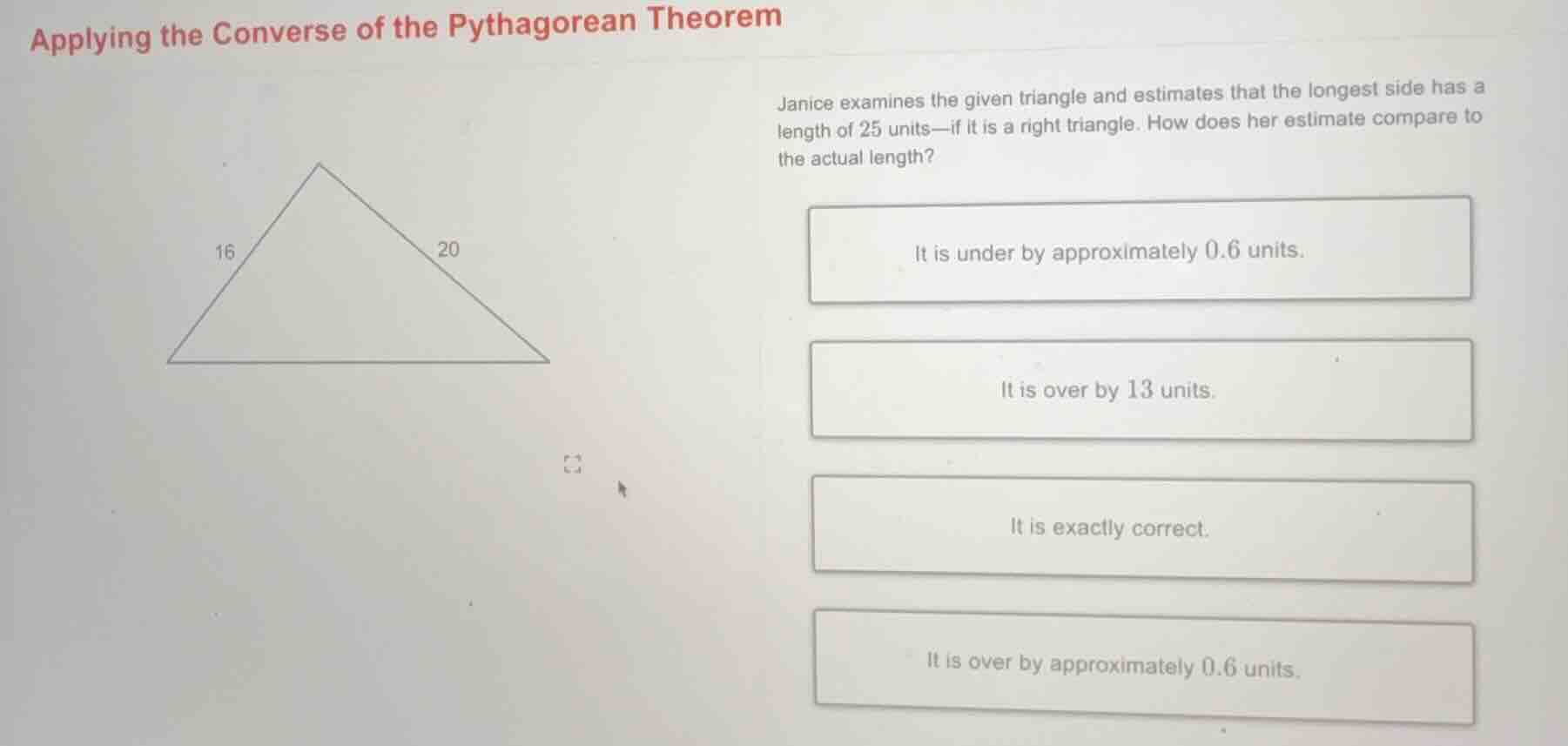
janice examines the given triangle and estimates that the longest side has a length of 25 units—if it is a right triangle. how does her estimate compare to the actual length?
16
20
it is under by approximately 0.6 units.
it is over by 13 units.
it is exactly correct.
it is over by approximately 0.6 units.
Step1: Calculate hypotenuse (right triangle)
$$c = \sqrt{16^2 + 20^2}$$
Step2: Compute squared side lengths
$$16^2=256, 20^2=400$$
Step3: Sum and take square root
$$c = \sqrt{256+400} = \sqrt{656} \approx 25.61$$
Step4: Compare estimate to actual
$$25.61 - 25 = 0.61 \approx 0.6$$

Snap & solve any problem in the app
Get step-by-step solutions on Sovi AI
Photo-based solutions with guided steps
Explore more problems and detailed explanations
It is over by approximately 0.6 units.