QUESTION IMAGE
Question
analyzing solution sets to linear equations with the variable on both sides - item 92454
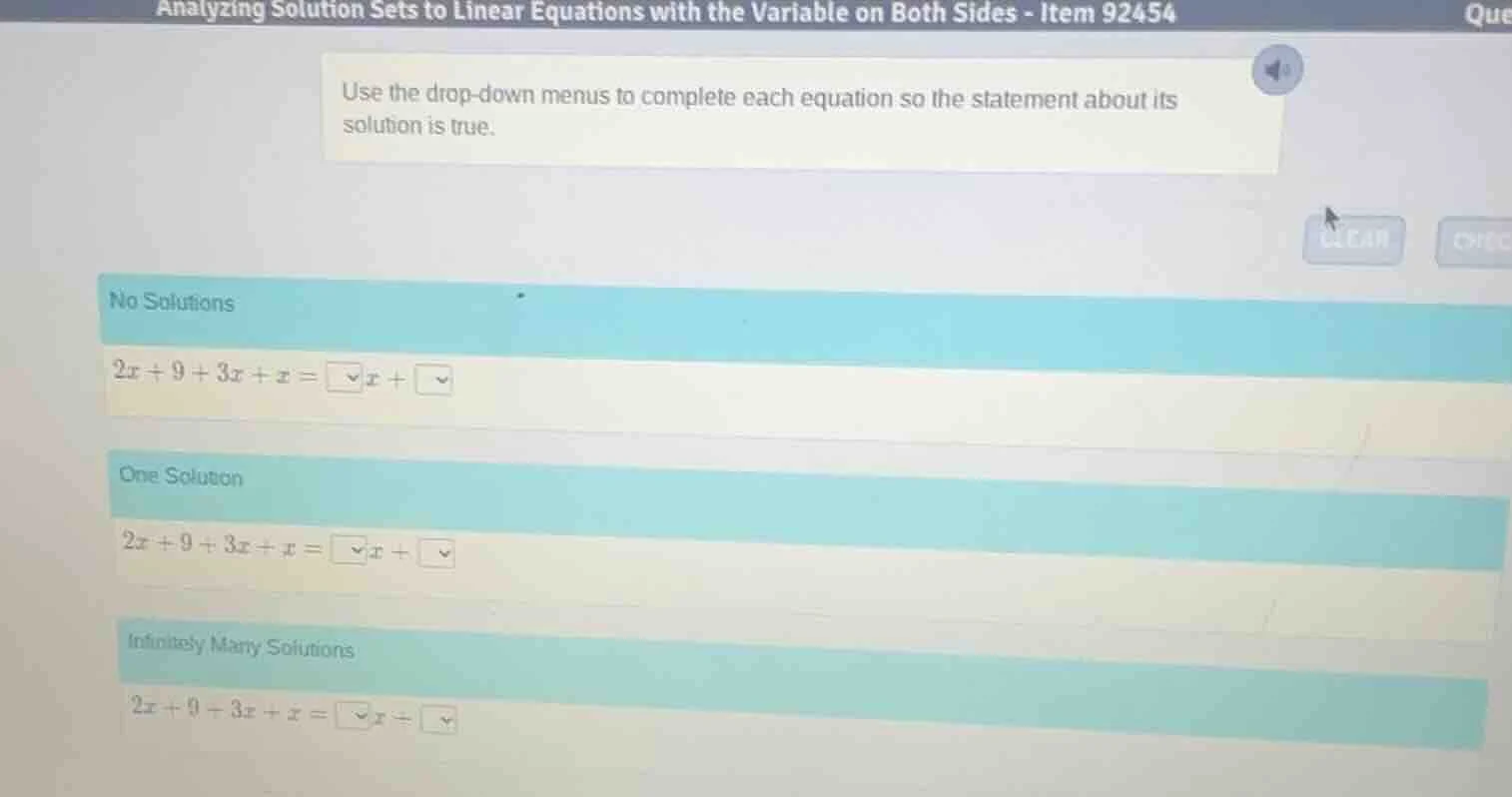
use the drop - down menus to complete each equation so the statement about its solution is true.
no solutions
$2x + 9 + 3x + x = \square x + \square$
one solution
$2x + 9 + 3x + x = \square x + \square$
infinitely many solutions
$2x + 9 + 3x + x = \square x + \square$
First, simplify the left - hand side of the equation \(2x + 9+3x + x\). Combine like terms: \(2x+3x + x=6x\), so the left - hand side is \(6x + 9\).
No Solutions:
For an equation \(ax + b=cx + d\) to have no solutions, we need \(a = c\) and \(b
eq d\). We know that \(a = 6\) (from the left - hand side \(6x+9\)). So we set the coefficient of \(x\) on the right - hand side equal to 6 (i.e., the first box is 6) and the constant term on the right - hand side not equal to 9. Let's choose the constant term as 8 (any number except 9 will work). So the equation for no solutions is \(2x + 9+3x + x=6x + 8\).
One Solution:
For an equation \(ax + b=cx + d\) to have one solution, we need \(a
eq c\). We know that \(a = 6\) (from the left - hand side \(6x + 9\)). So we can set the coefficient of \(x\) on the right - hand side to a number different from 6, say 5. And the constant term can be any number, let's choose 9. So the equation for one solution is \(2x+9 + 3x+x=5x + 9\) (we could also choose other values for the coefficient of \(x\) (not 6) and the constant term).
Infinitely Many Solutions:
For an equation \(ax + b=cx + d\) to have infinitely many solutions, we need \(a = c\) and \(b = d\). Since the left - hand side is \(6x+9\), we set the coefficient of \(x\) on the right - hand side to 6 and the constant term to 9. So the equation for infinitely many solutions is \(2x + 9+3x + x=6x + 9\).

Snap & solve any problem in the app
Get step-by-step solutions on Sovi AI
Photo-based solutions with guided steps
Explore more problems and detailed explanations
s:
- No Solutions: \(2x + 9+3x + x=\boldsymbol{6}x+\boldsymbol{8}\) (the second number can be any non - 9 number)
- One Solution: \(2x + 9+3x + x=\boldsymbol{5}x+\boldsymbol{9}\) (the coefficient of \(x\) can be any non - 6 number, and the constant term can be any number)
- Infinitely Many Solutions: \(2x + 9+3x + x=\boldsymbol{6}x+\boldsymbol{9}\)