QUESTION IMAGE
Question
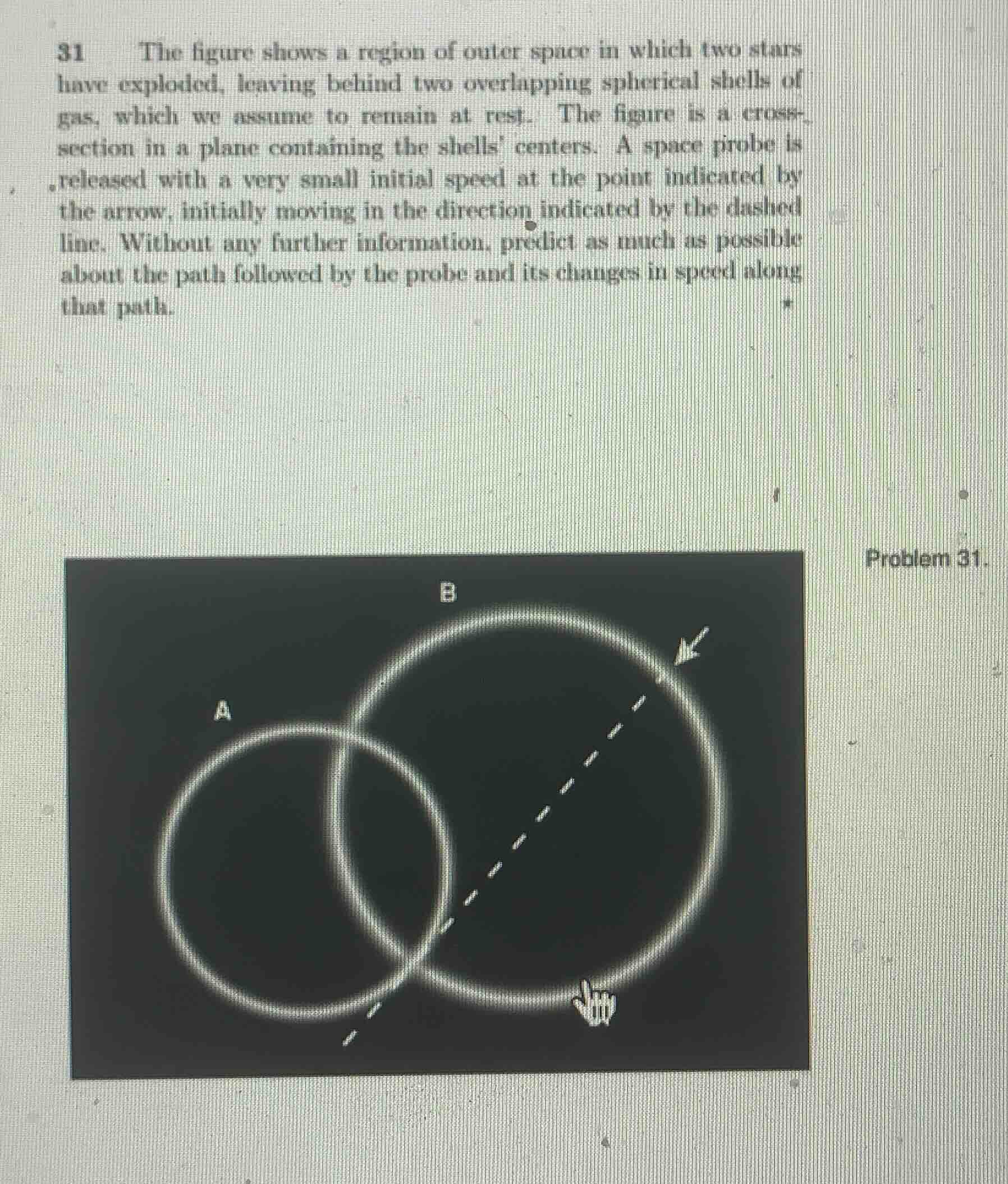
31 the figure shows a region of outer space in which two stars have exploded, leaving behind two overlapping spherical shells of gas, which we assume to remain at rest. the figure is a cross-section in a plane containing the shells centers. a space probe is released with a very small initial speed at the point indicated by the arrow, initially moving in the direction indicated by the dashed line. without any further information, predict as much as possible about the path followed by the probe and its changes in speed along that path.
Analyze the gravitational field in each region using the shell theorem
$$
LATEXBLOCK0
$$
- Region 1 (Outside both shells): Both shells act as point masses at their respective centers. The probe experiences a gravitational pull toward both centers.
- Region 2 (Inside shell B, outside shell A): Shell B exerts zero net gravitational force. Shell A pulls the probe toward its center.
- Region 3 (Inside both shells): Both shells exert zero net gravitational force. The gravitational field is completely zero.
Determine the path and motion of the probe
- Initial state: Released with a very small initial speed along the dashed line, which is directed toward the center of shell B.
- Motion outside shell B: Pulled toward both centers, causing a deflection from the dashed line.
- Motion inside shell B (but outside A): Only shell A exerts a force, pulling the probe toward the center of A.
- Motion inside the overlap region (inside both A and B): No gravitational forces act on the probe. It moves in a straight line at a constant speed.
Describe the speed changes along the path
- Approaching the shells: The probe accelerates as it falls into the gravitational potential wells.
- Inside the overlap region: The probe moves at a constant speed because the net gravitational field is zero.
- Exiting the shells: The probe decelerates as it moves away from the gravitational sources.

Snap & solve any problem in the app
Get step-by-step solutions on Sovi AI
Photo-based solutions with guided steps
Explore more problems and detailed explanations
- Path of the probe:
- Outside the shells, the probe is attracted to the centers of both shells, causing its trajectory to curve toward the center of mass of the system.
- Once it enters shell B (but remains outside shell A), it is attracted only toward the center of shell A, further curving its path.
- Upon entering the overlapping region (inside both shells), the net gravitational force is zero, so the probe travels in a straight line.
- After exiting the overlapping region, it curves again as it experiences gravitational forces from the individual shells.
- Changes in speed:
- The probe's speed increases (accelerates) as it approaches and enters the shells due to attractive gravitational forces.
- Its speed remains constant inside the overlapping region where the net gravitational field is zero.
- Its speed decreases (decelerates) as it exits and moves away from the shells.