Sovi.AI - AI Math Tutor

Scan to solve math questions

QUESTION IMAGE

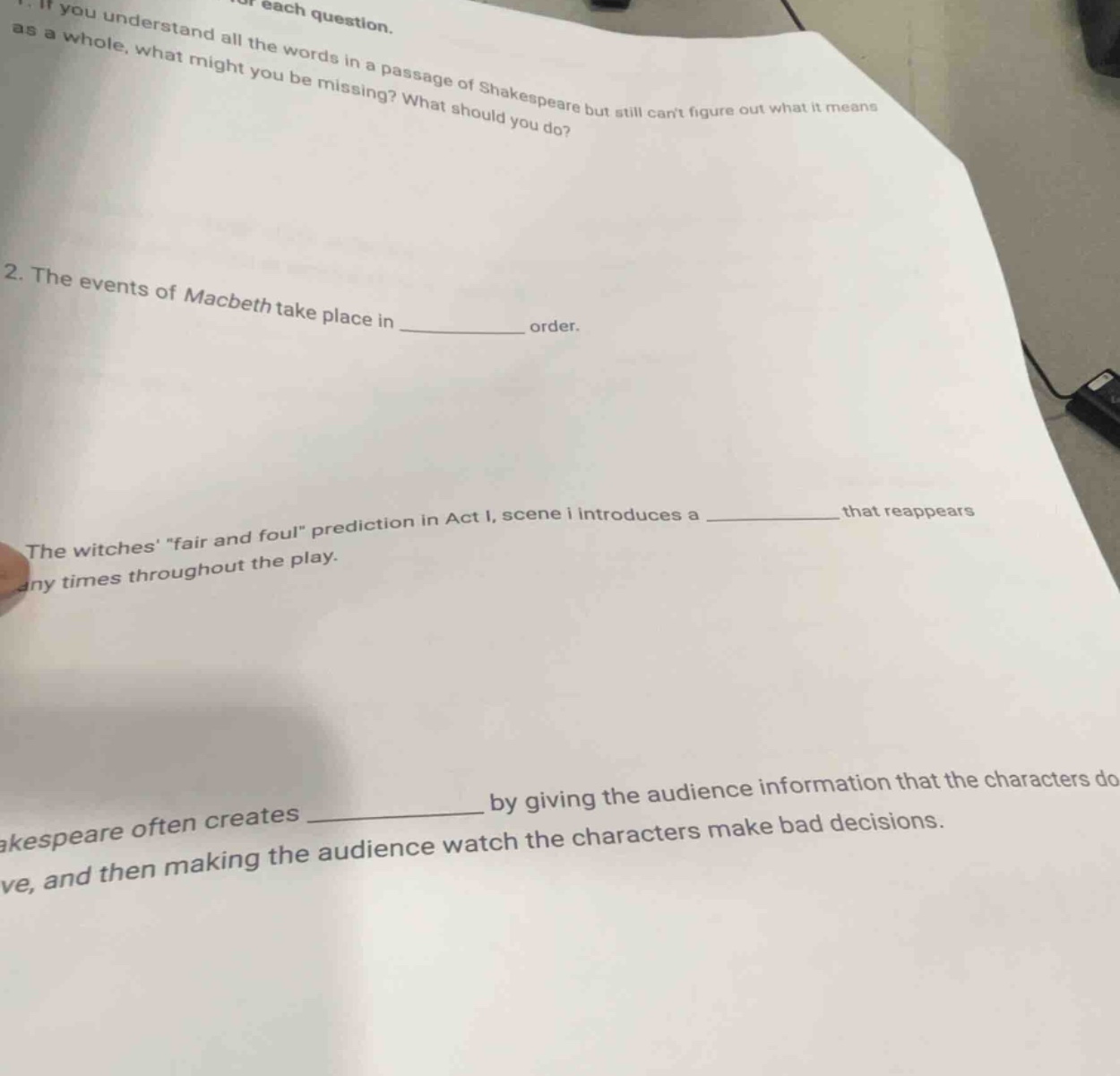
1. if you understand all the words in a passage of shakespeare but stil…

Question

  1. if you understand all the words in a passage of shakespeare but still cant figure out what it means as a whole, what might you be missing? what should you do?
  1. the events of macbeth take place in ___________ order.
  1. the witches \fair and foul\ prediction in act i, scene i introduces a ___________ that reappears many times throughout the play.
  1. shakespeare often creates ___________ by giving the audience information that the characters do not have, and then making the audience watch the characters make bad decisions.

Explanation:

Response

<pre_analysis>
{
"quality": "clear",
"question_count": 4,
"skills_matched": [
"direct_cot",
"blank_filling_formatter",
"explain_then_answer",
"quick"
],
"needs_drawing": false,
"concepts_used": [
"Macbeth Plot Structure",
"Macbeth Themes",
"Dramatic Irony"
],
"new_concepts": [
"Shakespearean Reading Strategies"
],
"current_concepts": [
"Shakespearean Reading Strategies",
"Macbeth Plot Structure",
"Macbeth Themes",
"Dramatic Irony"
]
}
</pre_analysis>

<reasoning>

Analyze the first question on reading Shakespeare

The question asks what might be missing and what to do if you understand all the words in a passage of Shakespeare but still cannot figure out what it means as a whole. The missing element is the context, subtext, or figurative meaning, and the solution is to look at the larger context, read aloud, or analyze the syntax and figurative language.

Analyze the second question on Macbeth plot order

The events of Macbeth take place in chronological order, following a linear narrative structure typical of Shakespearean tragedy.

Analyze the third question on the witches' prediction

The witches' "fair and foul" prediction in Act I, scene i introduces a motif (or theme/paradox) that reappears many times throughout the play.

Analyze the fourth question on dramatic irony

Shakespeare often creates dramatic irony by giving the audience information that the characters do not have, and then making the audience watch the characters make bad decisions.
</reasoning>

<answer>

Question 1

If you understand all the words in a passage of Shakespeare but still can't figure out what it means as a whole, what might you be missing? What should you do?
You might be missing the <blank>context or figurative meaning</blank>. You should <blank>read the passage aloud or look at the surrounding context</blank>.

Question 2

The events of Macbeth take place in <blank>chronological</blank> order.

Question 3

The witches' "fair and foul" prediction in Act I, scene i introduces a <blank>motif</blank> that reappears many times throughout the play.

Question 4

Shakespeare often creates <blank>dramatic irony</blank> by giving the audience information that the characters do not have, and then making the audience watch the characters make bad decisions.
</answer>

<post_analysis>
{
"subject": "Arts",
"question_type": "Fill-in-the-blank",
"knowledge_point": [
"Arts",
"Others",
"Shakespearean Drama"
]
}
</post_analysis>

Answer:

<pre_analysis>
{
"quality": "clear",
"question_count": 4,
"skills_matched": [
"direct_cot",
"blank_filling_formatter",
"explain_then_answer",
"quick"
],
"needs_drawing": false,
"concepts_used": [
"Macbeth Plot Structure",
"Macbeth Themes",
"Dramatic Irony"
],
"new_concepts": [
"Shakespearean Reading Strategies"
],
"current_concepts": [
"Shakespearean Reading Strategies",
"Macbeth Plot Structure",
"Macbeth Themes",
"Dramatic Irony"
]
}
</pre_analysis>

<reasoning>

Analyze the first question on reading Shakespeare

The question asks what might be missing and what to do if you understand all the words in a passage of Shakespeare but still cannot figure out what it means as a whole. The missing element is the context, subtext, or figurative meaning, and the solution is to look at the larger context, read aloud, or analyze the syntax and figurative language.

Analyze the second question on Macbeth plot order

The events of Macbeth take place in chronological order, following a linear narrative structure typical of Shakespearean tragedy.

Analyze the third question on the witches' prediction

The witches' "fair and foul" prediction in Act I, scene i introduces a motif (or theme/paradox) that reappears many times throughout the play.

Analyze the fourth question on dramatic irony

Shakespeare often creates dramatic irony by giving the audience information that the characters do not have, and then making the audience watch the characters make bad decisions.
</reasoning>

<answer>

Question 1

If you understand all the words in a passage of Shakespeare but still can't figure out what it means as a whole, what might you be missing? What should you do?
You might be missing the <blank>context or figurative meaning</blank>. You should <blank>read the passage aloud or look at the surrounding context</blank>.

Question 2

The events of Macbeth take place in <blank>chronological</blank> order.

Question 3

The witches' "fair and foul" prediction in Act I, scene i introduces a <blank>motif</blank> that reappears many times throughout the play.

Question 4

Shakespeare often creates <blank>dramatic irony</blank> by giving the audience information that the characters do not have, and then making the audience watch the characters make bad decisions.
</answer>

<post_analysis>
{
"subject": "Arts",
"question_type": "Fill-in-the-blank",
"knowledge_point": [
"Arts",
"Others",
"Shakespearean Drama"
]
}
</post_analysis>