QUESTION IMAGE
Question
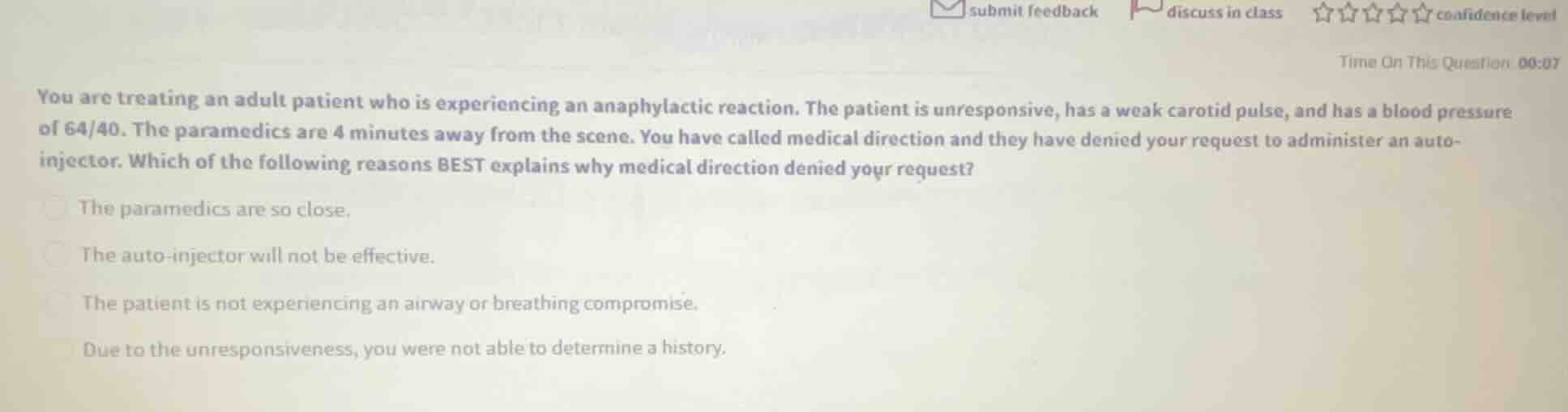
you are treating an adult patient who is experiencing an anaphylactic reaction. the patient is unresponsive, has a weak carotid pulse, and has a blood pressure of 64/40. the paramedics are 4 minutes away from the scene. you have called medical direction and they have denied your request to administer an auto-injector. which of the following reasons best explains why medical direction denied your request?
the paramedics are so close.
the auto-injector will not be effective.
the patient is not experiencing an airway or breathing compromise.
due to the unresponsiveness, you were not able to determine a history.
Analyze the clinical scenario
The patient is an adult experiencing an anaphylactic reaction. They are unresponsive, have a weak carotid pulse, and a blood pressure of \(64/40\text{ mmHg}\). Paramedics are 4 minutes away. Medical direction has denied the request to administer an epinephrine auto-injector.
Evaluate the role of patient history
Using the Anaphylaxis Management knowledge point
- Epinephrine auto-injectors are typically prescribed to specific patients with a known history of severe allergic reactions.
- For an EMT to administer or assist with a patient's prescribed auto-injector, they must establish that the medication belongs to the patient, which requires obtaining a patient history or identifying the prescription.
- Because the patient is unresponsive, the EMT cannot obtain a history or confirm if the patient has a prescribed auto-injector.
Assess epinephrine indications
Using the Epinephrine Indications knowledge point
- Epinephrine is indicated for severe allergic reactions (anaphylaxis) with respiratory distress or shock.
- The patient's low blood pressure (\(64/40\text{ mmHg}\)) and weak pulse indicate anaphylactic shock, meaning epinephrine is physiologically indicated.
- However, without a confirmed history or prescription, online medical control cannot authorize the use of an auto-injector that does not belong to the patient or whose prescription status is unknown.
Compare the given options
- "The paramedics are so close.": A 4-minute ETA does not preclude life-saving intervention for active anaphylactic shock.
- "The auto-injector will not be effective.": Epinephrine is highly effective and is the primary treatment for anaphylaxis.
- "The patient is not experiencing an airway or breathing compromise.": The patient is unresponsive with profound hypotension (\(64/40\)), indicating severe systemic shock, which is a critical compromise.
- "Due to the unresponsiveness, you were not able to determine a history.": This is the correct administrative and clinical reason. Without a history, you cannot verify the prescription or prior indication for the auto-injector.

Snap & solve any problem in the app
Get step-by-step solutions on Sovi AI
Photo-based solutions with guided steps
Explore more problems and detailed explanations
- The paramedics are so close.
- The auto-injector will not be effective.
- The patient is not experiencing an airway or breathing compromise.
- Due to the unresponsiveness, you were not able to determine a history. (Correct answer)