QUESTION IMAGE
Question
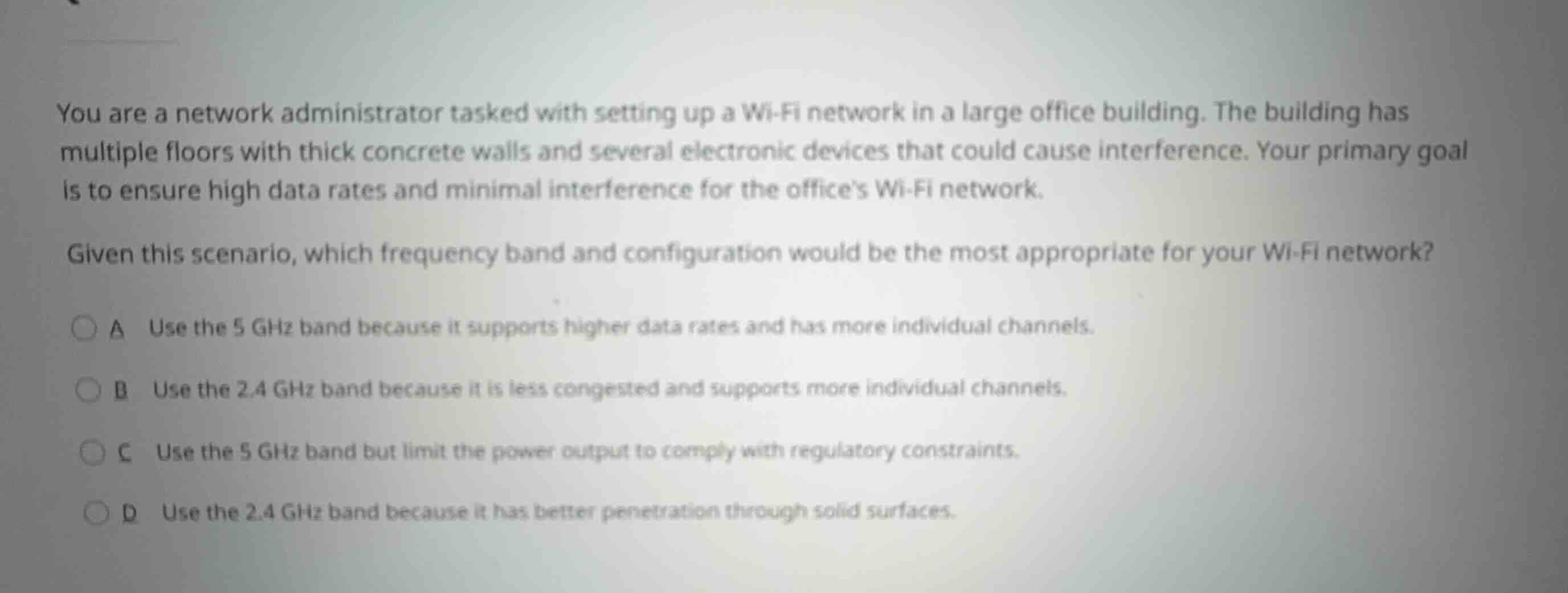
you are a network administrator tasked with setting up a wi-fi network in a large office building. the building has multiple floors with thick concrete walls and several electronic devices that could cause interference. your primary goal is to ensure high data rates and minimal interference for the offices wi-fi network.
given this scenario, which frequency band and configuration would be the most appropriate for your wi-fi network?
a use the 5 ghz band because it supports higher data rates and has more individual channels.
b use the 2.4 ghz band because it is less congested and supports more individual channels.
c use the 5 ghz band but limit the power output to comply with regulatory constraints.
d use the 2.4 ghz band because it has better penetration through solid surfaces.
Analyze the office environment constraints
The scenario describes a multi-floor office building with thick concrete walls and electronic devices causing potential interference. The primary goals are to ensure high data rates and minimize interference.
Evaluate frequency band characteristics
We compare the two main Wi-Fi frequency bands:
- 2.4 GHz band: Better propagation and penetration through solid obstacles (like concrete walls), but has lower data rates, only 3 non-overlapping channels, and is highly congested (susceptible to Radio Interference from microwaves, Bluetooth, etc.).
- 5 GHz band: Supports much higher data rates and has many more non-overlapping channels (reducing interference), but has poorer penetration through solid obstacles like concrete.
Align goals with the optimal choice
The primary goal is explicitly stated: "to ensure high data rates and minimal interference".
- The 5 GHz band directly satisfies both requirements because it offers wider channel bandwidths for higher throughput and has more individual, non-overlapping channels to avoid interference.
- While concrete walls reduce 5 GHz propagation, the primary design goal of high speed and low interference in an enterprise environment is achieved by deploying more 5 GHz access points to overcome attenuation, rather than reverting to the congested 2.4 GHz band.
- Option A correctly identifies that the 5 GHz band supports higher data rates and has more individual channels.
Verify incorrect options
- Option B is incorrect because the 2.4 GHz band is more congested, not less, and has fewer individual channels.
- Option C focuses on regulatory power limits, which is not the primary driver for achieving high data rates and low interference here.
- Option D is incorrect because while 2.4 GHz does penetrate solid surfaces better, it does not satisfy the primary goals of high data rates and minimal interference.

Snap & solve any problem in the app
Get step-by-step solutions on Sovi AI
Photo-based solutions with guided steps
Explore more problems and detailed explanations
- (A) Use the 5 GHz band because it supports higher data rates and has more individual channels. (Correct answer)
- (B) Use the 2.4 GHz band because it is less congested and supports more individual channels.
- (C) Use the 5 GHz band but limit the power output to comply with regulatory constraints.
- (D) Use the 2.4 GHz band because it has better penetration through solid surfaces.